
The Observer publishes a weekly colour supplement consisting mostly of childish rubbish which makes a nice contrast to the content of the paper’s other earnest, sober and usually responsible pages. It includes, for example a whole page of astrological drivel; having been quite busy lately, I have only just caught up with the edition of 23rd April, and thus missed the opportunity of benefiting from the advice that current planets were indicating a “a grand trine in water signs”, so that I (and a twelfth of the world’s population) would have been having a good week for publishing, going sailing, creating art, “twirling as a fashionista”, and tippling. I don’t mind too much because I never participate in any of these activities except the last, for which any week is a good one.
On a page of the same issue dealing with medical matters there are assorted experts, charlatans and fruitcakes earning an honest—or in some cases a dishonest—penny by providing solutions to the problem of the week. That week there was a query about a child who might, or might not, be suffering from an allergy to the family pet, and I was much taken with the splendidly dotty answer from one Anton Van Rhijn, described as a “consultant homeopathic physician” (he doesn’t put Dr. before his name but perhaps consultant homeopaths, like consultant surgeons, are grander than mere Drs).
Anyway, he recommended a concoction made from “dog hair in homeopathic potency”, which "can help relieve the symptoms of allergy to dogs and other pets". He says: "take 12c every day or 30c once a week".
(30C dilution is equivalent to 1 drop in the total mass of the sun, while 12c is many thousands of times stronger, so if you take the daily dose you are getting many many thousands of times more of the active element than if you take the weekly one: this is known as the "Less is more" principle, and some people actually believe in it.)
I really must stop poking fun at homeopaths and the mugs who buy their nostrums. Homeopathy is beyond satire, and criticising it is supererogatory, like throwing mud at a sewage farm.
Wednesday, 17 May 2006

Monday, 15 May 2006
Good job, bad job, McJob
From the Oxford English Dictionary:
McJob, n., colloq. and depreciative (orig. U.S.).
An unstimulating, low-paid job with few prospects, esp. one created by the expansion of the service sector.
Used with allusion to the McDonald's Corporation's practice of using Mc- as an initial element in a range of proprietary product names, rather than a direct allusion to the programme mentioned in the first of these quotations:
1985 Los Angeles Times 29 July II. 6/1 For instance, the McDonald's fast-food chain recently began a training program for the handicapped in the San Fernando Valley called McJobs. McDonald's has hired a dozen people after the two 10-week training programs held so far.]
1986 Washington Post 24 Aug. C1 (heading) The fast-food factories: McJobs are bad for kids.
1991 D. COUPLAND Generation X I. i. 5 Dag..was bored and cranky after eight hours of working his McJob.
1993 Albuquerque Jrnl. 4 Apr. C3/2 So many bright and ambitious young people are wasting what should be their apprentice years in low-wage, low-skilled jobs, what are called ‘McJobs’.
[Little more was heard of McDonald’s 1985 initiative, which may have been a PR stunt but was well-meant, and it was unfortunate for them that, as the other quotations show, the name they invented for it has acquired a connotation that does them no credit at all. They featured in a 2004 Bush-Cheney campaign poster.]
Saturday, 13 May 2006
We English
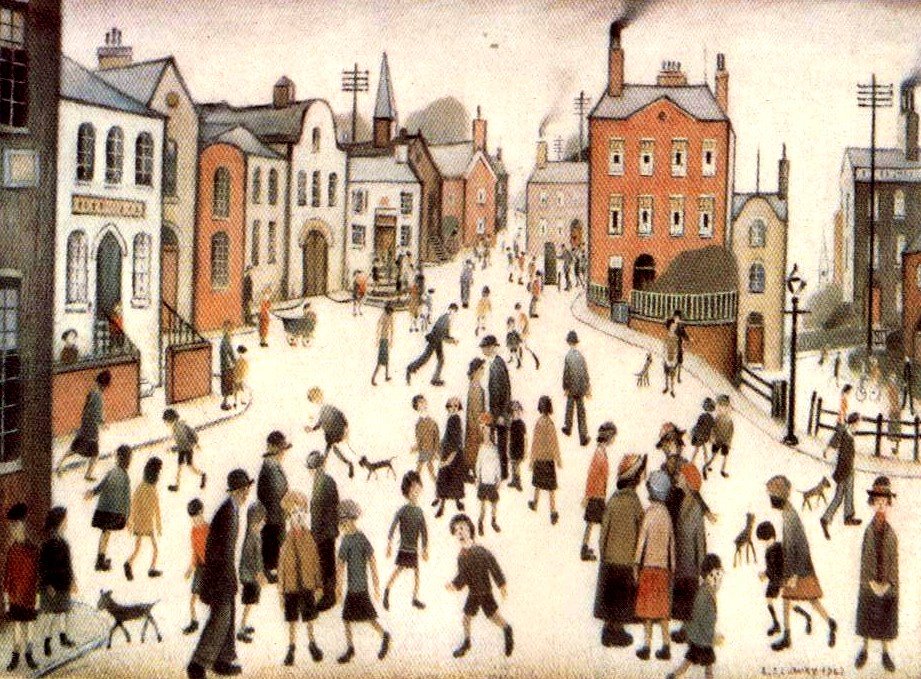 SATURDAY AFTERNOON: A Derbyshire Village. L.S.Lowry, 1943
In a post about warm beer a couple of years ago I commented on some of George Orwell’s much misquoted remarks about the characteristics of the English which he made in a 1941 essay called The Lion and the Unicorn.
I have just been re-reading a book he published in 1947 called The English People which goes into much more detail about what he considered to be the defining features of Englishness as they might be observed by an unprejudiced foreigner. It is interesting, nearly sixty years later, to look at those he chose, and to decide which are as accurate today as they were then and which are no longer true. Here is a selection of both kinds, unsorted:
• The language of the BBC is barely intelligible to the masses.
• The tall, lanky physique which is traditionally English is almost confined to the upper classes: the working classes, as a rule, are rather small and with a tendency among the women to grow dumpy in early middle life.
• [A foreign observer] …would find the salient characteristics of the English common people to be artistic insensibility, gentleness, respect for legality, suspicion of foreigners, sentimentality about animals, hypocrisy, exaggerated class distinctions and an obsession with sport.
• Except for certain well-defined areas in half a dozen big towns there is very little crime or violence.
• There is a general feeling that the law will be scrupulously administered, that a judge or magistrate cannot be bribed, and that no-one will be punished without trial.
• Almost never is any major honour bestowed on anyone describable as an intellectual.
• For perhaps a hundred and fifty years, organised religion, or conscious religious belief of any kind, have had very little hold on the mass of the English people.
• A tendency to support the weaker side merely because it is weaker is almost general in England; hence the admiration for a “good loser” and the easy forgiveness of failures, either in sport, politics or war.
• They will refuse even to sample a foreign dish … they regard such things as garlic and olive oil with disgust, life is unlivable to them unless they have tea and puddings.
• Poetry, the art in which England has above all others excelled, has for more than a century had no appeal whatever for the common people … indeed the very word “poetry” arouses either derision or embarrassment in ninety-eight people out of a hundred.
• At this moment the mass of the English people are mildly republican. But it may well be that another long reign, similar to that of George V, would revive royalist feeling and make it—as it was between roughly 1880 and 1936—an appreciable factor in politics.
• Imported labourers with low standards of living, such as the Irish, are greatly looked down on.
• The man of obviously upper-class appearance can usually get more than his fair share of deference from commissionaires, ticket-collectors, policemen and the like.
• It is the only European country where internal politics are conducted in a more or less humane and decent manner.
• Except for a handful of “self-made men” and Labour politicians, those who control our destinies are the product of about a dozen public schools and two universities.
[A very few of these comments may have been inaccurate then and remain so. Even Orwell, acute observer and honest critic that he was, didn’t always get it right, as we can now see. But on almost everything he was more nearly right than any of his contemporaries.]
Thursday, 11 May 2006
Where is Rover now?
 A woman I know attempted to comfort a bereaved friend by saying that at last the late lamented had been re-united with the much-loved spaniel who had predeceased him by some twenty years. I did not think it appropriate to point out that this is rank heresy, since nowhere in Holy Writ is there any mention of an after-life for lesser beings than Man.
But, for all except believers, common sense suggests that it is ridiculous to imagine that we are the only beings who qualify. No-one who has ever seen a gorilla cuddling her young or a chimpanzee scratching his bottom can doubt that we are very closely related indeed to them, and that they have the same rights as humans to spend eternity in reasonable comfort, though of course their total lack of interest in the Scriptures disqualifies them for a place anywhere in the vicinity of Jesus.
The same goes for lesser creatures. My own guess is that all of them spend eternity in some sort of heavenly annexe, with accommodation graded from plain but commodious quarters for the primates to smaller establishments for, say, water-voles, down to very tiny cubby-holes for worms and other creepy-crawlies.
After all, Noah made adequate arrangements for all contemporary living creatures, and we must suppose that the Almighty, with far more time and resources at His disposal, has set up something adequate for dead ones, though of course the Ark provided for only two of each whereas the number of dead creatures in residence upstairs must by now be running into zillions, even if you discount insects, bacteria, and others who for one reason or another are not eligible.
Tuesday, 9 May 2006
Without words
Animals cannot speak and have developed non-verbal ways of expressing themselves. Some of these signals we can use ourselves: we cannot wag our tails to indicate pleasure, and it is not considered proper to express contempt in the way that dogs do (there is a Winston Churchill anecdote about that), but we can if we want threaten an attacker with a snarl, or disarm him by licking his nose and purring. There are others we might usefully adopt:

The orang-utans of Suaq say goodnight to their families by blowing a loud raspberry noise, often amplified by cupping hands.

The orang-utans of Suaq say goodnight to their families by blowing a loud raspberry noise, often amplified by cupping hands.
Sunday, 7 May 2006
Badly designed
Pointing out people’s physical defects is generally considered offensive. Commenting on big ears, knock knees, bent noses, sagging bottoms and so on can get one disliked, if not punched in the face.
But what about those defects which we all have by virtues of our membership of the human race (those of us that belong, that is)? There is little point in commenting on the things which are fundamentally wrong with everyone, representing what the insurance industry calls inherent vice. Such flaws as sinus cavities that clog, pelvises wrongly angled so that most of us get backache, too many teeth for the size of our jaws, useless vestigial organs and so on can only be explained either as the result of our evolution from differently shaped beings, or by the fact that we were designed by an idiot.
Don Wise, Professor Emeritus of Structural Geology at the University of Massachusetts, believes that “ID” as a name for the junk science argument aimed at justifying anti-evolutionism and leading subtly into creationism should properly stand for “Incompetent Design”.
Friday, 5 May 2006
Time for a clear statement
 Home Secretary Charles Clarke is rapidly losing the confidence of the people of this country by his continued refusal to come clean about his plans. We have a right to know where he stands and he must give an honest answer without any further delay to the question that concerns us all: Does he intend to grow a proper beard or not?
Many commentators have pointed out that his stubble, if that is the right word for something so tentative, is very similar that sported by Noam Chomsky, though the latter’s is even less luxuriant, and confined to the bridge of his nose. Perhaps this is Clarke’s way of telling us that he is really an intellectual manqué and not a jug-eared bruiser. If that is the case he should never have been given a bruiser's task of running a government department, and we shouldn’t complain that he’s made a pig’s ear of it.
P.S. Just heard that he's been sacked, so we don't care now whether he shaves or grows it.
Wednesday, 3 May 2006
White collars
Not all the readers of Other Men's Flowers are living in Spain under an assumed name or are wanted for questioning in connection with serious crimes. A few are captains of industry, senior statesmen, noted intellectuals or distinguished academics.
One of the latter, an American professor of law, is also a writer whose latest book, Lying, Cheating, and Stealing has recently been published by Oxford University Press; it has been described as “a long-needed and path-breaking consideration of white-collar crime from the perspective of a top-notch legal scholar.”
An accomplished and well-researched treatise, it is also a fascinating read, equally informed by American and British approaches to criminal law theory. However, the kind of people described in the first sentence above will be disappointed if its title leads them to imagine that it contains useful hints of special interest to them: it is not a “How To…” book.
[One of the high profile cases analysed in the book is that of Jeffrey Archer, which is of particular interest to UK readers and fans of his rotten novels. Lying, Cheating and Stealing is one of the series of Oxford Monographs on Criminal Justice; sadly for impecunious law students, this series is not included in the Oxford Reference Library which is available free online in the UK as described here].
Monday, 1 May 2006
JKG
I wished him a Happy 96th Birthday in 2004 but for some reason I failed to mark his 97th last year; he died yesterday.
So farewell then, John Kenneth Galbraith. His assertion that he was the tallest man in the world, at 6ft 8in, was almost certainly false, but as a visionary economist he towered over all others.
 Just one quotation from hundreds of possible ones: "The only function of economic forecasting is to make astrology look respectable".
(I showed a photo of him once before, but here is a much better one by Richard Mildenhall in the Guardian).
P.S. And I liked the Guardian leader comment: "Hypocrisy will sleep more sweetly tonight for the knowledge that Galbraith is no longer around to look down from his very great height and skewer it".
Saturday, 29 April 2006
A Journey Up the Amazon
I ordered a Gift Certificate from a well-known internet retailer of books etc. and got an email acknowledgement. Then:
• After four days I checked on their website and found that it had not been despatched.
• In response to my enquiry asking for the reason I had a standard reply: “…apologise for any inconvenience…system error…working hard on a resolution…".
• Four days later I found that the order had still not been despatched, so I enquired again.
• I received another copy of the same message.
• There was a name at the bottom, so I tried to send a reply email.
• It came back “This address cannot accept emails”.
• Two days later, the order still came up as “Not despatched”.
• I cancelled the order. This produced yet another copy of the same message, with two additional paragraphs: "...We request you please write back to us after order completed so that we will refund you and serve you better... and "Please visit the following link to provide the information we requested...". The information requested was the order number, which I had already quoted on all my messages.
• I sent a second message cancelling the order again.
• There was no reply, but three weeks later the certificate was delivered.
• The recipient tried to buy a book with it and got a message: Invalid voucher.
And this was only an order for a Gift Certificate.... imagine what these idiots might have achieved if I had ordered something difficult, like a real book!
Epilogue
Two weeks on, I discovered that my credit card had been debited. I sent another message pointing out mildly that this matter might have been better handled and eventually got a reply saying that the amount would be refunded and offering "appologies" for the inconvenience.
Thursday, 27 April 2006
The OED, etc.
I wrote a post a year ago which began with a mention of rat’s testicles and a whale’s pizzle and went on to laud the virtues of The Oxford English Dictionary. Then, in June, I dealt with poo, pork scratchings and bonk, also with reference to the OED. Finally, a few months ago I wrote a fond and sad valedictory to this marvellous work, my subscription to its online version (£195 a year plus VAT) having expired.
Those who do not find the OED interesting may have been pleased to think that it will no longer be quoted here. These scrofulous degenerate louts—many with criminal records—will be disappointed, for from 1st April this year the online versions of Encyclopaedia Britannica, Grove Music Online, Grove Art Online, the Oxford Dictionary of National Biography, the Times Digital Archive and many other databases including the Oxford Reference Library and the mighty Oxford English Dictionary itself, all of which were formerly available only on subscription, can now be accessed FREE, and I can once again disport myself among the OED's half-million entries; talk about an embarrassment of riches.
This is the result of a landmark agreement under which 142 public library authorities in England have joined together for the first time to share the cost of a two-year national licence for a range of online publications, so that anyone with a ticket to a public library can simply get a PIN and use it to log on to these resources at home.
Tuesday, 25 April 2006
If you can fake that…
…you’ve got it made (referring to sincerity; variously attributed to Groucho Marx, George Burns et al.).
Or: He looked me straight in the eye and shook me firmly by the hand, so I knew he was a creep.
As with body language, so it is with speech patterns. Our leader tries hard, but, surprisingly for a former barrister, just doesn’t cut the mustard. A few moments of his matey, open, informal and confident style of discourse and you know beyond doubt that you are listening to a lying hypocrite cracking up under pressure.
I suppose that nowadays we would not be as stirred by Churchill’s Edwardian cadences as we once were, but what we hear now is surely the least inspiring political rhetoric ever. History might have taken a different course if we had heard on the radio in 1940: Hey, look, let me tell you frankly that we shall fight on the beaches…
Sunday, 23 April 2006
Tough on crime
 Pick pocketing, 15th January, 1680.
Elizabeth Spark and William Abbot were indicted the former being a notorious pickpocket, was as she pretended picked up in Cornhil, by one Nichols a Butcher, who would needs fasten a Glass of Wine upon her, so that they repairing to a Tavern, whilst he was searching her Placket, took the opportunity of searching his pocket, and drew thence for her own proper Use, about 14 or 15 Shillings, and then making an excuse to go down stairs, sheard off ; at which the Cully having some mistrust, all was not as it should be searching his Pockets, found his loss; and runs down stairs, to enquire after his departed new acquaintance, but she had left him to bewail his folly: yet whilst he was in pursute of her, she not fully satisfied, returns again, perhaps for more; but contrary to her expectation, was seized by the Master of the House, upon which Abbot lying perdue, endeavoured to rescue her, and fell upon the said Nichols, who was then returned from the pursute. She pleaded in Court, that he gave it her for to debauch her, yet she being an antient Pickpocket, was brought in Guilty, but Abbot not being in her Company when the Fact was committed, could not be found Guilty .
Elizabeth Spark was sentenced to death.
A Placket is a pocket in a woman’s skirt; why one Nichols a Butcher needed to search Elizabeth’s is not clear.)
This and details of 101,101 other trials at London’s Central Criminal Court are set out in The Proceedings of the Old Bailey, 1674-1834, an online edition of the largest body of texts detailing the lives of non-elite people ever published; it is fully searchable by, for example, Keyword, Crime, Verdict, Punishment, Gender, and Date.
The site also has notes on the historical background, including essays on Crime, Justice and Punishment, London and its Hinterland, Community Histories and Gender in the Proceedings.
From December 1834 to April 1913 the Proceedings continued to be published under the title of The Proceedings of the Central Criminal Court. The creators of this fascinating website have received funding from the Arts and Humanities Research Council to enable them to put online all 100,000 trials between those dates; the project will take three years, and should be completed by September 2008. his2
Friday, 21 April 2006
Do not read on
If you are keen to catch the attention of those who stumble across your blog, and to tempt them to read it, it is easy enough to give your posts seductive titles, suggesting that what follows is amusing, informative or salacious. It is almost as easy to choose titles which do the opposite, and suggest the casual reader who comes across them that he should switch off his computer and get out in the fresh air. Few bloggers do this deliberately, but here are three fine examples of this kind of title which I found by chance:
My shoes and other stuff I buy
Our gorgeous Jenny is five today!
Why I want to sell Honda generators in Kalimpong
And here's one of mine:
Old Men Singing and Dancing
My shoes and other stuff I buy
Our gorgeous Jenny is five today!
Why I want to sell Honda generators in Kalimpong
And here's one of mine:
Old Men Singing and Dancing
Wednesday, 19 April 2006
Limited sphere of operations
 Having, in adult years, rented four flats and owned four houses, some Victorian and all in various degrees of dilapidation, I am no mean hand with drill, saw, paintbrush and screwdriver. Usually I tackled with some enthusiasm whatever needed to be done, and at some periods this occupied all my spare time.
I read recently that DIY is now going out of fashion, and I am following this trend ardently, for nowadays I cannot do ladders or bend down or lie on the floor (well, of course I can, but getting up calls for assistance). But the skills laboriously acquired over the years can still occasionally be brought into play: if the job is sited between, say, between three and five feet from the ground (and preferably can be done sitting down), requires little strength or dexterity, and someone is on hand to pick up dropped screws or tools for me, then I am your man.
Except that on the whole it bores the hell out of me, and I would rather read a book.
Monday, 17 April 2006
I bet it makes the corgis sick
When so many people nowadays think of religious festivals merely as holidays or excuses for gluttony it is good to hear that the Head of the Church of England understands their true meaning. Nick Crean, joint owner of Piccadilly-based Prestat, “the Queen’s chocolatier”, has again delivered the traditional Easter gift to Buckingham Palace—a 4lb egg stuffed with handmade truffles—and reports: “The Queen takes Easter very seriously and we make a very special egg for her”.
But this seems almost frugal compared with the way that the average householder apparently marks holy days: I have just been informed that my household contents insurance cover has been increased (without me asking) by £3,000 "during any month in which you celebrate a religious festival, to cover gifts and food bought for the occasion". This might give rise to false claims, since there are few months of the year in which no religious wingding takes place: who is to say that Zoroaster's birthday is not October 14th, and that the crate of Mumm which got smashed on that day had not been bought to celebrate the event?
Anyway, it is pleasant to think that if my house burnt down this month I could claim for a bottle of Saussignac...

and this.......
(though that would be dishonest, for these items are in my house over Easter to celebrate my birthday and not the resurrection of Jesus Christ or even Zoroaster).
(though that would be dishonest, for these items are in my house over Easter to celebrate my birthday and not the resurrection of Jesus Christ or even Zoroaster).
Saturday, 15 April 2006

Thursday, 13 April 2006
Home alone
For a (happily) short period recently The Other One was heavily occupied elsewhere for reasons not entirely unconnected with open heart surgery, and I found myself with unwonted domestic responsibilities. These turned out to be rather less onerous than I had feared, and I summarise below my approach to them:
• Bed-making. Unnecessary: it’s a duvet, so I just got out carefully in the mornings.
• Shopping. I like this anyway. I find that a bit of suggestive banter at the checkout sets me up for the day.
• Cooking. This too I like, and when I got bored with it there was always M&S.
• Dusting. Certainly not. What’s the point?
• Vacuuming. Had good intentions, but somehow didn’t seem to get round to it.
• Keeping up the supply of ice. A constant pre-occupation but not too tiring.
• Giving TLC to the cat. A doddle. She slept whenever she wasn't dribbling on my keyboard.
• Watering the seedlings in the greenhouse. Tough one, this: it meant going right to the bottom of the garden, EVERY DAY.
• Putting out the rubbish. Only once a week and no problem when it’s not raining.
• Washing up. (Doing the dishes as those other people call it.) I've always been a bit of a whiz at stacking the dishwasher. And we’ve plenty of crockery, so the rest could be done every third day, or before meals.
• Dealing with Jehovah’s Witnesses. I tried hard but didn’t succeed in converting any of them to my own beliefs.
All in all, an interesting experience, though I am glad it is over. And probably The Other One would say the same.
Tuesday, 11 April 2006
The cliché is still going strong
In a post in October 2004 I quoted a comment on Political correctness gone mad explaining why this phrase, which at that time had appeared at least 631 times in British national newspapers since 1993, was a silly cliché.
In February the tedious columnist Cristina Odone referred to “little Welshies” in a Question Time programme. Apparently some idiot—possibly a small Welshman—complained to the BBC, and, hilariously, the police telephoned the wrong woman to administer a rebuke. Odone then phoned the police to have a go at them and they told her that they "take anti-Welsh racial slurs seriously".
The comment of the egregious Cristina, always on the lookout for a witty and original phrase, was: "I think this is political correctness gone mad". Still, it enabled her to fill her Guardian column with a rant about the North Wales police, so she's done well out of this supremely uninteresting story.
The Sunday Times was always very fond of p.c.g.m., and it appeared twice in their last Sunday edition; in both cases it was in inverted commas as if to say "Yes, we know this is hackneyed and foolish phrase but lots of people use it so why shouldn't we?".
[I must make it clear that in my own view many Welsh persons are neither idiots nor little, though some of course may be both.]
Sunday, 9 April 2006
Omelette
One of the world’s great tourist traps is Mont St Michel, where the Hotel Poulard became famous for the omelettes made by the proprietress. On the web there are some 27,000 pages in English with a reference to la Mère Poulard, and twice as many in French (with slightly less referring to the historic Abbey; the French have their priorities right). Many of them give recipes for the omelette which differ widely from the only one ever revealed by its creator. In a letter dated 6 June 1922, responding to the request of a celebrated Parisian restaurateur and collector of cookery books, she wrote as follows:
Monsieur Viel,
Voici la recette de l'omelette: je casse de bons oeufs dans une terrine, je les bats bien, je mets un bon morceau de beurre dans la poêle, j'y jette les oeufs et je remue constamment.
Je suis hereuse, monsieur, si cette recette vous fait plaisir.
ANNETTE POULARD
[quoted in Elizabeth David’s French Provincial Cooking]
The menu at her hotel was always the same: the famous omelette, ham, a fried sole, pré-salé lamb cutlets with potatoes, a roast chicken, salad and dessert. With cider and butter on the table (this is Normandy) it cost, before the 1914 war, 2.50 fr.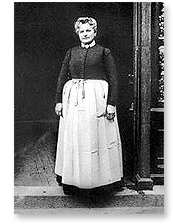
Madame Poulard founded the hotel in 1888 and died in 1931 at the age of eighty, though she had retired many years before. Later there were two establishments claiming to serve the one-and-only true omelette Poulard and charging up to $40 for it. Since 2003 Michel Bruneau, founder of the Michelin 2-star La Bourride in Caen has been the master chef at La Mère Poulard and no doubt his omelette is pretty good, though to justify his prices he probably has to make more of a business with the preparation of it than Mme Poulard described in her letter to M.Viel.
Monsieur Viel,
Voici la recette de l'omelette: je casse de bons oeufs dans une terrine, je les bats bien, je mets un bon morceau de beurre dans la poêle, j'y jette les oeufs et je remue constamment.
Je suis hereuse, monsieur, si cette recette vous fait plaisir.
ANNETTE POULARD
[quoted in Elizabeth David’s French Provincial Cooking]
The menu at her hotel was always the same: the famous omelette, ham, a fried sole, pré-salé lamb cutlets with potatoes, a roast chicken, salad and dessert. With cider and butter on the table (this is Normandy) it cost, before the 1914 war, 2.50 fr.

Madame Poulard founded the hotel in 1888 and died in 1931 at the age of eighty, though she had retired many years before. Later there were two establishments claiming to serve the one-and-only true omelette Poulard and charging up to $40 for it. Since 2003 Michel Bruneau, founder of the Michelin 2-star La Bourride in Caen has been the master chef at La Mère Poulard and no doubt his omelette is pretty good, though to justify his prices he probably has to make more of a business with the preparation of it than Mme Poulard described in her letter to M.Viel.
Subscribe to:
Posts (Atom)