Showing posts with label military. Show all posts

Sunday, 25 March 2012

An old trick, but a good one

There comes a point in life when one has ceased to acquire major new skills, and but still have some which need to be perfected: getting out of bed without falling over, for example (or indeed doing anything without falling over).

Many of the skills which I have retained are of very little practical value to me now. Will I ever again need to stand properly to attention? I could, if necessary, because I remember very clearly the instructions for doing it, which I never saw written down but only heard bawled: Headup-chinin-chestout-stomachin-heelstogether-feetatanangleof45degrees-thumbsinlinewiththeseamsofthetrousers-standperfectlySTIW! It’s probably done differently nowadays.

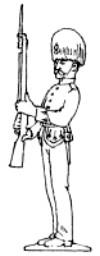
Something else I could still do if asked was rarely called for even at the time. It was called Rest On Your Arms Reversed, and it went like this:

On the appropriate commands, you sloped arms, then presented them (more fun doing this with a sword, but that's another story).

You are now in this position, only in a different sort of uniform (unless you were in the Royal Scots Fusiliers) and without the bayonet, for reasons which will become clear. (Also, the position of his right foot isn't quite correct: it should have been crashed down at a slight angle so that its heel was tucked into the the instep of the left.)

Then comes the tricky bit: on the command Rest...etc., you rotated the rifle forwards through 180 degrees (first moving it away from you to avoid giving yourself a nasty knock with the butt) until the muzzle rested on the toe of your left boot. Then, slowly, one at a time, you made a big circle with each arm, following the hand with your eyes until they (your hands, that is) were clasped over the end of the butt with your elbows still sticking out. Finally, in one quick move, you dropped your elbows and bowed your head, reverently.

How you got back from this position I have quite forgotten. But given a hint or two about that, and a short Lee-Enfield, I would love to play a small part, if called upon to do so, in the obsequies of some royal person, for that is the kind of occasion when this manoevre is—or used to be—carried out. A misty autumn day with a slight drizzle, the Dead March in Saul, the black-draped coffin on the gun carriage....... Great!

.

Tuesday, 25 October 2011

Our new destroyer


It used to be said that no ship, not even a warship, could be ugly....


Thursday, 18 November 2010

When This Lousy War is Over

This song was not sung during any of the recent remembrance ceremonies.

Saturday, 13 November 2010

Soldiers of the King, Part Three

Continued from  HERE . 
  
We stopped in Malta for a night and luxuriated in a fine drizzle, the first rain I had seen for more than a year. On landing in England we were deposited in Tottenham Court Road underground station which was being used as a rather cosy holding camp.

There we heard the news that Lilibet had replaced Bertie, which  meant that I had become a Soldier of the Queen. This made me feel rather Victorian; I imagined myself and my men, bayonets fixed, red jackets with brass buttons gleaming in the African sun, advancing fearlessly under a shower of assegais, ready to give the Matabele horde a real pasting. But, of course, I would have been no use at that sort of thing.

The War Office Selection Board was not too difficult for me; my fellow candidates were mostly rather callow youths so although I lacked the aristocratic background of most of them my advanced age, deep tan and camel flashes gave me some kind of cachet which enabled me to compete. Anyway, I passed.

Then, finally, I found myself at last where I had been trying to get to for most of my military career, Mons Officer Cadet School, where I became one of the 40,000 cadets who passed through the hands of the legendary Regimental Sergeant-Major R Brittain, MBE, Coldstream Guards, a fearsome but basically kindly man. He had become the best-known soldier in the country, having appeared in a number of films, some in a character part and some as himself; he was very proud of this and if he saw eyes straying as he strolled down the ranks standing to attention he would bark "Don't look at me! If you want to see me, go to the pictures".

We spent a lot of time standing to attention and I still remember the mantra which tells you exactly how to assume the position:
HeadupChininChestoutStomachinEyestothefront*
HeelstogetherFeetatanangleoffortyfivedegrees
ThumbsinlinewiththeseamofthetrousersSTANDPUFFEKLYSTIW!


It is worrying to think that there are now two generations of young and not-so-young men who have no idea how to do this; lacking this skill and some others, they will be absolutely nonplussed if they are ever called up to defend us from Mongol hordes, or a nuclear-armed rogue state, or whoever.

I enjoyed the fourteen weeks at Mons and after it was over not only was I able at last to put on the hat I had coveted for so long (I lashed out and had one made to measure; it cost me a weeks' pay) and the little stick, and at the passing-out parade I got to carry a (blunt) sword and give the order to fix bayonets.

But my pleasure in such glories was short-lived: the only really remarkable thing about my two years' National Service was that after all the messing about on the Suez Canal only ten weeks elapsed between gaining a commission and being demobbed.

[*I have just seen in newsreel film of Cameron's visit to Beijing a shot of the Guard of Honour in their very pretty uniforms, being inspected. They do not keep their eyes to the front at all, but turn their heads Mexican-wave fashion as he passes. This is impressive but slightly creepy.] 

Friday, 20 August 2010

Soldiers of the King, Part Two

Warning:  Here are more maudlin reminiscences, continued from  HERE; two clicks on Page Down will move you on to something that may be more interesting.

...After a while it occurred to me that I could have another go at getting a commission, and so I asked to be put in front of a Unit Selection Board. This consisted of the CO and the adjutant, and much to my surprise they agreed that I should be sent back to England for a War Office Selection Board; this was probably because they couldn't find much use for me in the Middle East. While I was waiting they made me a corporal ("umbasha" in Arabic, I rather liked the sound of that) with the idea of giving me some experience in leadership. This was well-meant but very silly: anyone can be a subaltern, but NCOs need to be made of sterner stuff, which I wasn't.

They also posted me to the GHQ Car Company in Fayid, which was a rather up-market affair which had the task of driving senior officers up and down the Suez Canal Road in Humber Super Snipes. It was a nice change, and it was there that I picked up a remark that gave me more pleasure than anything else I ever heard said during my two years service.

We were taking down to Alexandria a brigadier who had just flown in to Suez with his family. I was sitting in front with the driver and the brigadier, his wife and his two small children sat in the back. A few hundred yards ahead we  saw some sort of disturbance going on: no shooting, but a crowd of fellahin throwing stones and generally getting stroppy. We stopped, I cocked my (empty) sten and we sat there and thought for a bit; the children started to chatter with excitement, but the brigadier remained utterly calm and took control:
"Quiet, dears," he said "Daddy's trying to make an appreciation of the situation".

And so the days dragged on, the only event worth recording being a bad attack of Gyppo Tummy which kept me busy during the whole of my twenty-first birthday and the night that f0llowed.  I began to realise that if I was to get home in time to go to Officer Cadet School,  something had to happen soon. My CO, a pompous double-barrelled ass, gave me a cheery greeting from time to time but clearly wasn't interested in furthering my military career. So I did what any ambitious aspiring officer would have done and wrote to my mother; with the help of my brother-in-law she concocted a letter to our MP pointing out that if they didn't get a move it would soon be too late for me to fulfil my destiny. He replied that he was putting my case to the Secretary of State for War, who in turn promised to send a "hastener" to my unit.

To my huge surprise, my mother then received another letter saying that I was to be sent  to England within three weeks. The CO sent for me a couple of weeks later: "Good news, corporal, you're going home!".
"Oh, yes, sir", I replied, "I know, my mother told me last week". He never spoke to me again.

By the end of that month I was on a flight to England.

[Continued HERE 

Monday, 26 July 2010

Soldiers of the King, Part One

Warning: This post consists of personal reminiscences, and is therefore of no interest whatsoever to anyone except my family and close friends, and very little to them. Some names have been changed to protect the guilty, though the chances are that these are all dead.

Two years into a degree course I was asked to leave University College London, mainly because I was no good with Meccano. This meant that my deferment from National Service expired and I was invited to carry out two years of it. I didn't mind much because I hadn't been enjoying myself learning to be a Mechanical Engineer.

During basic training I applied to be sent on a WOSB (War Office Selection Board for Officer Cadet School). I wanted to be an officer, not from any inflated ideas about my leadership qualities but because I rather fancied myself in the hat, with, under my arm, the little stick they give you, presumably for striking recalcitrant private soldiers lightly on the face to enforce discipline. And anyway, I suspected that many junior officers are asses and that I would not have much difficulty in keeping up with them. I must have explained this rather badly, because the members of the board smiled gently and suggested that it might be better for everyone if I finished my training and then became a driver, or something.

In a fit of pique I volunteered to be sent abroad as soon as they had taught me to drive; I was not seeking adventure but merely thought that spending the rest of my two years military duties in some exotic spot might be more enjoyable than languishing in Aldershot. The choices were limited to Korea, where there was a war going on, and Egypt, where a General Neguib (Nasser's predecessor) was being disrespectful to us.

I chose Egypt and was quickly despatched to a Field Bakery unit at Ismailia on the Suez canal. There I shared a tent with five other conscripts. I had little in common with them but after initial suspicion they decided that I was harmless and they treated me with an amused contempt. Actually, we became good friends; I helped them with writing letters to their wives and girl friends and they treated me as a sort of mascot, calling me 'Perfessor'.

They were a colourful bunch of characters but only two stay in my memory: Paddy Reilly, who thought 'the murtherin' British' ought to leave Ireland forthwith, and Filthy MacDonald, whose speciality when dealing with men who did not share his opinions was 'gi'ing 'em the heid'. I taught him a bit about writing and he taught me a bit about how to use a shiv.

The unit was equipped with AEC Matadors, 10-ton diesel trucks used for pulling mobile ovens when we drove out into the desert and baked 50,000 loaves for practice, or at other times for carrying loads of dough-encrusted 'whites' down the canal road to the laundry. They rather optimistically let me drive one, but not for long; to change gear you had to put both hands on the gearstick, brace your foot against the dashboard and heave. I was no good at all at this sort of thing and was soon transferred to the company office as a clerk.

There I had nothing much to do; I practised calligraphy with my letters home and filled in the time with little jobs like making out a Certificate of Competence to Drive for myself and getting it signed; of course I had had a test after my driver training, but this was given by the man who had taught me, and he wasn't going to fail anybody, was he? So, quite reasonably, you had to get the army to confirm that you could drive in order to obtain a civilian driving license, and this I was happy to do for myself.

And so the days wore on. It wasn't a bad life really, though some found it so: some sad boy in a neighbouring unit couldn't stand it and one day ran amok with a sten gun, killing several of his fellow-conscripts. I heard that Albert Pierrepoint, then nearing retirement, was flown out to hang him, but I couldn't confirm that this was true.

I learned a few words of Arabic, none of which were of the slightest use to me in later years when I had to visit the Middle East frequently. There were also songs which we sang in raucous chorus: some of these were slanders on the private life of the Egyptian royals at the time, King Farouk and Queen Farida, while others were sentimental ballads with such refrains as You're My Little Gyppo Bint, You're Kuwayyis Ketir. These were mere fantasies, for penned up in our camps we never encountered any local beauties, and for most of us romance of any kind was just a dream: at that time there were 30,000 British troops in the Suez Canal Zone, so the few dozen NAAFI girls also serving there were not short of offers of one kind or another.

[Continued HERE. The next instalment will include what the brigadier said to his children and how my mother made the CO look a complete prat, which he was.]


Tuesday, 22 September 2009

The invasion of Afghanistan

Inhabited by some of the most warlike peoples on the face of the earth, the country has always been glowering, secretive and veiled in intrigue, little known to Europeans except by disrepute. The Afghans think trade an ignoble occupation and leave it to foreigners; their general character is at once savagely independent and desperately unpredictable. They can be lively, humorous, courageous and warm-hearted but can also be bigoted, sly and murderous. Split into tribal divisions subdivided into clans, they fight incessantly among themselves and are almost impossible to govern.

We British have known them longer and better than most, and at times have wished, on the whole, to preserve the independence of the nation, but when it became apparent that foreign influences at work there posed a threat to our interests, the decision was taken to invade, while proclaiming that "once the independence and integrity of Afghanistan is established, the British Army will be withdrawn".

The principal invasion force consisted of 9,000 troops, with 6,000 more not under our direct command. Progress was slow and laborious, for behind them there followed 38,000 camp followers. The army was to live off the country but nevertheless took with them thirty days' rations of grain and enough sheep and cattle for ten weeks. Every platoon of every regiment had its water-carriers, its sadlers, its blacksmiths, its cobblers, its tailors, its laundrymen, and there were the men who polished brasses, and the men who put up tents, and the cooks, the orderlies, the stable-boys—together with all their wives, all their children and often aunts, uncles or grandparents—and troops of prostitutes from half India, with fiddlers, dancing-girls, fortune-tellers, wood-gatherers—with herdsmen to look after the cattle, sheep and goats, and butchers to slaughter them. There were carts and wagons by the thousand, palanquins, drays, chargers, ponies and dogs.

All this great multitude stumbled away to war, each corps with its band playing, a regiment of Queen's cavalry, nine regiments of infantry, engineers and gunners. A mighty dust hung in the air behind them, as a sign that the British were coming.

As a military operation the invasion was a qualified success. Organized opposition seemed to be at an end, and on August 6th, 1839, the panoply of British imperial power entered Kabul. At their head was the king, Shah Shuja, whom the British had restored to his throne; he was a splendid sight, scintillating with jewellery, and rode a white charger accoutred in gold, but was greeted with sullen silence by the Kabulis, who didn't much like him.

Much of the army was now sent back to India, leaving a division of infantry, a regiment of cavalry and an artillery battery. The British settled in, built a racetrack, organised amateur dramatics and persuaded a few Kabulis to take up cricket. However, in 1841 a riot became a rising and the head of Her Majesty's Envoy and Plenipotentiary was paraded through the capital while the rest of his corpse was suspended from a meathook in the great bazaar. Despite this discourteous behaviour, General Elphinstone, who was in command in spite of being debilitated by a wound in his buttock, negotiated an agreement with the insurgents, who promised to see the army safely through the passes to Jalalabad on the Indian frontier. No-one really believed them.

On January 6th, 1842, the army began its retreat, the most terrible in the history of British arms, and some 16,500 souls struggled out of their cantonment. The retreat lasted just a week; by January 13th all had died or been slaughtered except for one army surgeon who reached Jalalabad hotly pursued by sabre-waving Afghans.

So the first of Queen Victoria's imperial wars came to its terrible end. The British returned to Kabul within the year, blew up the great bazaar as a reminder of their displeasure and subdued the Afghans until the next Anglo-Afghan war forty years later. Shah Suja was soon murdered, and Afghanistan provided perennial strife for the rest of the century.

The above was adapted from an account by the essayist Jan Morris in her trilogy Pax Britannica. She concludes:
As for the retreat from Kabul, though largely forgotten in Britain it is vividly remembered in Afghanistan. When in 1960 I followed the army's route from Kabul to Jalalabad with an Afghan companion, we found many people ready to point out the sites of the tragedy, and recall family exploits. I asked one patriarch what would happen now if a foreign army invaded the country. "The same", he hissed, between the last of his teeth.

Wednesday, 22 April 2009

No title

Actually he has nine major ones and many others; it was just that I couldn't think of a caption for this magnificent picture.

Please, no comments.

Friday, 9 May 2008

Guarding Old Redsocks

Nowadays his minders are just like those of any other celebrities: highly trained, inconspicuously dressed, watchful eyes in expressionless faces, weapons concealed but ready for instant use. In earlier times they were much prettier although possibly less effective; today the Swiss Guards still exist, but have only a ceremonial function.

The one pictured here looks a bit sulky. This might be because he knows that he will never have a chance to defend the Pope heroically like those being commemorated at this wreath-laying ceremony (they were all slaughtered in May 1527), or merely because he feels a bit of a buffoon standing to attention in a fancy hat and comic pantaloons.

And, the little man in the black suit behind him is undoubtedly up to something.

Saturday, 31 March 2007

Faithful to the last

Farewell then, Lieutenant General Baron Bernd Freytag von Loringhoven, who has died aged 93.

In April 1945, then a major and adjutant to the army chief of staff, he was one of the handful of Wehrmacht staff officers who stayed with Hitler in the bunker as the Nazi regime fell apart. One of the last to leave, he was entrusted with a signed copy of Hitler's political and personal testament for Dönitz.

After the war he worked in the publishing industry until West Germany joined Nato in 1955, and then went back into uniform, serving in various West German army posts and Nato staff appointments and reaching the rank of Lieutenant-General.

You see, he had been able to prove to the Americans that he had never been a Nazi, so that was all right.

Wednesday, 31 January 2007

A better kind of hat

No. 187 in Notable Hats, soon to be a major new TV series

Having said all that there is to be said about Napoleon’s hat, it is now time to turn our attention to something much jollier. Several hundred soldiers were wearing these with brio, not to mention panache, at the Republic Day Parade in New Delhi last week. It must have been a sight to stir the blood.

Wednesday, 3 January 2007

Happy New Year, Iraq

A sergeant in the US Marines called Gunny (or Jarhead) John writes a lively blog and lists his interests as fishing, hunting, cars, trucks, golf, and blowing shit up (one of the perks of the job)[sic].
I’m not sure exactly what this last item involves but if many of his comrades also think of it as one of the perks of the job then this might explain why bringing peace and stability to Iraq is taking longer than expected.

Saturday, 23 December 2006

Warrior headgear

I was quite right to think that I wouldn't be able to keep writing about Christmas for a week. Enough of all that, let's move on to something else.
Here is a reconstruction of the rather splendid kind of helmet with visor, called a rhizopoda, worn by the Mongol horsemen, who, operating from the Mongol base in Persia and led by Genghis Khan’s grandson Hulegu Khan, destroyed the Abbasid Caliphate in Baghdad in 1250.

Halegu Khan himself used to top his helmet off with an impaled baby, which was said to give him a fearsome aspect and discourage the opposing forces.

[From an 1862 engraving by Dr Ernst Haeckel in the Museum für Ostasiatische Kunst, Berlin]


Thursday, 9 November 2006

Steadily, and blade by blade…

Skip this one, unless maudlin reminiscence turns you on.

Fifty-five years ago, I was languishing (exactly the right word in this context) in Ismailia, in the Suez Canal Zone. There had been a long bureaucratic delay in sending me home for a WOSB (if you don’t know what that is you shouldn’t be reading this), so I wrote to my mother and asked her to write to the Minister for War (they had honest titles in those days). He replied courteously, saying that “a hastener” was being sent to the War Office.

A few weeks later, my CO, a pompous double-barrelled ass who had done nothing to press my cause, summoned me and announced ceremoniously that I was about to be flown back. I replied: “Yes sir, I know, my mother has already told me”. He never spoke to me again, not even to wish me luck.

I passed the WOSB, just in time to go to cadet school and buy the hat (£5 10s 0d, made to measure) before my undistinguished two years of National Service drew to its close. Not long after, the rest of the 30,000 brave lads guarding the Canal were also brought home, but a couple of years after that Nasser nationalised the canal and Anthony Eden cooked up a plot with the Israelis and the French to provide an excuse for parachuting troops in to seize it back again. This led to what many referred to as The Suez Debbakull; if Eden, and later Tony Blair, had consulted me about the wisdom of invading Arab countries on flimsy pretexts, they might have avoided such idiocy and the world would now be a safer place.

Then, in 2003, it was announced that a medal was to be awarded to all those who had served in the Canal Zone (presumably the cheapskates had delayed this for half a century in the hope that many of those eligible would have died and so would be unlikely to ask for one), and as I wasn’t at all dead I applied. Two years went by and then I wrote to ask why it hadn’t come, to be told, “Now look, there are thousands to be sent out and it will take time”.

Another year passed and then I read the other day that there is now a Minister for Veterans, one Derek Twigg, MP (imagine, a whole minister just for us!), so I sent him an email. He didn’t reply, but ten days later —today—my medal arrived.

It’s a pretty thing, and I shall wear it with pride in the unlikely event that an appropriate occasion arises.


P.S. And the next day there came a charming letter from Pamela Kay, BSc (Hons), Secretariat Officer 1a, The Armed Forces Personnel Administration Agency, on whose desk my email to young Twiggers had evidently landed. "Problem with the computer system... completely unacceptable delay... really sorry... far short of the standard we strive to achieve and to which you are entitled... please accept my apology..." The letter also told me that I may apply for a free Veterans Lapel Badge.
Also, it confirmed that my application "was received on the 21 February and approved on 12th April", though it didn't actually mention the year, which was 2004.
But I was not being sarcastic when I said it was a charming letter—it was not short and had clearly been composed with some thought, and not merely by stringing together the standard phrases. And it was on cream laid vellum: I take back what I wrote about cheapskates at the MoD.

Monday, 18 September 2006

Environmentally responsible warfare

According to an absolutely serious, even po-faced, report in the Sunday Times yesterday:
BAE Systems, one of the world’s biggest arms manufacturers, is designing a new generation of ‘green’ munitions”, cutting out “dangerous compounds which can harm the environment and pose a risk to people"

Apparently, among the exciting possibilities under consideration are lead-free bullets, quieter warheads to reduce noise pollution, safer and sustainable artillery, biodegradable plastic for missiles, and grenades that produce less smoke. There have also been experiments to see if explosives can be turned into manure (before they are let off?)

Many will be reassured to learn of these initiatives, which should do much to improve the image of the arms manufacturers. Up to now they have been widely believed to be concerned only with finding better ways of killing people; it is good to know that they are developing ways of doing it quietly and without leaving toxic residues.

However, there is nothing new about the idea of conducting a battle without actually hurting anybody very much: back in the thirties Beachcomber came up with the concept of a powerful gas called Bracerot (nowadays it would be BraceRot, I suppose). In the event of an infantry attack, huge clouds of the gas would be blown towards the enemy troops and when it reached them their braces (or suspenders, if they were American) would quickly disintegrate, their trousers (or pants) would fall down round their ankles, and the advance would be brought to an ignominious halt.

Tuesday, 28 February 2006

Oxymoron

Adrian Leppard, assistant chief constable of Kent, has said that the £50 million raid on the cash depot in Tonbridge "had been planned and executed with military precision". Clearly, he has never been in the army.
Or perhaps he has, and is being sarcastic. He has also said "I've got no doubt in my mind we will catch these people", so he may believe that the apparent success of the robbery was only temporary, and that the operation was actually an FCMBU.
But note that at midday today, 28th February, there are only just over three days left to try for a bargain.
[Later note: This was a link to an item offered on eBay: 50 million pounds in used banknotes, complete with an illustration of the pile, with a note to the effect that it would interest someone who wouldn't ask too many questions. Last time I looked there were around twenty bids, with the highest £100,000 or so and then, after leaving it there for four days, dozy eBay woke up and killed it. All good clean fun.]

Friday, 27 January 2006

Freshening up the Taliban

I was listening to the news with rather less than half an ear, in the way that we used to listen to announcements about new peace initiatives in Northern Ireland, when suddenly one item seized my complete attention: An advance party of British troops from 16 Aerosol Brigade will fly to Afghanistan this week….

The last weapons I handled were Stens, Brens and Short Lee-Enfields, but for some years after I took early retirement (at 22) from the army my name featured on the reserve list, so in case I should one day be summoned to defend democracy, or something, I always tried to keep abreast of developments, noting the introduction of the M1 and the AK47, and being aware that the Hechler & Koch is a submachine gun and not a firm of investment bankers. But I had somehow missed the addition of deodorant sprays to the arsenal of British military hardware.

I suppose, when you come to think about it, such weapons were bound to be deployed sooner or later in the kind of warfare with primitive people that takes place in remote spots. Clearly, mountain fighters must sometimes go without a hot shower for several days at a time, and it is better not to think about the state of their underwear.


It is good to know that we now have specialist units to deal with this sort of thing. 16 Aerosol Brigade presumably forms part of the Queen’s Own Fragrancer Regiment (motto: Semper Redolens), known affectionately as The Squirts, and back at Pinefresh Barracks in Hampshire some grizzled old Perfumier-Sergeant is training recruits in the skills they will need—the volleys of short puffs in hand-to-hand fighting, the long co-ordinated bursts in a disciplined advance, and so on.


It is re-assuring to know that our Ministry of Defence will, in accordance with its tradition, have supplied these troops before they go into battle with the finest of modern equipment, ranging from lightweight fast-draw cans worn on the hip for dealing with individual bearded fanatics as they advance with wild yells wearing socks which have not been washed for weeks, up to the huge StenchMaster carrier-mounted cylinders which can take out a whole latrine from half a mile away.


And their ammunition will have been brought right up to date, too. Feeble domestic Lavenders and Citrons would be no good for tackling the personal hygiene of fundamentalist tribesmen, but no doubt there are refills of combat-strength Cinnamon, Musk Ox or Old Stogie already waiting to be loaded onto the transport aircraft.

Disappointingly, I discovered when I read the newspaper that I had misheard the announcement: Air Assault Brigade.

Monday, 24 October 2005

An old trick

There comes a point in life when one has ceased to acquire major new skills, and but still have some which need to be perfected: getting out of bed without falling over, for example (or indeed doing anything without falling over).
Many of the skills which I have retained are of very little practical value to me now. Will I ever again need to stand properly to attention? I could, if necessary, because I remember very clearly the instructions for doing it, which I never saw written down but only heard bawled: Headup-chinin-chestout-stomachin-heelstogether-feetatanangleof45degrees-thumbsinlinewiththeseamsofthetrousers-standperfectlySTIW! It’s probably done differently nowadays.
Something else I could still do if asked was rarely called for even at the time. It was called Rest On Your Arms Reversed, and it went like this:
On the appropriate commands, you sloped arms, then presented them (more fun doing it with a sword, but that's another story).

You are now in this position, only in a different sort of uniform (unless you were in the Royal Scots Fusiliers) and without the bayonet, for reasons which will become clear. (Also, the position of his right foot isn't quite correct: it should have been crashed down at a slight angle so that its heel was tucked into the the instep of the left.)


Then comes the tricky bit: on the command Rest...etc., you rotated the rifle forwards through 180 degrees (first moving it away from you to avoid giving yourself a nasty knock with the butt) until the muzzle rested on the toe of your left boot. Then, slowly, one at a time, you made a big circle with each arm, following the hand with your eyes until they (your hands, that is) were clasped over the end of the butt with your elbows still sticking out. Finally, in one quick move, you dropped your elbows and bowed your head.
How you got back from this position I have quite forgotten. But given a hint or two about that, and a short Lee-Enfield, I would love to play a ceremonial role, if called upon to do so, at the funeral of some Head of State, for that is the kind of occasion when this manoevre is—or used to be—carried out. A misty autumn day with a slight drizzle, the Dead March in Saul, the black-draped coffin on the gun carriage....... Great!

Wednesday, 21 July 2004

Semper Fidelis

"Knock, knock"
"Who's there?"
"Sam and Janet"
"Sam and Janet who?"
"Sam and Janet Evening....."

Another of the tender love songs in South Pacific was the one in which a lot of sweaty Marines bawl out their desire for dames. This is not actually the anthem of the United States Marines; they do have an official one - or "hymn" as they call it - which will be very familiar to anyone who remembers American war movies of the forties and fifties.

Over the opening credits, and often the closing ones as well, you would hear this tune sung by male voices in unison (like plainchant only louder and with brass accompaniment). The words were something about Halls of Montezuma and Shores of Tripoli, Fighting Our Country's Battles on Land and on the Sea, etc. Stirring stuff.

If you want to annoy a francophobe Marine (and personally I should strongly advise against attempting this), you could remind him that the tune is not American at all, but was originally a song from a comic opera by Jacques Offenbach, the son of a synagogue cantor in Cologne who later became a French citizen.

The opera was called Geneviève de Brabant and the song was Les Deux Gendarmes, sung by a pair of corrupt and cowardly policemen:

We're public guardians bold yet wary
And of ourselves we take good care
To risk our precious lives we're chary
When danger threatens we're not there
But when we see a helpless woman
Or little boys who do no harm
We run them in, we run them in
To show them we're the beaux gendarmes...

Full lyrics HERE