
Tonight, Other Men's Flowers marches (staggers? crawls?) into its ninth year, having since January 2004 amassed (garnered? spewed?) 347,768 words in 1,213 posts, with 598 pictures, 1,290 links and 1,852 comments (not counting comment spam).
I know a dozen people who read every word of the blog, and there are perhaps a hundred more who glance at it from time to time. This is quite enough for me and the figure of 237,091 page views logged by one of my counters over the past eight years is of no interest, since the great majority of visitors will have stumbled on OMF when looking for something else, and there is no reason to suppose that more than a handful actually read any of it; I do not labour under the delusion that I am reaching out to a planet-wide community.
So why do I bother?
Well, actually, maintaining the thing is really no bother: I am committed only to publishing five or six posts a month (used to be fifteen) of any length, in any style and on any topic, and if I sometimes don't quite make it no-one will care or even notice. Also, only about 60% of the content is actually written by me: the rest is plagiarised or merely pasted wholesale from books, newspapers or elsewhere on the web, so there is no stress and little sweat involved.
The benefits to me are substantial:
First, it gives me something to do; Other Men's Flowers, a couple of websites and nine other blogs (rarely updated) keep me happily occupied and I am never bored.
Second, it brings me acquaintanceship with an extraordinary variety of people around the world: I never feel lonely.
Third, it is a modest intellectual exercise, helping to keep the mind alive.
Finally, after a few hours at the keyboard I have a sense of achievement, much more than I get from any of my other major activities such as emptying the dishwasher or watching old movies. I have done something, even if it was only drafting a paragraph of a post which I later decide is not worth publishing.
Oh, and HAPPY NEW YEAR to everybody. Fat chance, we are told.
.
Showing posts with label blogs. Show all posts
Showing posts with label blogs. Show all posts
Saturday, 31 December 2011

Monday, 5 December 2011
Nothing to add
It's not surprising that very few of the posts in OMF evoke any comments. The explanation could be that its most assiduous readers are diffident about expressing fulsome praise, or are merely stunned into admiring silence by OMF's forceful arguments and subtle analyses, or the erudition and percipience of its content.
My own view, however, is that after their biweekly perusal of the latest posts these readers simply have no time to spare to set out their own viewpoints, most of them being fully occupied by such things as chairing multinationals or ecumenical conferences, running major law practices, fulfilling their ministerial responsibilities or studying for their doctorates.
However, there are exceptions, and it is interesting to note that it is the posts dealing with the least interesting topics that seem to attract the most comments. For example, a boring and facetious item I posted about an opinion poll some years ago attracted some two thousand words of comment. After a brief and relevant comment from an old friend, two other ladies joined in with lengthy dissertations on feminist issues. I felt impelled to insert some hot news about gastro-oesophageal reflux before drawing the stimulating discussion to a close.
I suppose all this happened because the word sex had cropped up in the original post; similarly, a rather feeble post in which Jehovah was mentioned inspired a bit of tedious chat. Yet what I thought was a fascinating piece - lavishly illustrated - about the theatre in North Korea evoked no comments at all.
So you really can’t tell. Perhaps there are keywords other than the two I have mentioned which are bound to elicit a reaction from readers; I might try a few.
.
My own view, however, is that after their biweekly perusal of the latest posts these readers simply have no time to spare to set out their own viewpoints, most of them being fully occupied by such things as chairing multinationals or ecumenical conferences, running major law practices, fulfilling their ministerial responsibilities or studying for their doctorates.
However, there are exceptions, and it is interesting to note that it is the posts dealing with the least interesting topics that seem to attract the most comments. For example, a boring and facetious item I posted about an opinion poll some years ago attracted some two thousand words of comment. After a brief and relevant comment from an old friend, two other ladies joined in with lengthy dissertations on feminist issues. I felt impelled to insert some hot news about gastro-oesophageal reflux before drawing the stimulating discussion to a close.
I suppose all this happened because the word sex had cropped up in the original post; similarly, a rather feeble post in which Jehovah was mentioned inspired a bit of tedious chat. Yet what I thought was a fascinating piece - lavishly illustrated - about the theatre in North Korea evoked no comments at all.
So you really can’t tell. Perhaps there are keywords other than the two I have mentioned which are bound to elicit a reaction from readers; I might try a few.
.
Saturday, 5 June 2010
Under surveillance
Why is Google spying on me?
Well, of course, Google spies on everybody in the known universe, and many outside it. But few people have a watcher as assiduous as the one who looks at Other Men's Flowers. My hit counter tells me that almost every day, and sometimes several times a day, someone in or near Mountain View, California (pop. 70,700), logs on to this blog and has a good read. In some cases he (or she) goes to only one page so it is not possible to tell how long he was logged on or to what pages, but at other times he visits several pages and is there for much longer.
For example, on June 1st he logged on to OMF half a dozen times, mostly short visits but including one of 25 minutes, looking at two pages, and one of 66 minutes, looking at seven pages. From the record of the entry and exit pages it looks as if this person is working his way through all the 1,093 posts currently in the blog, a substantial task.
Just because his domain is googlebot.com and Mountain View is the home of Google does not mean that Larry or Sergey is taking a personal interest. It may be that a number of top Google operatives who are nearing retirement after years of undistinguished service have been formed into a team, the OMF Unit (or Squad), and given this tedious but very easy job as compensation for never having quite made it up the promotion ladder. This will keep them happily and uselessly employed for several years; their final report will, of course, be binned unread as soon as it is submitted.
Or perhaps this has nothing at all to do with dear old Google, but is the cherished project of some elderly resident of the Mountain View Sunset 'n Smiles Rest Home who works at it for hours every day and sometimes far into the night.
But what is his game? What does he want? Why has he never sent me a Christmas card?
Well, of course, Google spies on everybody in the known universe, and many outside it. But few people have a watcher as assiduous as the one who looks at Other Men's Flowers. My hit counter tells me that almost every day, and sometimes several times a day, someone in or near Mountain View, California (pop. 70,700), logs on to this blog and has a good read. In some cases he (or she) goes to only one page so it is not possible to tell how long he was logged on or to what pages, but at other times he visits several pages and is there for much longer.
For example, on June 1st he logged on to OMF half a dozen times, mostly short visits but including one of 25 minutes, looking at two pages, and one of 66 minutes, looking at seven pages. From the record of the entry and exit pages it looks as if this person is working his way through all the 1,093 posts currently in the blog, a substantial task.
Just because his domain is googlebot.com and Mountain View is the home of Google does not mean that Larry or Sergey is taking a personal interest. It may be that a number of top Google operatives who are nearing retirement after years of undistinguished service have been formed into a team, the OMF Unit (or Squad), and given this tedious but very easy job as compensation for never having quite made it up the promotion ladder. This will keep them happily and uselessly employed for several years; their final report will, of course, be binned unread as soon as it is submitted.
Or perhaps this has nothing at all to do with dear old Google, but is the cherished project of some elderly resident of the Mountain View Sunset 'n Smiles Rest Home who works at it for hours every day and sometimes far into the night.
But what is his game? What does he want? Why has he never sent me a Christmas card?
Monday, 30 November 2009
The Gang of Ten
I started making comments—friendly, mocking, complimentary, contentious or ribald—on other peoples' blogs soon after I started writing my own. Sometimes I used pseudonyms and then I realised that it would be amusing to link these to blogs which I wrote for them so that they might get some comments in return.
That was how it began, but over the past six years this has led me to devise a bunch of doppelgangers, each publishing a fairly convincing blog, so that I have a circle of non-existent people to play with. I suppose they're a bit like the imaginary friends that children sometimes dream up, in that they are me but not me. Since I lack sufficient imagination to create proper characters, they are only stereotypes.
Below are the details of the current cast. In most cases I give only the surnames since their first names are used as their IDs and I do not want them widely identified as fictional. They are listed alphabetically (any other order would cause dissension among them):
Ames is a Boston Brahmin and a keen yachtsman. He aims to be in the America's Cup Team before he is 30.
De Basil is a German/Russian collector of icons who lives alone in France. He writes about art and about his aristocratic relations, some of whom really did exist.
Frand is an English soi-disant artist whose pictures consist of digitally distorted photographs. He is, not surprisingly, virtually unknown in the art world.
Galinos is an anti-feminist, a Greek-born woman who now lives in Los Angeles with her attorney partner.
Hutchinson is descended from eighteenth-century immigrants to the USA. She is a writer and left-wing political activist who likes to quote examples of bigotry and racism on the net and then post comments on the blogs of the writers; this brings her a great deal of hate mail.
McGillivray is an elderly Scottish lecturer; his subjects are Scottish history, the Icelandic sagas and John Knox. He is very boring
.
Whittingham-Bohun is an an English country gentleman, stockbreeder and retired investment banker living in a Gloucestershire oast house; his grandchildren like to comment on his blog.
Riemenschneider is an amiable tough who lives in Bentonville AR. He is barely literate and is helped to write his blog by his partner Patsy, whom he describes as his "hot patootie". He recently inherited a fortune from his Uncle Herman who had owned an unspecified business which was "not 100 pacent legit".
Van Dilst (Created in association with Grumio.) Two brothers, Septimus and George, are Endtimers who want to warn the world that the Rapture will come in 2012, when the righteous shall be gathered unto the Lord and the sinful shall descend to the uttermost pit. Their blog has some impressive pictures showing exactly how it will be.
These people have between them a great variety of attributes—they are erudite, ignorant, coarse, sensitive, snobbish, misguided or just plain silly. What they have in common with their begetter is that they are, on the whole, well-meaning and without malice. I am really quite fond of them all.
That was how it began, but over the past six years this has led me to devise a bunch of doppelgangers, each publishing a fairly convincing blog, so that I have a circle of non-existent people to play with. I suppose they're a bit like the imaginary friends that children sometimes dream up, in that they are me but not me. Since I lack sufficient imagination to create proper characters, they are only stereotypes.
Below are the details of the current cast. In most cases I give only the surnames since their first names are used as their IDs and I do not want them widely identified as fictional. They are listed alphabetically (any other order would cause dissension among them):
Ames is a Boston Brahmin and a keen yachtsman. He aims to be in the America's Cup Team before he is 30.
De Basil is a German/Russian collector of icons who lives alone in France. He writes about art and about his aristocratic relations, some of whom really did exist.
Frand is an English soi-disant artist whose pictures consist of digitally distorted photographs. He is, not surprisingly, virtually unknown in the art world.
Galinos is an anti-feminist, a Greek-born woman who now lives in Los Angeles with her attorney partner.
Hutchinson is descended from eighteenth-century immigrants to the USA. She is a writer and left-wing political activist who likes to quote examples of bigotry and racism on the net and then post comments on the blogs of the writers; this brings her a great deal of hate mail.
McGillivray is an elderly Scottish lecturer; his subjects are Scottish history, the Icelandic sagas and John Knox. He is very boring
.
Whittingham-Bohun is an an English country gentleman, stockbreeder and retired investment banker living in a Gloucestershire oast house; his grandchildren like to comment on his blog.
Riemenschneider is an amiable tough who lives in Bentonville AR. He is barely literate and is helped to write his blog by his partner Patsy, whom he describes as his "hot patootie". He recently inherited a fortune from his Uncle Herman who had owned an unspecified business which was "not 100 pacent legit".
Van Dilst (Created in association with Grumio.) Two brothers, Septimus and George, are Endtimers who want to warn the world that the Rapture will come in 2012, when the righteous shall be gathered unto the Lord and the sinful shall descend to the uttermost pit. Their blog has some impressive pictures showing exactly how it will be.
These people have between them a great variety of attributes—they are erudite, ignorant, coarse, sensitive, snobbish, misguided or just plain silly. What they have in common with their begetter is that they are, on the whole, well-meaning and without malice. I am really quite fond of them all.
Monday, 12 October 2009
Who is this man?
...and what's his game?
For weeks now my tracker has been telling me that a Mac user whose ISP is based somewhere near Dartford in Kent has been a persistent visitor to Other Men's Flowers.
Most of my visitors have found the site by accident and move on very quickly, never to return, but this one (let us call him Arthur, though of course she may be a Winifred) seems to have been devoting a substantial part of his spare time over the past few weeks to splashing about in its turbid waters. Last Saturday, for example, he was here at mid-day for 16 minutes, at 1.30 for 54 minutes, at 3.22 for 67 minutes and at 5.16 for 60 minutes, having visited a total of 61 pages.
Do I know him? What does he want? Why, after all those hours of reading, has he no desire to make any comments? Did he arrive one day by chance, set himself the challenge of finding something interesting somewhere among its 230,000 words and is now determined not to give up until he does?
One possible explanation is that some sinister agency is paying him to read every post in the hope that he will catch me out publishing sedition, treason, filth, or incitement to murder. If so, then clearly his employers have so far been disappointed; this is nice to know, though slightly worrying, for if his visits suddenly stop I shall suspect that he has reported on something reprehensible I have written and it is only a matter of a day or two before my door is smashed open and heavily armed men burst in, shouting at me to lie down on the floor.
So, Arthur, if you do simply get bored and decide to cheese it, please drop me a line and tell me.
For weeks now my tracker has been telling me that a Mac user whose ISP is based somewhere near Dartford in Kent has been a persistent visitor to Other Men's Flowers.
Most of my visitors have found the site by accident and move on very quickly, never to return, but this one (let us call him Arthur, though of course she may be a Winifred) seems to have been devoting a substantial part of his spare time over the past few weeks to splashing about in its turbid waters. Last Saturday, for example, he was here at mid-day for 16 minutes, at 1.30 for 54 minutes, at 3.22 for 67 minutes and at 5.16 for 60 minutes, having visited a total of 61 pages.
Do I know him? What does he want? Why, after all those hours of reading, has he no desire to make any comments? Did he arrive one day by chance, set himself the challenge of finding something interesting somewhere among its 230,000 words and is now determined not to give up until he does?
One possible explanation is that some sinister agency is paying him to read every post in the hope that he will catch me out publishing sedition, treason, filth, or incitement to murder. If so, then clearly his employers have so far been disappointed; this is nice to know, though slightly worrying, for if his visits suddenly stop I shall suspect that he has reported on something reprehensible I have written and it is only a matter of a day or two before my door is smashed open and heavily armed men burst in, shouting at me to lie down on the floor.
So, Arthur, if you do simply get bored and decide to cheese it, please drop me a line and tell me.
Monday, 24 August 2009
One thousand up
What to publish for the millenary* post in Other Men's Flowers? How about some pointless statistics such as that every month for five and a half years around fifteen Omfposts (as aficionados call them) have been published, each month's batch containing on average 4,151 words, 14 links and 8 pictures, and eliciting 22 comments?
No, those figures are all quite accurate but not at bit interesting; better to list a few Omfposts which typify the style and content of the blog. Here are some:
•The Story of Ginger Biscuits;
•A frank account of an embarrassing experience I had in 1958;
•Twenty-five questions about obscure Victorian novels, with answers;
•Something scurrilous about a well-loved national figure;
•Some thoughts on people who profess enthusiasm for the Tory party or Jesus or homeopathy;
•A rude limerick in Portuguese;
•A selection of witticisms lifted without acknowledgement from the works of Frank Muir;
•A review of a play which I very nearly went to see last week;
•Key paragraphs from Schopenhauer's Die Welt als Wille und Vorstellung;
•Some notes on ringworm from an article in the British Medical Journal, August 1925;
•A nice photo of a man in a funny hat;
These are imaginary, but all are typical, and redolent of the profound superficiality, the careful insouciance, the consistently erratic approach and the gentle Schrecklichkeit which have made Other Men's Flowers essential reading for top international Leichenbegleiteren ever since it started publication in January 2004. The list itself gives a good idea of the blog's flavour, so I will leave it at that: THIS IS OMFPOST 1000.
[*i.e. one-thousandth, not to be confused with posts about millinery (women's hats), of which there are many among these.]
No, those figures are all quite accurate but not at bit interesting; better to list a few Omfposts which typify the style and content of the blog. Here are some:
•The Story of Ginger Biscuits;
•A frank account of an embarrassing experience I had in 1958;
•Twenty-five questions about obscure Victorian novels, with answers;
•Something scurrilous about a well-loved national figure;
•Some thoughts on people who profess enthusiasm for the Tory party or Jesus or homeopathy;
•A rude limerick in Portuguese;
•A selection of witticisms lifted without acknowledgement from the works of Frank Muir;
•A review of a play which I very nearly went to see last week;
•Key paragraphs from Schopenhauer's Die Welt als Wille und Vorstellung;
•Some notes on ringworm from an article in the British Medical Journal, August 1925;
•A nice photo of a man in a funny hat;
These are imaginary, but all are typical, and redolent of the profound superficiality, the careful insouciance, the consistently erratic approach and the gentle Schrecklichkeit which have made Other Men's Flowers essential reading for top international Leichenbegleiteren ever since it started publication in January 2004. The list itself gives a good idea of the blog's flavour, so I will leave it at that: THIS IS OMFPOST 1000.
[*i.e. one-thousandth, not to be confused with posts about millinery (women's hats), of which there are many among these.]
Friday, 20 February 2009

Friday, 6 February 2009
Quoting
I was recently described online as follows: ...The cranky old so-and-so is a bit of a cheat in some ways, since many of his posts simply reprint amusing pictures, or quote from other blogs or newspaper articles (or dictionaries or encyclopedias)...
This seems fair comment except for the word cheat; I have never attempted to conceal the fact that much of OMF is not original but second-hand, and have frequently reminded readers of this, occasionally even going so far as to credit my sources.
Sometimes I like to quote someone else's quotation. The critic James Agate wrote several million words in many books and theatre reviews, as well as keeping a diary called Ego which was published in nine volumes. A high proportion of this was not written by him at all, but consisted of lengthy quotations from a variety of sources. One diary entry notes that Mrs Patrick Campbell, a famous actress in the early years of the twentieth century, complimented him thus: " I did so enjoy your book, James. Everything that everybody writes in it is so good".
This seems fair comment except for the word cheat; I have never attempted to conceal the fact that much of OMF is not original but second-hand, and have frequently reminded readers of this, occasionally even going so far as to credit my sources.
Sometimes I like to quote someone else's quotation. The critic James Agate wrote several million words in many books and theatre reviews, as well as keeping a diary called Ego which was published in nine volumes. A high proportion of this was not written by him at all, but consisted of lengthy quotations from a variety of sources. One diary entry notes that Mrs Patrick Campbell, a famous actress in the early years of the twentieth century, complimented him thus: " I did so enjoy your book, James. Everything that everybody writes in it is so good".
Wednesday, 28 January 2009
Blokeism, laddishness and other specialities
Some blogs cater exclusively for those with particular professional or cultural interests: if you are a proctologist, say, or a Karlheinz Stockhausen fan, you can exchange news and discuss controversial issues with others with the same enthusiasm. These blogs are not widely read, and the only quality they generally have in common is that they rarely feature any good jokes or funny pictures.
There are other blogs which cover a wider range of topics but are still restricted in scope, and the most common of these are blogs which appeal to blokes or lads. The OED describes both these words as colloquial (mainly British), so for the benefit of North Americans who may be unfamiliar with their usage here are the OED definitions of them or their derivatives:
blokeish adj.
Characteristic of a man, or of men socializing together; straightforward, affable, bluff, down-to-earth (or keen to appear so); typically or stereotypically male in behaviour or interests. Freq. also depreciative (esp. with reference to the behaviour of all-male social groups): chauvinistic, boorish.
lad n.
A young man characterized by his enjoyment of social drinking, sport, and other activities considered to be male-oriented, his engagement in casual sexual relationships, and often by attitudes or behaviour regarded as irresponsible, sexist, or boorish; (usually) one belonging to a close-knit social group.
lad mag n.
a magazine aimed at young men, featuring esp. interviews with and pin-ups of female celebrities.
Then there are blogs for the opposite sex:
girly adj.
1a Characteristic of or befitting a girl; girlish. Also: effeminate. Freq. depreciative.
1b Involving girls or women and girlish or female concerns.
2 Of a publication, entertainment, etc.: featuring young women, usually naked or partially naked, in erotic contexts.
...and, of course, there are feminist blogs, which come under 1b above, but are really in a special category of their own.
Blogs written for any of these groups vary enormously in sophistication and literacy, but all are specialised and therefore with very limited appeal. Other Men's Flowers tries to straddle their constituencies and to cater for the interests of them all by providing the lads with notes on such topics as the latest weaponry, moustaches, powerful cars, skateboarding, lewd Ice Age implements, beach volleyball and booze.
...and the girls with comprehensive information on washing up, shopping, famous women writers and composers, where to find gigolos, astrology and crochet.
There are other blogs which cover a wider range of topics but are still restricted in scope, and the most common of these are blogs which appeal to blokes or lads. The OED describes both these words as colloquial (mainly British), so for the benefit of North Americans who may be unfamiliar with their usage here are the OED definitions of them or their derivatives:
blokeish adj.
Characteristic of a man, or of men socializing together; straightforward, affable, bluff, down-to-earth (or keen to appear so); typically or stereotypically male in behaviour or interests. Freq. also depreciative (esp. with reference to the behaviour of all-male social groups): chauvinistic, boorish.
lad n.
A young man characterized by his enjoyment of social drinking, sport, and other activities considered to be male-oriented, his engagement in casual sexual relationships, and often by attitudes or behaviour regarded as irresponsible, sexist, or boorish; (usually) one belonging to a close-knit social group.
lad mag n.
a magazine aimed at young men, featuring esp. interviews with and pin-ups of female celebrities.
Then there are blogs for the opposite sex:
girly adj.
1a Characteristic of or befitting a girl; girlish. Also: effeminate. Freq. depreciative.
1b Involving girls or women and girlish or female concerns.
2 Of a publication, entertainment, etc.: featuring young women, usually naked or partially naked, in erotic contexts.
...and, of course, there are feminist blogs, which come under 1b above, but are really in a special category of their own.
Blogs written for any of these groups vary enormously in sophistication and literacy, but all are specialised and therefore with very limited appeal. Other Men's Flowers tries to straddle their constituencies and to cater for the interests of them all by providing the lads with notes on such topics as the latest weaponry, moustaches, powerful cars, skateboarding, lewd Ice Age implements, beach volleyball and booze.
...and the girls with comprehensive information on washing up, shopping, famous women writers and composers, where to find gigolos, astrology and crochet.
Saturday, 24 January 2009
No news is bad news
In 2005 I lost contact with an internet friend; his blog had disappeared and his email address became inactive. He had set out to travel from Albuquerque to Oaxaca in a camper, and was describing on line, with wit and perception, his adventures and encounters on the road. The only possible explanation for his sudden silence was that something had happened to him before he reached his destination.
I had no real hope that he would renew contact, but I really wanted to know what had become of him. So I wrote about him in a post a couple of years later, imagining that perhaps someone who had encountered him on his travels, or who had known him before he set off, might read it and leave a comment. Of course this was a preposterous notion; I heard nothing more, and lost hope. Sadly, I had never downloaded and kept any of his blog.
So this is just a valediction. Farewell, Miguel: it was a privilege to know you.
I had no real hope that he would renew contact, but I really wanted to know what had become of him. So I wrote about him in a post a couple of years later, imagining that perhaps someone who had encountered him on his travels, or who had known him before he set off, might read it and leave a comment. Of course this was a preposterous notion; I heard nothing more, and lost hope. Sadly, I had never downloaded and kept any of his blog.
So this is just a valediction. Farewell, Miguel: it was a privilege to know you.
Sunday, 4 January 2009
Victor's chef-d'oeuvre and mine
This week, Other Men's Flowers enters its sixth year and passes the quarter-million word mark.
 Les Misérables has more than twice as many words and these were all written by Hugo, whereas only about 40% (at a guess) of the words in OMF are mine, and the remainder are other men's (or women's). Another difference between the two works which critics have noted is that OMF is mostly in English, unlike LM, which is virtually all in French; the latter has been translated into English seven times and into many other languages, while translations of OMF have been made only by Google and are totally incomprehensible.
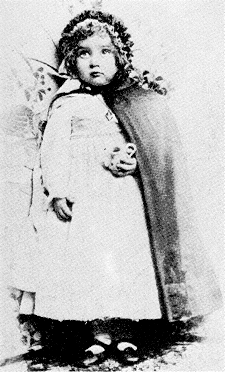
OMF is divided into 881 posts, while LM comes in 5 volumes, 48 books and 577 chapters; no editions of it contain, as OMF does, 1,291 comments, 883 hyperlinks and 466 pictures. However, the picture reproduced here, Cosette by Emile Bayard, also appeared in the original edition of LM and is thus common to both.
Hugo's great novel tells an epic story and covers an enormous canvas; OMF is less ambitious, consisting as it does of little snippets of this and that, most of which exhibit a facetious banality—or, as some critics maintain—a vapid flippancy; LM is noted for its total lack of flippancy. It is widely considered that both works contain some passages of memorable prose and many long and tedious sections which are totally unreadable and quite irrelevant to the main theme.
LM features characters called Marius Pontmercy and Ultime Fauchelevent, a.k.a. Urbain Fabre or Jean Valjean; these people have never been mentioned at all in OMF until today.
Since 1907, there have been about fifty film adaptations of Les Misérables and so far none at all of Other Men's Flowers, but it is early days yet.
 Les Misérables has more than twice as many words and these were all written by Hugo, whereas only about 40% (at a guess) of the words in OMF are mine, and the remainder are other men's (or women's). Another difference between the two works which critics have noted is that OMF is mostly in English, unlike LM, which is virtually all in French; the latter has been translated into English seven times and into many other languages, while translations of OMF have been made only by Google and are totally incomprehensible.
OMF is divided into 881 posts, while LM comes in 5 volumes, 48 books and 577 chapters; no editions of it contain, as OMF does, 1,291 comments, 883 hyperlinks and 466 pictures. However, the picture reproduced here, Cosette by Emile Bayard, also appeared in the original edition of LM and is thus common to both.
Hugo's great novel tells an epic story and covers an enormous canvas; OMF is less ambitious, consisting as it does of little snippets of this and that, most of which exhibit a facetious banality—or, as some critics maintain—a vapid flippancy; LM is noted for its total lack of flippancy. It is widely considered that both works contain some passages of memorable prose and many long and tedious sections which are totally unreadable and quite irrelevant to the main theme.
LM features characters called Marius Pontmercy and Ultime Fauchelevent, a.k.a. Urbain Fabre or Jean Valjean; these people have never been mentioned at all in OMF until today.
Since 1907, there have been about fifty film adaptations of Les Misérables and so far none at all of Other Men's Flowers, but it is early days yet.
Tuesday, 14 October 2008
Now the pressure is on
One of the advantages of advanced age is that you are liberated from most of the commitments which make the prime of life so stressful—earning money, bringing up children, playing a role in the community, being nice to people and so on. You still get out of bed most mornings but it isn't absolutely necessary, and in other ways you can do anything you like and, more importantly, fail to do things you don't like.
Five years ago I decided to make a commitment; self-imposed ones are little danger to one's mental well-being because no-one is disappointed—in fact no-one need know—if one drops them because they have proved difficult, or just boring, to fulfil. I resolved that I would write something every second day and post it on the internet, allowing myself some latitude in execution by defining "something" very loosely: I would not aim at consistency of theme or focus and the pieces I wrote could be of any length, in any style and on any topic. In summing up the whole publication, the phrase "dog's dinner" springs to mind.
This, I thought, would make the project a doddle, and so it has proved. Later I realised that on days when no words at all came to mind I could just shove in some kind of picture instead. This made the task even easier, and it has not been much of a strain.
Now that has all changed. Last week an English polymath ex-lawyer with the net name of Froog, resident in Beijing, posted in his urbane and witty blog a compliment—nay, an encomium—nay, a panegyric—directed at Other Men's Flowers. I was feeling a bit low when I read it and it lifted my spirits: you might call that complimentary medicine. Incidentally, his praise was not fulsome, for that means disgusting by excess and I was not at all disgusted.
Actually I was very pleased, for after stealing other men's flowers since 2004 it was gratifying to be given a bouquet for oneself. However, the sad truth is that the good fellow has done me a great disservice: no longer can I sit at the keyboard light-heartedly tapping out a load of old codswallop just for my own amusement, not caring whether anyone appreciates it or even reads it. I would really hate to disappoint such a kind and generous reader, and now as I sweat through the 48 hours gestation of each post I shall always have at the back of my mind a nagging question: Is Froog going to like this one?
This means keeping up some kind of standard, something quite foreign to my experience and inclination. I cannot say yet whether the constant worry will inhibit me or even cause a writer's block or some other kind of breakdown. Time will tell.
[Modesty restrains me from reproducing here what Froog actually wrote, but someone with IT skills may be able to work out a way of locating it.]
Five years ago I decided to make a commitment; self-imposed ones are little danger to one's mental well-being because no-one is disappointed—in fact no-one need know—if one drops them because they have proved difficult, or just boring, to fulfil. I resolved that I would write something every second day and post it on the internet, allowing myself some latitude in execution by defining "something" very loosely: I would not aim at consistency of theme or focus and the pieces I wrote could be of any length, in any style and on any topic. In summing up the whole publication, the phrase "dog's dinner" springs to mind.
This, I thought, would make the project a doddle, and so it has proved. Later I realised that on days when no words at all came to mind I could just shove in some kind of picture instead. This made the task even easier, and it has not been much of a strain.
Now that has all changed. Last week an English polymath ex-lawyer with the net name of Froog, resident in Beijing, posted in his urbane and witty blog a compliment—nay, an encomium—nay, a panegyric—directed at Other Men's Flowers. I was feeling a bit low when I read it and it lifted my spirits: you might call that complimentary medicine. Incidentally, his praise was not fulsome, for that means disgusting by excess and I was not at all disgusted.
Actually I was very pleased, for after stealing other men's flowers since 2004 it was gratifying to be given a bouquet for oneself. However, the sad truth is that the good fellow has done me a great disservice: no longer can I sit at the keyboard light-heartedly tapping out a load of old codswallop just for my own amusement, not caring whether anyone appreciates it or even reads it. I would really hate to disappoint such a kind and generous reader, and now as I sweat through the 48 hours gestation of each post I shall always have at the back of my mind a nagging question: Is Froog going to like this one?
This means keeping up some kind of standard, something quite foreign to my experience and inclination. I cannot say yet whether the constant worry will inhibit me or even cause a writer's block or some other kind of breakdown. Time will tell.
[Modesty restrains me from reproducing here what Froog actually wrote, but someone with IT skills may be able to work out a way of locating it.]
Saturday, 1 March 2008
Recycling (1)
Recycling, v. According to the OED, the word was first seen in print in 1926 in the Journal of the Institute of Petroleum Technologists, referring to an industrial process.
It was not used figuratively until forty years later, and ever since then all kinds of things have been re-cycled: hot money (Guardian, 1969); the output of the secondary schools (Nature, 1973); workers without jobs (Black Panther, 1973); fads (Weekend Magazine, Montreal, 1974); OPEC funds (Newsweek, 1974); repeat offenders (Washington Post, 1978), and so on, to this day.
I'm punctilious about putting bottles, paper, and plastic containers out for re-cycling, and it has now occurred to me that I should take the same care with the contents of Other Men's Flowers. Of course, the 741 posts currently mouldering in OMF's archives are unlikely to cause large-scale pollution , or to contribute towards global warming by giving off methane, so they are not an environmental hazard: it is a question of energy-saving, an equally important concern. If at least some of these items are re-used there will be a huge reduction in the amount of energy expended in creating new ones.
So I have decided that, starting today, the first post in every month will consist entirely of some old items, unchanged but dusted off and economically re-packaged with merely a note of the category and a description linked to the original. All these appeared in 2004:
theatre
Are actresses all actors these days?
sport
Pea-pushing: A sport in decline
cinema
An inspired choice of a screen name
quotations
Noël Coward speaks
music
Comparing the great ones
literature
A sly tribute to Somerset Maugham
It was not used figuratively until forty years later, and ever since then all kinds of things have been re-cycled: hot money (Guardian, 1969); the output of the secondary schools (Nature, 1973); workers without jobs (Black Panther, 1973); fads (Weekend Magazine, Montreal, 1974); OPEC funds (Newsweek, 1974); repeat offenders (Washington Post, 1978), and so on, to this day.
I'm punctilious about putting bottles, paper, and plastic containers out for re-cycling, and it has now occurred to me that I should take the same care with the contents of Other Men's Flowers. Of course, the 741 posts currently mouldering in OMF's archives are unlikely to cause large-scale pollution , or to contribute towards global warming by giving off methane, so they are not an environmental hazard: it is a question of energy-saving, an equally important concern. If at least some of these items are re-used there will be a huge reduction in the amount of energy expended in creating new ones.
So I have decided that, starting today, the first post in every month will consist entirely of some old items, unchanged but dusted off and economically re-packaged with merely a note of the category and a description linked to the original. All these appeared in 2004:
theatre
Are actresses all actors these days?
sport
Pea-pushing: A sport in decline
cinema
An inspired choice of a screen name
quotations
Noël Coward speaks
music
Comparing the great ones
literature
A sly tribute to Somerset Maugham
Saturday, 2 February 2008
Good blog, bad blog
It has been said that the best blogs:
have a consistent style; are focussed on a particular theme; are honest and sincere; contain no offensive material; are planned to appeal to special groups, or to a general readership; are written tightly, without padding; are unpretentious, avoiding the use of words which few will understand; and are pleasingly styled, with original and striking graphic design.
Other blogs are:
inconsistent; unfocussed; deceitful and disingenuous; full of objectionable content; totally unplanned and therefore likely to appeal to hardly anybody; verbose and banal; show-offs, using rare words for effect; and based on a bog-standard template which the writer cannot be bothered to modify.
Foremost among these is Other Men's Flowers. During its four years on line it has attracted both brickbats and bouquets, and some of the former can be considered as compliments. Take the Weblog Review, for example: one of its reviewers gave the blog 2 out of 5 and wrote: I left this site feeling ripped off... feel as if I have nothing from it ... no bit of wisdom to carry on ... no real desire to return to this site at all, which is fair comment if a little blunt, but another noted that ...the vast majority of the posts are off topic and trivially nondescript.
This showed great discernment and I was much encouraged when I read it in 2004, for it is exactly the effect I have always aimed at.
have a consistent style; are focussed on a particular theme; are honest and sincere; contain no offensive material; are planned to appeal to special groups, or to a general readership; are written tightly, without padding; are unpretentious, avoiding the use of words which few will understand; and are pleasingly styled, with original and striking graphic design.
Other blogs are:
inconsistent; unfocussed; deceitful and disingenuous; full of objectionable content; totally unplanned and therefore likely to appeal to hardly anybody; verbose and banal; show-offs, using rare words for effect; and based on a bog-standard template which the writer cannot be bothered to modify.
Foremost among these is Other Men's Flowers. During its four years on line it has attracted both brickbats and bouquets, and some of the former can be considered as compliments. Take the Weblog Review, for example: one of its reviewers gave the blog 2 out of 5 and wrote: I left this site feeling ripped off... feel as if I have nothing from it ... no bit of wisdom to carry on ... no real desire to return to this site at all, which is fair comment if a little blunt, but another noted that ...the vast majority of the posts are off topic and trivially nondescript.
This showed great discernment and I was much encouraged when I read it in 2004, for it is exactly the effect I have always aimed at.
Monday, 7 January 2008
Top sonnets for 2007
I did not expect that many of the bare-knuckle fighters, street traders and used car dealers among my readers would accept my sonnet-writing challenge. There are a few intellectuals and top professional men and women who occasionally leaven OMF's banalities with their wit and erudition, but I knew that these would be too busy chairing international conferences or coping with their ministerial responsibilities to spend time on such a frivolous project. And, of course, the prelates among them would be carrying a heavy burden of sacerdotal duties over the Christmas period; one can never expect to get much feedback from high-ranking men of the cloth at peak holy times.
However, I am happy to report that very creditable fourteen-liners were submitted by three of my friends and two unknowns:
• Eric: a distinguished American law professor who mistakenly believes that all lawyers are poets manqué
• Outeast: a person who supplies a nickname but no personal details or URL and who I therefore suspect may be wanted for questioning by the police in connection with a series of axe murders
• Gervase: a Scottish lecturer
• Anonymous: an elderly retired gentleman from Warwickshire
• Grumio: This old reprobate is a resident of Soho but spends much time abroad.
The full texts of their sonnets (in the order in which they were received), and a comment on each by a noted critic are given HERE. The standard was very high; every one of these sonnets has some quality to be commended, so I am unable to pick a winner and I am sending the donation to the Save the Children Fund in my own name. Thank you all.
However, I am happy to report that very creditable fourteen-liners were submitted by three of my friends and two unknowns:
• Eric: a distinguished American law professor who mistakenly believes that all lawyers are poets manqué
• Outeast: a person who supplies a nickname but no personal details or URL and who I therefore suspect may be wanted for questioning by the police in connection with a series of axe murders
• Gervase: a Scottish lecturer
• Anonymous: an elderly retired gentleman from Warwickshire
• Grumio: This old reprobate is a resident of Soho but spends much time abroad.
The full texts of their sonnets (in the order in which they were received), and a comment on each by a noted critic are given HERE. The standard was very high; every one of these sonnets has some quality to be commended, so I am unable to pick a winner and I am sending the donation to the Save the Children Fund in my own name. Thank you all.
Sunday, 23 December 2007
Two days to go

Deck the halls with boughs of holly
Tralalalala la la la la
Let us all be frightfully jolly
Tralalalala la la la la
Or not, if you’d rather not. As Eeyore said in a different context: Gaiety. Song-and-dance. Here we go round the mulberry bush. We can’t all, and some of us don’t. That’s all there is to it.
In eight days time Other Men's Flowers (the blog, not Wavell's anthology) will be four years old, and now contains more than one third as many words as War and Peace. There has been much controversy over the relative merits of the two works, but actually they have very little in common: there is practically no reference to the retreat from Moscow in OMF (though there are two fascinating notes on Napoleon’s hat), and no-one is going to film it with either Henry Fonda or Anthony Hopkins, because Pierre Bezukhov hardly figures in it at all. On the other hand, W&P is not made up of over 700 posts and does not contain 1100 comments, 360 pictures and 670 hyperlinks. Above all, Other Men's Flowers reproduces no less than SEVEN cartoons by James Thurber and THERE ARE NONE in Tolstoy’s great novel. I think the conclusion is obvious.
The day after tomorrow is the First Day of Christmas. For that day and every day until Epiphany I have sought the help of John Julius Cooper, 2nd Viscount Norwich CVO, an English historian, travel writer and television personality known as John Julius Norwich: posts on those days will be entirely his work.
So until 7th January 2008, toodle-pip and A Happy New Year to everyone .
Sunday, 28 October 2007
Homeopathy and other snake oil
Every sensible person keeps paracetamol tablets in the house to relieve pain, and adhesive plasters in case of injury. It is also a good plan to have always to hand something to counteract the effects of finding material on the internet which offends one’s regard for the truth, feeling for justice or merely one’s common sense.
Happily, many such antidotes are freely available and take the form of websites expressing sane and considered points of view based on evidence and not superstition or bigotry. There is, for example, RationalWiki, which discusses crackpot ideas in general and the beliefs of the American religious right in particular; an example of its style is its note on Faith Healers. For a corrective to anti-science, there is Sense About Science, which is an independent charitable trust responding to the misrepresentation of science and scientific evidence on issues that matter to society, and Ben Goldacre’s Bad Science with a similar aim.
There is also Bad Astronomy, which is currently dealing briskly with:
"Asteroid 1999 AN10 is predicted to come close to Earth in 2027 and 2039. NASA doesn’t think that it will hit. However there is evidence that it will—from the Bible."
Naturally there are many sites devoted to medicine and health, for this is the field in which more greedy charlatans flourish than any other. To cure the depression engendered by encountering pernicious rubbish about miracle cures, you can turn to Quackwatch or Quackometer which are an assurance that the snake-oil salesmen do not have it all their own way.
 Then there is Homeowatch, which notes that
“Homeopathic 'remedies' are usually harmless, but their associated misbeliefs are not. When people are healthy, it may not matter what they believe. But when serious illness strikes, false beliefs can lead to disaster. This website provides information about homeopathy that is difficult or impossible to find elsewhere. The bottom line is that it is senseless and does not work.”
An illustration of the value of such sites in counteracting the outpouring of quackery was provided when Dr Andy Lewis put on his Quackometer website an article criticising the Society of Homeopaths (Europe ’s largest professional organisation of homeopaths) in no uncertain terms. The SoH did not attempt to challenge his assertions, but sent a threatening legal letter to his hosting company Netcetera, demanding they take his page down. Dr Lewis emailed the SoH politely asking which of his comments they wished to counter. There was no response but instead their lawyers sent another angry letter to his hosting company, who finally took the page down.
Of course, it has now been replicated a hundred times across the internet, on blogs or websites which have a total readership many times greater than that of the original article. You can read it here and Dr Lewis’s polite email is here.
[News items beginning ‘Scientists have discovered that…’ or an assertion that the efficacy of a product has been ‘scientifically proven’ should be regarded with scepticism (or by Americans with skepticism) until the relevant research has been published and peer-reviewed as described here.]
Happily, many such antidotes are freely available and take the form of websites expressing sane and considered points of view based on evidence and not superstition or bigotry. There is, for example, RationalWiki, which discusses crackpot ideas in general and the beliefs of the American religious right in particular; an example of its style is its note on Faith Healers. For a corrective to anti-science, there is Sense About Science, which is an independent charitable trust responding to the misrepresentation of science and scientific evidence on issues that matter to society, and Ben Goldacre’s Bad Science with a similar aim.
There is also Bad Astronomy, which is currently dealing briskly with:
"Asteroid 1999 AN10 is predicted to come close to Earth in 2027 and 2039. NASA doesn’t think that it will hit. However there is evidence that it will—from the Bible."
Naturally there are many sites devoted to medicine and health, for this is the field in which more greedy charlatans flourish than any other. To cure the depression engendered by encountering pernicious rubbish about miracle cures, you can turn to Quackwatch or Quackometer which are an assurance that the snake-oil salesmen do not have it all their own way.
 Then there is Homeowatch, which notes that
“Homeopathic 'remedies' are usually harmless, but their associated misbeliefs are not. When people are healthy, it may not matter what they believe. But when serious illness strikes, false beliefs can lead to disaster. This website provides information about homeopathy that is difficult or impossible to find elsewhere. The bottom line is that it is senseless and does not work.”
An illustration of the value of such sites in counteracting the outpouring of quackery was provided when Dr Andy Lewis put on his Quackometer website an article criticising the Society of Homeopaths (Europe ’s largest professional organisation of homeopaths) in no uncertain terms. The SoH did not attempt to challenge his assertions, but sent a threatening legal letter to his hosting company Netcetera, demanding they take his page down. Dr Lewis emailed the SoH politely asking which of his comments they wished to counter. There was no response but instead their lawyers sent another angry letter to his hosting company, who finally took the page down.
Of course, it has now been replicated a hundred times across the internet, on blogs or websites which have a total readership many times greater than that of the original article. You can read it here and Dr Lewis’s polite email is here.
[News items beginning ‘Scientists have discovered that…’ or an assertion that the efficacy of a product has been ‘scientifically proven’ should be regarded with scepticism (or by Americans with skepticism) until the relevant research has been published and peer-reviewed as described here.]
Monday, 1 January 2007
Now we are three
 Another birthday for OMF, now with 525 posts containing 136,000 words, 230 pictures, 476 links and 834 comments.
A Happy New Year to almost everyone.
I don't need to name the two public figures, both with names beginning with B, to whom I wish bad scran (an Anglo-Irish expression, according to the OED).
Wednesday, 27 December 2006
Comment is free...
...but often not worth reading. The Guardian has “a collective group blog, bringing together regular columnists from the Guardian and Observer newspapers with other writers and commentators representing a wide range of experience and interests. The aim is to host an open-ended space for debate, dispute, argument and agreement and to invite users to comment on everything they read”.
This seems a nice idea, but the comments often provide little in the way of worthwhile debate, particularly when the original piece leans to the left a little, as Guardian writing occasionally does. There was a cool and reasonable article the other day by Melissa McEwan about nasty Republicans which inspired a couple of thousand words of comments, some of them merely making the obvious point that there are some pretty nasty Democrats too, but many of them (perhaps most, I couldn’t be bothered to count) consisting of abuse from simple-minded and often illiterate bigots who have nothing to add..
This wouldn’t matter too much—most such comments reveal in the first couple of lines how little the writer has to say, so really tedious mouthings can be skipped—except that others who comment are tempted to waste their time responding to people with whom it is pointless to argue, when they could be making intelligent comments on the original article.
When the collective blog (called Comment Is Free) was started I registered a name and participated for a while, but now I just read some of the articles and don’t join in the feeble ranting that follows many of them.
This seems a nice idea, but the comments often provide little in the way of worthwhile debate, particularly when the original piece leans to the left a little, as Guardian writing occasionally does. There was a cool and reasonable article the other day by Melissa McEwan about nasty Republicans which inspired a couple of thousand words of comments, some of them merely making the obvious point that there are some pretty nasty Democrats too, but many of them (perhaps most, I couldn’t be bothered to count) consisting of abuse from simple-minded and often illiterate bigots who have nothing to add..
This wouldn’t matter too much—most such comments reveal in the first couple of lines how little the writer has to say, so really tedious mouthings can be skipped—except that others who comment are tempted to waste their time responding to people with whom it is pointless to argue, when they could be making intelligent comments on the original article.
When the collective blog (called Comment Is Free) was started I registered a name and participated for a while, but now I just read some of the articles and don’t join in the feeble ranting that follows many of them.
Thursday, 14 September 2006
What happened to my friend?
Last year I wrote a post about meeting people on the net and mentioned the advantages of making friends that way. I have since discovered the downside.
Just after that piece was published I saw a note in a now defunct forum from someone who had just started a personal blog called Bonhead under the name of Orso I Tink. This was a rather silly pseudonym but here was something about what he wrote which suggested he would be interesting to know so I left a comment. He wrote a friendly comment back and over the next five months there was an exchange of messages between us, some in comments on his blog, some on mine, and some by email.
When we began writing he was just setting off in a camper with his dog to travel from Albuquerque to Oaxaca, buying craft products on the way and planning to start a retail business when he got there. He wrote an amusing account in his blog of his adventures on the journey and many other things. He also won a little competition I posted (see comments to the post) and we had a friendly argument about the prize.
I used to look forward to reading whatever he wrote and clearly he was enjoying the correspondence as much as I was.
Then, five months later, his blog suddenly disappeared from the net; after a few weeks I emailed him but there was no response. All that was nearly a year ago and I have since heard nothing, which makes me sad. I very much fear that something has happened to him and he never reached Oaxaca.
His first name is Miguel and he was born and grew up in Puerto Rico. He speaks English, Castilian and Catalan and had some Scottish/Irish ancestors named Fletcher and O’Farrell. I know nothing more about him: if there is anyone out there who knows (or knew) him I would be very happy to hear from them.
Just after that piece was published I saw a note in a now defunct forum from someone who had just started a personal blog called Bonhead under the name of Orso I Tink. This was a rather silly pseudonym but here was something about what he wrote which suggested he would be interesting to know so I left a comment. He wrote a friendly comment back and over the next five months there was an exchange of messages between us, some in comments on his blog, some on mine, and some by email.
When we began writing he was just setting off in a camper with his dog to travel from Albuquerque to Oaxaca, buying craft products on the way and planning to start a retail business when he got there. He wrote an amusing account in his blog of his adventures on the journey and many other things. He also won a little competition I posted (see comments to the post) and we had a friendly argument about the prize.
I used to look forward to reading whatever he wrote and clearly he was enjoying the correspondence as much as I was.
Then, five months later, his blog suddenly disappeared from the net; after a few weeks I emailed him but there was no response. All that was nearly a year ago and I have since heard nothing, which makes me sad. I very much fear that something has happened to him and he never reached Oaxaca.
His first name is Miguel and he was born and grew up in Puerto Rico. He speaks English, Castilian and Catalan and had some Scottish/Irish ancestors named Fletcher and O’Farrell. I know nothing more about him: if there is anyone out there who knows (or knew) him I would be very happy to hear from them.
Subscribe to:
Comments (Atom)