Showing posts with label abroad. Show all posts

Friday, 11 March 2011

In Glorious Drearicolor!


The website World of Soviet Groceries is not nearly as exciting as it sounds, though it does give an accurate if depressing picture of what life in the Soviet Union must have been like

When I was there the USSR still had a few years of life left in it and I don't remember what I ate in Moscow so I suppose most of the dishes must have been along the same lines as those illustrated.

So indeed were the entertainments provided for us by our hosts, though I suppose they meant well: the high spot was an hour spent in a glum queue waiting to file past the embalmed corpse of Lenin, and a close second was a promised afternoon at the Bolshoi Theatre, which turned out not to be one one of the great ballets or operas but a two-hour talk on the history of the Bolshoi, in Russian.

Thursday, 18 December 2008

Border incident

Exactly thirty years ago, in December 1978, I took the train from Beijing to Pyongyang. No doubt nowadays it is full of happy tourist parties off for a jolly time with Our Dear Leader in the Democratic Peoples Republic of Korea, but at that time no-one much wanted to go there or could get a visa if they did.

Clearly I was going to be the only gweilo on the train, and I nervously asked the Chinese minders seeing me off in Beijing how I would manage about ordering food and so on. "No problem", they reassured me, "the guard speaks Russian". In the event I just ate whatever came round, which wasn't much.

I can remember nothing of the twenty-four hours as the train rumbled through Manchuria; there were some stops but only one of them was at all memorable. Bleary-eyed, I stumbled out and stretched my legs along the deserted platform while they were changing the locomotive, and a Chinese border guard hurried towards me. There was nothing menacing about him and when he accosted me in passable English I found that he was not going to check my passport and visa, or arrest me for some unspecified crime, but simply wanted to talk.

He seemed to have some managerial responsibilities, but with only two trains a day and apparently no-one getting on or off them his duties could not have occupied much of his time: after he had polished his belt, boots and pistol holster the days must have dragged terribly. Generally my impression is that Chinese people cope well with boredom, being inured or impervious to it; this young man had spent his time teaching himself English. As I was the first native Anglophone he had ever met he was determined to make the most of an opportunity to practise.

I have heard other European travellers in China say that earnest students met by chance often demand answers to difficult questions about such things as the proper use of the mandative subjunctive, but happily the problem which had been bothering my new friend was easy to for me to solve. He was supervising the installation of some new bins to keep the station tidy: should he have them labelled TRASH or GARBAGE?

Of course I said it should be RUBBISH; REFUSE would have confused him. I wrote it for him on the back of my card (ming pian) and we parted with a handshake and expressions of mutual esteem. I like to think that he kept my card as a souvenir and that he retains as happy a memory of our encounter as I do.

Friday, 12 December 2008

Bollywood poster

No folk-art is livelier than an Indian film poster, which characteristically includes a space rocket, a clutch of skyscrapers, a distant view of Kashmir, a group of skin-divers, a submarine, two or three Mercedes cars and a fattish young hero, centre front, who, while gazing moistly into the eyes of his beloved, seems to be searching her long black hair for nits.
from An Indian Journey by Jan Morris

Friday, 24 October 2008

Season of smoke

Mists we shall probably have, and maybe a hint of mellow fruitfulness, but the other manifestations of this time of year are less romantically enjoyable; the dreary imported Halloween will be closely followed by our own Guy Fawkes night. But it's not much fun in China, either, according to a netfriend of mine who lives in Beijing. He has a civilised blog called Froogville in which he writes perceptively about life generally but particularly in China, and had this to say recently about what happens there in October:

The air has been freakishly clear for the past week or so. One rather suspects that the country's entire manufacturing industry has been shut down until further notice because of the global economic meltdown. Then again, maybe we've just been lucky to have a long run of cleansing easterly breezes (rather than the more usual westerly ones that bring in the industrial fug from the rest of the country, or the occasional southerly ones that pin the city's accumulated smog up against the mountains to the north and west).

Clear, that is, by day. The nights have been horrendous. The beginning of the tenth lunar month in the Chinese calendar is yet another of those appeasing-the-ancestors festivals. At other times of the year, they burn money (or, more and more often, elaborate paper effigies of consumer goods) to make sure that their departed forebears can continue down the capitalist road in the afterlife. In autumn they burn clothes - so that the dead can dress warm in winter. I think it's the first day of the month that is supposed to be devoted to this, but in practice it drags on for a week or more. Every night, hundreds of thousands of people are out building mini-bonfires on the streets. And the damp autumn air quickly becomes saturated with the soot this produces. This year has been worse than ever, the very worst I can recall. The air quality after dark has been just poisonous this week.

The decades of hardcore Communism were remarkably ineffective in rooting out these antique superstitions; and now these fatuous practices are once again freely tolerated (if not actively encouraged, as a charming manifestation of China's "rich and ancient culture"). How long can we continue to condone a quaint tradition that is so massively pointless and so shockingly deleterious to the environment? There are a lot of Chinese customs that irritate me, and this is one of the worst. And I don't suppose the majority of Chinese really believe in this ancestor-worship nonsense - any more than we Westerners believe in Father Christmas. But our customs - hanging out stockings, etc. - are innocent, non-noxious. The Chinese custom of lighting millions of small bonfires across the country every night for a week is a massive assault on the environment - and it needs to be ended. Soon.

Wednesday, 23 April 2008

Bunged up

At the Barcelona Olympic Games in 1992 I was a sort of official, so they provided me with a car and a young student to drive it. Antonio spoke quite good English, and when he needed an English word which he didn't know he would simply anglicise the Spanish. This usually worked well, but once when we were having dinner together I sneezed, and with some concern he enquired: "Are you constipated?".

When we explained, he laughed as much as we had. It was an easy mistake to make: constipado means congested. There are both English and Spanish words deriving from the Latin constipare (to cram together) but for us the general sense is obsolete: nowadays we use our word only to describe a medical condition.


My six-year-old grand-daughter probably knows this; she is totally bilingual , although in Spanish she has a strong Andalusian accent. The Spanish way of life seems to suit her and she loves her school, particularly the flamenco lessons on Wednesday afternoons.


Tuesday, 13 November 2007

Suspicion and deceit

A couple of days ago I posted a picture of part of a parade in Brussels featuring some marchers wearing splendid green furry costumes. As I had found this, uncaptioned, on the cover of a tourist brochure, I had no idea who they were or what they were representing: The Gnomes of Flanders, perhaps? Die Grünen? The Brussels Lettuce Growers Association? I was certain that someone living in Brussels would write in and tell me.

Sure enough, within a few hours several comments had appeared on the blog, including one in French and one in Dutch. Both of these informed me that the parade was in fact part of the 2007 21ème Festival Gay et Lesbien de Belgique. The Frenchman not only gave me the website but said that his sister Éloise was on the left in the photo.

Well, fine. And yet…

I am ever mindful of Thomas Paine’s dictum: Suspicion is the companion of mean souls, and the bane of all good society. So I stifled my doubts and engaged this helpful pair in an exchange of comments. Finally, though, the doubts increased and I emailed a polyglot friend who writes under the name of Grumio. He is an unashamed blackguard and, on being pressed, freely admitted that he had written the comments, and that the G&L people of Brussels, had never, as far as he knew, marched in green fur.

By then I really wanted to know what it was all about, and asked a friend in Brussels for her help. She didn’t know the answer but referred me to a website which posts answers to questions about Belgium.

Bingo! Two anonymous people replied to my query with the totally convincing suggestion that "this could well be a group taking part in the Zinneke Parade (which takes place every two years). The theme changes on each occasion, and this sounds like the ecological theme from a couple of years ago".

That seems extremely likely. Anyway, I am going to accept it as the truth and make no more enquiries, suppressing the thoughts that anyone can send in answers to that website, the comments on it were anonymous, and Grumio is a persistent spoofer with time on his hands…

Thursday, 6 September 2007

Nursery school, Spanish style

A number of my acquaintances have emigrated to Spain or are thinking of doing so. I have never wanted to go and live there, though I have had some happy times in Spain and have met some delightful Spaniards. I don’t like the climate, I don’t play golf and I don’t think I would care much for some of the expatriates I might encounter. But there is a huge benefit in living there if you have small children.

One of my twin daughters has a happy life in a small town in the foothills of the Sierra Nevada (the Spanish one, not the California/Nevada one where Roy ‘Mad Dog’ Earle came to a violent end). Her daughter went the local nursery school (Guarderia) when she was fifteen months old (they start in the September after they have learnt to walk). She went on to the main school two years later; children in Spain do not have to start school until they are six, but can do so before then if the parent pays for books and equipment.

The Guarderia is a world away from mere baby-minding. It is purpose-built, with two classes; the hours are 9am till 2pm. There are two teachers, both qualified, for each group of about twenty children, and a male teacher. The toddlers loved him; he gave them lots of cuddles—you couldn’t do that in England, of course. All foreign residents in Spain have the right to send their children there.

They give them all birthday parties—my granddaughter’s third (shared) one is pictured here—and offer a huge range of activities. They have at least three festivals in the year when they dress up in some costume. The holidays are much shorter than main school, six weeks instead of three months.

The Guarderia, subsidised by the Junta de Andalucia, costs 20 euros a month. Andalucia used to be the richest region in Spain; it is now one of the poorest but they somehow they can still manage to make such a provision for their children.

Now, at five, my daughter’s child is confident, sociable and extremely articulate in two languages. This, I guess, is largely down to her upbringing, but much must be the effect of her very early start at the nursery. By most measures we are substantially richer than the Spanish; if they can do this then why can’t we? It’s a rhetorical question: there are several reasons, none of them very good ones.

Wednesday, 25 April 2007

You can’t cross here

A much admired competitor in the 1907 Peking to Paris car "challenge" was a Frenchman called Auguste Pons, who had to withdraw when his three-wheeled 6 HP ice-cream cart type of vehicle ran out of fuel in the middle of the Gobi desert. He can in no way be considered a failure in life, because nine years earlier he had become the father of Lily Pons, who was a principal soprano at the Met for thirty years, starred in three films with Henry Fonda in the thirties and could vocalise up to the A-flat above high C without visible effort.

In the hundred years since that great 1907 rally, there have been many attempts to repeat the event, the latest being an optimistic one planned, perhaps not entirely seriously, for 2007. But the difficulties faced in making such journeys nowadays are illustrated by a report in the Guardian about the proliferation of barriers of one kind and another which now exist or are being developed. A graphic attached to the report enumerates them, classified by their raison d’être: anti-immigration (8), anti-terror (8), internal (2) and so on.

The latest, still proposed or under construction, are in the West Bank and Russia/Chechnya, and the oldest (1953) is between the two Koreas, described by Bill Clinton as ‘the scariest place on earth’. It is certainly the most impenetrable of all borders; when I went with a colleague to Pyongyang in 1978 we had been to the other Korea first but although Pyongyang is only 30 or so miles from the border we had to fly there from Seoul via Tokyo.

My colleague, as a special treat, was taken down to Panmunjom, where they were hurling insults and threats across the DMZ over a powerful loudspeaker system. As a distinguished guest he was given the microphone and asked to say something.
“What shall I say?” he asked.
“Well, you could say “Go home, filthy American fascist-imperialist hyenas” was the answer.

The reason he gave for declining was something to the effect that the Americans and South Koreans were also members of the international sports federation of which he was the president, so he didn’t feel it would be quite right for him to send such a message. Anyway, they didn’t insist.


.

Thursday, 15 February 2007

A new Great Leader of All Turkmen

I and those of my friends who follow closely the changing political scene in the gas-rich central Asian states were dismayed to learn the result of the recent elections in Turkmenistan. Most of us, in the course of our late-night pub discussions over the years, had mastered the correct pronunciation of the president’s name: Saparmurat Niyazov (though sometimes we referred to him as Sapper). He was a brutal megalomaniac; the cult of his personality—he ran the country like a private Disney World—made Kim Jong-Il look like Clement Attlee.

The lovable old fellow died, full of years and fine cognac, a couple of months ago. So far so good, but this week 98.5% of the five million Turkmenis turned out to elect a successor. And whom have they chosen? The acting president, one Gurbanguli Berdymukhamedov.

Clearly, dramatic changes are afoot. It will take us a while to catch up with that one, and he’ll have to be just Gurbers—or possibly Berdy—to us until we’ve got it right. We're playing the video of the swearing-in ceremony over and over again; the commentator pronounces his full name beautifully.

Friday, 22 September 2006

In the ranks that were led by the Tsar

Only those who know the difference between Ruy Lopez and Jennifer will be following closely the news from Kalmykia this week. In Elista, a small town in this self-governing republic, Veselin Topalov and Vladimir Kramnik, the title holders of international chess's two rival federations, are fighting a series of matches in the World Chess Championships.

The inhabitants of Kalmykia are called Kalmyks, or Kalmuks. Finding out about them throws an interesting light on the story, for many years celebrated in song, which describes quite a different sort of battle: I had always thought of it as an epic fight between representatives of two different civilisations, the Western and the Eastern, or if you like the Christian and the Islamic, which ended in the death of both.


But this was clearly not the case: there is no doubt about Abdul the Bul-Bul Emir’s appearance and background, and I had imagined his opponent as being lean, dark, thin-moustached or possibly looking like this, a high-ranking officer in the Preobajensky Guard:


But:
As Abdul’s long knife was extracting the life
In fact, he was shouting “Huzzah!”
He felt himself struck by that wily Kalmuk
Count Ivan Skivinsky Skivar


The Kalmuks are of Mongol stock, either Buddhist or Muslim, so Ivan probably looked like this.

Nevertheless, country boy or not, Ivan is referred to as “this bold Russian”, so he must have spent much of his life in Moscow and acquired sophisticated skills there:
He could imitate Irving, play Euchre and Pool
And strum on the Spanish guitar
In fact quite the cream of the Muscovite team
Was Ivan Skivinsky Skivar.

and after his death:
There’s a Muscovite maiden her lone vigil keeps
‘Neath the light of a pale Polar star
And the name that she whispers so oft as she weeps
Is Ivan Skivinsky Skivar.

Saturday, 29 July 2006

Abroad is bloody

“Don’t go abroad,” George VI is alleged to have advised, “…abroad’s bloody”.]
In a piece* published in the New York Times Jan Morris notes that:
Travel, which was once either a necessity or an adventure, has become very largely a commodity, and from all sides we are persuaded into thinking that it is a social requirement too—not even just a way of having a good time, but something that every self-respecting citizen ought to undertake, like a high-fibre diet, say, or a deodorant.

Morris, the greatest living travel writer, understands that not everyone feels the urge to see the world:
Consider the advantages of purely vicarious travel—travelling, so to speak, at home. Readers sometimes thank me for my books because, having read them, they feel they need never go to the places they describe. I sympathize entirely with their point of view, even when, as occasionally happens, it is less than kindly expressed. ''You have quelled in me all desire,'' a woman wrote to me once, ''to visit the city of Venice. I hope you're satisfied".

If you stay at home, read the best travel books, and watch TV selectively, you can have nearly all the pleasures of travel without ever having to stand in line at the check-in counter. A flick of the page, and you are off that Patagonian Express and on to that Mississippi barge—pour yourself a coffee, and there is the Snow Leopard before your eyes—a martini or two, and all the sensualities of the East will be there around you, scented and salacious in your very apartment! (Almost all, anyway.)

Great minds have been fostered entirely by staying close to home. Moses never got further than the Promised Land. Da Vinci and Beethoven never left Europe. Shakespeare hardly went anywhere at all— certainly not to Elsinore or the coast of Bohemia.

Actually there is a great deal to be said, even by a professional traveller like me, against travelling at all.

Indeed, she should know. I went overseas about twice a month for thirty years, so I've done abroad, but mostly I did not go for pleasure. The nice thing about working trips is that you are not under the terrible pressure to enjoy yourself that you feel when you are on holiday: when you’re having a good time you think “and I’m being paid as well”, and when you’re not you can tell yourself “oh well, at least I’m being paid for this misery”. Nowadays, holidays abroad I can do without.

Having said all that, tomorrow we’re off to Provence for ten days.

[*It's O.K. To Stay At Home]

Monday, 24 July 2006

Sad News from Nepal

Last January I commiserated with God-King Gyanendra for the pudding basin he was obliged to wear on his head on ceremonial occasions.

The hot news from Kathmandhu is that by popular demand he is to be stripped of the major powers derived from his God-head and Kingship, and will in future be permitted to carry out only three ceremonial duties: accepting the credentials of new ambassadors, visiting a girl-goddess at the temple where he was formerly patron, and receiving a priest who flashes at him a bejewelled undergarment in a holy ceremony. None of these sound much fun except possibly the second.

There is perhaps some compensation for the poor fellow in that he may no longer have to wear that silly plumed thing on his head. However, ordinary Nepali hats do little for one’s dignity, and he probably won’t regard its replacement as much of an improvement.

Friday, 24 February 2006

No need for thermals


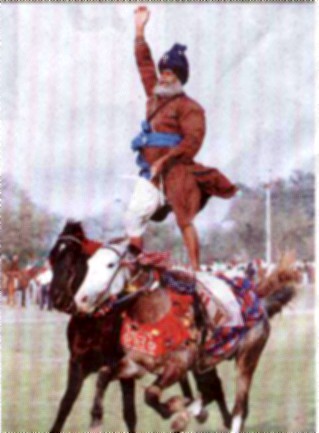
Can anyone doubt that the Punjab Rural Olympics are much more fun than all that chilly sliding around in Turin?

Sunday, 20 November 2005

Above the 49th

Reading with enjoyment the other day of the arrest and indictment of Conrad Black, it occurred to me that Other Men's Flowers has paid insufficient attention to Canada. I frequently post items of interest to Americans, noting some of their quaint orthographical habits or discussing their major historical figures such as Hattie McDaniel and Curly Joe DeRita, but I have never dealt in depth with that great country which Americans from Albuquerque to the Bronx fondly refer to as The Friendly Giant to the North.
I do not know why this should be so, since there has been much in my life which relates to this former—now, alas, no longer—Dominion:
1. My wife was for some years a Canadian citizen and has relatives who live there, except in the winter when it gets cold and they go to Phoenix AZ.
2. I have been there on two occasions, one of them extending to more than a week (not counting several touchdowns in Vancouver en route to somewhere else),
3. I possess a splendidly bound two-volume history of the CPR which I have every intention of reading one of these days, and
4. I am one of the very few non-Québécois who know why they put sweetcorn in Shepherds’ Pie and call it Pâté chinois.
Not only all that, but I have read up on the Yukon, and used to be able to recite the whole of the poem that begins:
A bunch of the boys were whooping it up in the Malamute saloon;
The kid that handles the music-box was hitting a jag-time tune;
Back of the bar, in a solo game, sat Dangerous Dan McGrew;
And watching his luck was his light-o'-love, the lady that's known as Lou.


Anyway, let me now make up for my neglect by passing on some information of interest only to Canadians, hoping that it will bring a moment or two of happiness into their drab, miserable lives. No, on second thoughts, let them wait; I’ll do it in the next post.

Sunday, 3 April 2005

Kirgistan

Or maybe Kurgistan, or Kirgiztan. But it seems to be usually transliterated as Kyrgysztan. Why? It doesn't help us to pronounce it more accurately.
The CIA Factbook has a map (which they probably copied from a 19th century children's book about missionaries in Central Asia), showing that there's no difficulty with the transliteration of the capital, Bishkek, or the towns of Osh, Sary-Tash or So'x, but that there is some uncertainty with Tokmok (or Tokmak) and Kyzyl-Kyya (or Kyzyl-Kiya).


The latest news from this former Soviet republic is that the ousted president, Askar Akayev, has agreed to resign if they promise not to kill him, and that it is doubtful if Kurmanbek Bakiev, 56, the new interim president and prime minister, is popular enough to take over. Here's a picture of the latter wearing his rather unusual ceremonial hat.

...and since he looks a bit dull here's a jolly picture of a Kirgiz (or Kyrgysz) family, taken by an intrepid pair of back-packers who visited them in 1998 and shared their lunch of rice and decomposed duck.

Tuesday, 18 January 2005

Our Great and Respected Leader: Part 4

…continued from Part 3
I read the other day that North Korean state television is showing a five-part series entitled Let's Trim our Hair in Accordance with the Socialist Lifestyle, exhorting badly coiffured men to opt for one of several officially sanctioned haircuts.

I do not seem to have any appropriate photographs to illustrate this news item so here is a totally irrelevant picture recalling a visit to the circus in Pyongyang.


Thursday, 25 November 2004

Which one is he, then?

It has been brought to my attention that even some of my literate, cultured, sharpwitted readers are having difficulty keeping up with the news from Ukraine, where there is headline strife and the possibility of worse to come. This is not because the situation is particularly complex, but simply because we are used to discussing world leaders who have nice crisp names like Blair or Bush, and while we could manage the World War II two-syllablers - Stalin, Churchill, Hitler - the troubles in Ukraine are requiring us to remember which protagonist is the one to cheer and which the one to boo-hiss when they are both called Viktor and both have surnames beginning with Y containing a joint total of SEVEN SYLLABLES.
But Other Men's Flowers is The Blog That Makes Everything Easy, so pay attention and don't fidget:

Viktor Yanukovitch is the official winner of the election for President, but this is disputed by the supporters of the opposition leader Viktor Yushchenko, who say that the poll was fixed, while the still acting President Leonid Kuchma is keeping a low profile, as well he might, and the situation has been complicated by the arrival of dear old Lech Waleska (pron. Vawensa) of Solidarity (or Solidarnosc), who addressed the vast crowd in Polish.

Oh, and the colour of the revolution (opposition) is ORANGE, while the other side favours BLUE and WHITE, which are also the colours of the Ukrainian football club Dynamo, but Dynamo fans are wearing orange because the club is owned by the unpopular Kuchma supporter Grigoriy Surkis.

All clear now? Carry on, then.

Monday, 27 September 2004

Our Great and Respected Leader: Part 3

…continued from Part 2
I was taken to the theatre three or four times during my visits to Pyongyang. The productions I saw were not only all much the same, but had been performed unchanged for decades, and are no doubt still being performed, with occasional changes of cast. They were described as revolutionary operas, and certainly had some rattling good tunes, with titles like Infinite Is the Raftsman’s Honour and Let Us Send More Rice to the People’s Revolutionary Army.
These operas were by no means monotonous, with some very lively ensemble work…

The Sea of Blood

…alternating with quieter interludes when the entire cast stands about immobile as if stricken with a palsy…

A True Daughter of the Party
(Note some interesting touches: the gentleman second from the left is NOT standing to attention, and the lady with the Sonja Henie hat has not quite succeeded in getting her feet into the first ballet position.)
continued in Part 4

Friday, 17 September 2004

And only UHT milk

It would be absurd to assess the qualities of a holiday destination solely on the basis of what there is to eat when you get there.

However, if the sun isn't shining, the insects are biting, and the baroque churches are beginning to pall, then the prospect of a splendid lunch is really all that there is to make you want to get out of bed in the morning or to stop you from wishing that you'd stayed at home.

I have to say that from recent experience I have the feeling that in these circumstances northern Portugal is not the very best place in the world to be. It's not that Portuguese cooking is bad; the goat stew is, well, OK, the sardines are nice (though not always properly gutted, and apparently best eaten early in the summer), and we had a few pleasant dishes and a memorable octopus in red wine. But some misconceptions are cherished here: for example, that boiled potatoes and rice, together, are a perfect accompaniment to any meal, that stewed pork is made more exciting if you throw a few clams in with it, and that if you call cod bacalhau it automatically becomes interesting, however boringly you cook it.

So, kind and friendly as the Portuguese people are, there is no denying that their cuisine is among the dullest in Europe.

My wife can be counted on to get the very best out of any situation, but there she could only make a rather sad proposal as we pored over a depressing menu identical with a dozen others we had seen: "We really must investigate the vegetable soup" she said, brightly.

Saturday, 4 September 2004

Ate mais tarde

Off to Portugal so no more posts for a couple of weeks.

Northern Portugal, not the Algarve. I hear they've had mosquitos there, blown over from North Africa and carrying the Nile Virus. It is estimated that about 20% of people who become infected with West Nile Virus will develop West Nile Fever, the symptoms of which include fever, headache, tiredness, and body aches, occasionally with a skin rash. While the illness can be as short as a few days, even healthy people have reported being sick for several weeks.


Don't like the sound of that; I mean, one can get all those sensations just by sitting on an English beach, without having to get on an aeroplane first.