
More re-cycled posts from 2005:
literature
Books that sound fascinating but probably aren't
religion
Sadly, now topical: fatuous comment on God's role in Katrina
personal
Casual observation on trivial matter evokes lively argument
Showing posts with label editor's choice. Show all posts
Showing posts with label editor's choice. Show all posts
Monday, 21 March 2011

Monday, 8 August 2005
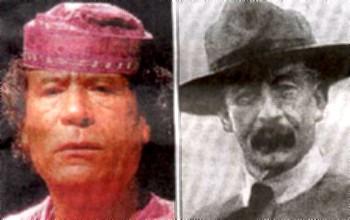
Role model

Thursday, 4 August 2005
Hold the mung beans with fenugreek
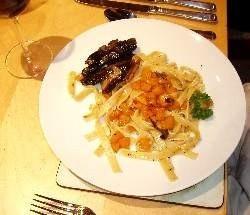
We had some vegetarian friends to dinner the other day and gave them pasta with mushrooms and butternut squash.
It was really rather nice and I thought perhaps I might become a veggie.
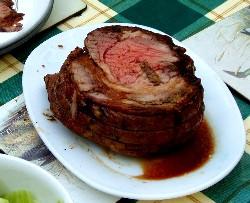
Then I remembered the piece of rib we'd had the previous week and thought...
...no, I mightn't.
[A friend has just given us a recipe for a Paraguayan snack called entrañasitas, which are little patties made from bull's guts which you dip in blood sauce. Must try these next weekend, if our butcher can get the right sort of bull's guts.]
Tuesday, 2 August 2005
Versatility in the Ice Age
Phones which take pictures are only one modern example of things which serve more than one purpose; the Garlic-and-Butter-Bean Purée which can also be used for grouting the bathroom is another. Often, neither function is performed particularly well.
It is difficult to say whether this would have been true of the artefact recently discovered in south-western Germany, but anyway it shows that dual-use items were common 28,000 years ago. Such implements, or rather tools, must have been a real boon to the busy prehistoric man (or woman) who was suddenly struck by an urgent need to do a bit of flint-knapping, as they used to call it.
It is difficult to say whether this would have been true of the artefact recently discovered in south-western Germany, but anyway it shows that dual-use items were common 28,000 years ago. Such implements, or rather tools, must have been a real boon to the busy prehistoric man (or woman) who was suddenly struck by an urgent need to do a bit of flint-knapping, as they used to call it.
Friday, 29 July 2005
Get you're free druggs at our pharmercy!
My local superstore (Sainsbury’s) was today setting up a new display stand which announced in huge letters that they offer complimentary medicines, so I told the girl behind the counter that I thought this was a most generous gesture absolutely in line with their price-cutting policy. I don’t think she quite understood me but she looked pleased so had obviously taken what I said as a complement.
Wednesday, 27 July 2005
It’s all Tim’s fault
The Public Institute for the Stringent Suppression of Unnecessary Polysyllablicity has been carrying out valuable work in its field since it was created as a sub-group of the Fabian Society soon after the latter’s foundation in 1884, though I sometimes feel that those who devised its title lacked both a sense of irony and any awareness of the desirability of avoiding unfortunate acronyms.
It is clear, however, that this venerable organisation is lagging behind the times: it has no website of its own or even an email address. Most shameful of all, it seems to be taking no action whatsoever to discourage the use of the most appalling example of the sort of thing it was founded to attack: all over the world people are using nine syllables for a very common expression where three ought to serve. The invaluable Wikipedia sums up the situation like this:
Most English-speaking people pronounce the 9-syllable letter sequence www used in some domain names for websites as "double U, double U, double U", but many shorter pronunciations can be heard: "triple double U", "double U, double U" (omitting one W), "dub, dub, dub", "hex u", etc. Some speakers, mostly those with southern accents, pronounce the sequence "dubya, dubya, dubya." Some languages do not have the letter w in their alphabet (for example, Italian), which leads some people to pronounce www as "vou, vou, vou." Perhaps a shorter pronunciation will become standard usage in the future. Several other languages (e.g. German, Czech, Dutch etc.) pronounce the letter W as a single syllable, so this problem doesn't occur….
In English pronunciation, saying the full words "World Wide Web" takes one-third as many syllables as saying the initialism "WWW". According to Berners-Lee, others mentioned this fact as a reason to choose a different name, but he persisted.
It’s particularly galling that German-speakers, not noted for syllabic parsimony, have no problem with it.
I don’t much like any of the shorter variations mentioned by Wikipedia, logical though some of them are. My own coinage, which I have found to be instantly grasped without misunderstanding by almost everyone, though it may confuse francophones and small children, is Wee Wee Wee, and I invite all my readers to join me in promoting this obviously sensible usage.
It is clear, however, that this venerable organisation is lagging behind the times: it has no website of its own or even an email address. Most shameful of all, it seems to be taking no action whatsoever to discourage the use of the most appalling example of the sort of thing it was founded to attack: all over the world people are using nine syllables for a very common expression where three ought to serve. The invaluable Wikipedia sums up the situation like this:
Most English-speaking people pronounce the 9-syllable letter sequence www used in some domain names for websites as "double U, double U, double U", but many shorter pronunciations can be heard: "triple double U", "double U, double U" (omitting one W), "dub, dub, dub", "hex u", etc. Some speakers, mostly those with southern accents, pronounce the sequence "dubya, dubya, dubya." Some languages do not have the letter w in their alphabet (for example, Italian), which leads some people to pronounce www as "vou, vou, vou." Perhaps a shorter pronunciation will become standard usage in the future. Several other languages (e.g. German, Czech, Dutch etc.) pronounce the letter W as a single syllable, so this problem doesn't occur….
In English pronunciation, saying the full words "World Wide Web" takes one-third as many syllables as saying the initialism "WWW". According to Berners-Lee, others mentioned this fact as a reason to choose a different name, but he persisted.
It’s particularly galling that German-speakers, not noted for syllabic parsimony, have no problem with it.
I don’t much like any of the shorter variations mentioned by Wikipedia, logical though some of them are. My own coinage, which I have found to be instantly grasped without misunderstanding by almost everyone, though it may confuse francophones and small children, is Wee Wee Wee, and I invite all my readers to join me in promoting this obviously sensible usage.
Wednesday, 1 June 2005
Boring professionally
One more bore, and then I will find another topic.
This time, I am the bore. I cannot really claim to be a top rank bore because I don’t have the necessary determination: of course, like most people, I am sometimes very boring, but usually I become aware of the symptoms in my victims – the glazed eyes, the drumming fingers – and drop the subject or cut the anecdote short. But there was a period in my life when inspiring boredom was a useful skill.
I was working for an international sports federation which had Biennial General Meetings; these took place every two years, as is so often the case with BGMs, and were usually held in some remote and unglamorous spot – Pyongyang, it might be, or Novi Sad, or Birmingham. Delegates from a hundred or more countries attended and simultaneous translation in six or more languages was provided. Politics played a major part in our deliberations; I have pointed out elsewhere why this is just as likely with sports federations as with other international bodies.
It sometimes happened, therefore, that a crisis would arise which, if not dealt with skilfully, might cause a breakdown. Perhaps one delegation had suffered a real or imaginary slight: sides would be taken, the Soviet bloc would be angrily whispering among themselves, there would be an inflammatory speech from a Chinese delegate and a possibility that a least one of the two Koreas or one of the two Germanys, or all four, would walk out in a huff.
Sometimes in such a situation the Chairman would give me my cue by saying something like, "I think the Secretary-General has a point he’d like to make…”
I would put on my special boring secretarial spectacles (or, if I was already wearing them, take them off) and start droning away in my special boring secretarial voice. Almost immediately, the tension would ease; delegates would start pouring themselves glasses of water, looking through their documents to see what time lunch was, or just sitting back and thinking about their plans for the evening.
It would not be many minutes before the Chairman could interrupt me and say “Thank you. Let’s press on, shall we? Number Fourteen on your agenda….” and it would be a very determined delegate who could remember what the row had been about and insist on re-starting it.

The Great Hall of the People, outside.....

... the BGM inside.....

...me on the extreme right, about to be very boring indeed.
.
This time, I am the bore. I cannot really claim to be a top rank bore because I don’t have the necessary determination: of course, like most people, I am sometimes very boring, but usually I become aware of the symptoms in my victims – the glazed eyes, the drumming fingers – and drop the subject or cut the anecdote short. But there was a period in my life when inspiring boredom was a useful skill.
I was working for an international sports federation which had Biennial General Meetings; these took place every two years, as is so often the case with BGMs, and were usually held in some remote and unglamorous spot – Pyongyang, it might be, or Novi Sad, or Birmingham. Delegates from a hundred or more countries attended and simultaneous translation in six or more languages was provided. Politics played a major part in our deliberations; I have pointed out elsewhere why this is just as likely with sports federations as with other international bodies.
It sometimes happened, therefore, that a crisis would arise which, if not dealt with skilfully, might cause a breakdown. Perhaps one delegation had suffered a real or imaginary slight: sides would be taken, the Soviet bloc would be angrily whispering among themselves, there would be an inflammatory speech from a Chinese delegate and a possibility that a least one of the two Koreas or one of the two Germanys, or all four, would walk out in a huff.
Sometimes in such a situation the Chairman would give me my cue by saying something like, "I think the Secretary-General has a point he’d like to make…”
I would put on my special boring secretarial spectacles (or, if I was already wearing them, take them off) and start droning away in my special boring secretarial voice. Almost immediately, the tension would ease; delegates would start pouring themselves glasses of water, looking through their documents to see what time lunch was, or just sitting back and thinking about their plans for the evening.
It would not be many minutes before the Chairman could interrupt me and say “Thank you. Let’s press on, shall we? Number Fourteen on your agenda….” and it would be a very determined delegate who could remember what the row had been about and insist on re-starting it.
The Great Hall of the People, outside.....
... the BGM inside.....
...me on the extreme right, about to be very boring indeed.
.
Sunday, 29 May 2005
A chat with Samuel Taylor Coleridge
Here’s another bore, quite unforgettable although it’s many years since I met him.
We didn’t have gap years in those days, but there was always a few months to wait and my fill-in job was as a barman at a pub in Tooting, South London. Then it was a fairly deprived area; it probably still is, relatively, but nowadays if you want to buy a one-bedroom flat there it will set you back around £120,000.
When the head barman told me his name was Macbeth I said “What bloody man is this?”, which was both feeble and pointless, since, as I later discovered, The Thane of Cawdor wasn’t even in that scene, but I was only seventeen. Anyway, I think he thought I was just being offensive.
But he was a friendly and helpful man, and on my first day he gave me a warning: “You want to watch that old chap in the corner”.
“Why”, I asked him, “is he dangerous?”. But Mac just smiled and said, “You’ll see.”
Later, when I went round collecting glasses, the old man beckoned me and I went over to him. He was certainly Ancient, and may well have been a Mariner, but he didn’t have a long grey beard and his eye was rheumy rather than glittering; before I could ask wherefore he had stopp’st me, he pulled out a battered old tin fob watch and began to speak.
You must imagine the story told over many minutes, with repetitions and long pauses while he lost the thread, took a sip of his half of mild or just decided to rest for a bit, and punctuated with frequent interjections like what I meanter say is. This is a greatly abridged version:
“My grandfather gave this watch ter my father when ‘e was 21, my father I mean. Course, when ‘e died, the watch come ter me. Now. I got two daughters and THEY got two daughters, each of ‘em. Now, what I wanter know is, what’s gonna ‘appen to this ‘ere watch WHEN I’M GORN?”
Eftsoons his hand dropt he, and not a moment too eftsoon. I couldn’t answer his question, though long afterwards it occurred to me that I might have suggested that he left instructions for the watch to be buried with him as a memorial to his grandfather. Anyway, when I went back behind the bar I told Mac I didn’t think the old boy was all that bad. Once again, he just smiled.
The next day when I went to collect the glasses I was beckoned over to the same table; out came the watch and:
“My grandfather gave this ……..”
I worked in that pub every day for seven weeks, which is why I have never forgotten that watch.
.
We didn’t have gap years in those days, but there was always a few months to wait and my fill-in job was as a barman at a pub in Tooting, South London. Then it was a fairly deprived area; it probably still is, relatively, but nowadays if you want to buy a one-bedroom flat there it will set you back around £120,000.
When the head barman told me his name was Macbeth I said “What bloody man is this?”, which was both feeble and pointless, since, as I later discovered, The Thane of Cawdor wasn’t even in that scene, but I was only seventeen. Anyway, I think he thought I was just being offensive.
But he was a friendly and helpful man, and on my first day he gave me a warning: “You want to watch that old chap in the corner”.
“Why”, I asked him, “is he dangerous?”. But Mac just smiled and said, “You’ll see.”
Later, when I went round collecting glasses, the old man beckoned me and I went over to him. He was certainly Ancient, and may well have been a Mariner, but he didn’t have a long grey beard and his eye was rheumy rather than glittering; before I could ask wherefore he had stopp’st me, he pulled out a battered old tin fob watch and began to speak.
You must imagine the story told over many minutes, with repetitions and long pauses while he lost the thread, took a sip of his half of mild or just decided to rest for a bit, and punctuated with frequent interjections like what I meanter say is. This is a greatly abridged version:
“My grandfather gave this watch ter my father when ‘e was 21, my father I mean. Course, when ‘e died, the watch come ter me. Now. I got two daughters and THEY got two daughters, each of ‘em. Now, what I wanter know is, what’s gonna ‘appen to this ‘ere watch WHEN I’M GORN?”
Eftsoons his hand dropt he, and not a moment too eftsoon. I couldn’t answer his question, though long afterwards it occurred to me that I might have suggested that he left instructions for the watch to be buried with him as a memorial to his grandfather. Anyway, when I went back behind the bar I told Mac I didn’t think the old boy was all that bad. Once again, he just smiled.
The next day when I went to collect the glasses I was beckoned over to the same table; out came the watch and:
“My grandfather gave this ……..”
I worked in that pub every day for seven weeks, which is why I have never forgotten that watch.
.
Wednesday, 25 May 2005
Flower Power
Leaving the theme of boredom for the moment - no, hang on, continuing with the same theme – The Chelsea Flower Show is about to open. I have always had the feeling that this is an occasion I must not fail to miss, and the previews of it on TV have confirmed this, though happily the strike of BBC staff reduced the coverage somewhat.
We have seen a great deal of an irritating Yorkshireman and an even more irritating Irishman who have been inviting us to admire the show gardens. Many of these are built round eccentric accessories (“Here are the famous coloured balls again, and over here we have a large blue slate sphere… ”) or feature stainless steel bits and cascading water which make them look like rather chic sewage farms. Why, even dear old green-fingered Microsoft has sponsored a garden with wireless connectivity, combined with a custom-built work pod. Just imagine, you can sit here with your laptop in a sort of steel cage, downloading your emails while you enjoy the flowers! How about that, Capability Brown, eh?

Then we saw a giggle of B List celebrities interviewed, telling us how beautiful it all is and how much they love gardening, but there was a refreshing moment when another Irishman cheerfully announced that gardening held no pleasure at all for him: this was Terry Wogan, an appropriate guest here as the Eurovision Song Contest gives much the same degree of aesthetic pleasure as the Flower Show. Sadly, there was nothing at Chelsea to inspire Terry to say anything as memorable as his comment on one of the Eurovision contestants: “Will ye look at the thighs on that woman?”.
The irritating Yorkshireman had been well instructed: the main sponsors, Merrill Lynch, haven’t yet quite got their name indissolubly welded to the title of the event, but he constantly worked it in. The Royal Horticultural Society has clearly made a wise choice: these sponsors, with their innovative solutions for affluent individual investors across the world, their strategic advice to corporations and institutions worldwide, and above all their skilled underwriting of debt & equity securities clearly have much to offer garden lovers.
We have seen a great deal of an irritating Yorkshireman and an even more irritating Irishman who have been inviting us to admire the show gardens. Many of these are built round eccentric accessories (“Here are the famous coloured balls again, and over here we have a large blue slate sphere… ”) or feature stainless steel bits and cascading water which make them look like rather chic sewage farms. Why, even dear old green-fingered Microsoft has sponsored a garden with wireless connectivity, combined with a custom-built work pod. Just imagine, you can sit here with your laptop in a sort of steel cage, downloading your emails while you enjoy the flowers! How about that, Capability Brown, eh?
Then we saw a giggle of B List celebrities interviewed, telling us how beautiful it all is and how much they love gardening, but there was a refreshing moment when another Irishman cheerfully announced that gardening held no pleasure at all for him: this was Terry Wogan, an appropriate guest here as the Eurovision Song Contest gives much the same degree of aesthetic pleasure as the Flower Show. Sadly, there was nothing at Chelsea to inspire Terry to say anything as memorable as his comment on one of the Eurovision contestants: “Will ye look at the thighs on that woman?”.
The irritating Yorkshireman had been well instructed: the main sponsors, Merrill Lynch, haven’t yet quite got their name indissolubly welded to the title of the event, but he constantly worked it in. The Royal Horticultural Society has clearly made a wise choice: these sponsors, with their innovative solutions for affluent individual investors across the world, their strategic advice to corporations and institutions worldwide, and above all their skilled underwriting of debt & equity securities clearly have much to offer garden lovers.
Sunday, 22 May 2005
Boree
Following the previous post, I shall stay on the theme of boredom for a while; I have at least two more Grade A bores to write about, both of them totally unknown to the world at large, with good reason. But first here’s a famous victim of boredom: Hedda Gabler.

Eve Best at the Duke of York’s Theatre
“I have a vocation for boring myself to death”, she says. And of course it is the literal truth: after the sound of the shot with which she blows her brains out, Judge Brack ends the play with a puzzled “People don’t do that sort of thing”.
Yesterday I saw Richard Eyre’s fine new production of Ibsen’s 1890 play; it is years since I saw it, and I had forgotten what a marvellous savage comedy it is.
Eve Best at the Duke of York’s Theatre
“I have a vocation for boring myself to death”, she says. And of course it is the literal truth: after the sound of the shot with which she blows her brains out, Judge Brack ends the play with a puzzled “People don’t do that sort of thing”.
Yesterday I saw Richard Eyre’s fine new production of Ibsen’s 1890 play; it is years since I saw it, and I had forgotten what a marvellous savage comedy it is.
Wednesday, 18 May 2005
Boring for England
Major league bores are of many kinds, but the commonest variety have one characteristic: everything they say, but everything, is either a stupefying banality or a totally pointless anecdote. I know one – let us call him UTF, which happen to be quite close to his initials but might stand for Unbelievably Tedious Fellow – who could combine the two with powerful effect.
The discussion is, let us say, about the injustice of workers losing their pensions when a company goes bust while the directors walk away with millions. In comes UTF:
“Well, I always say, what’s sauce for the goose is sauce for the gander”. Far from being entombed in the wave of glum silence which follows this remark, UTF, having got the floor, presses on: “That’s what a friend of mine called Peter often used to say: What’s sauce for the goose is sauce for the gander, he used to say”. At this point he realises that what is called for now is some background information about Peter:
“Interesting chap, Peter, used to live in St Albans, well, at any rate, he was at school there but moved to Harpenden when he married, girl I knew who used to work with me at ICI, actually, that’s how I met him. Anyway, he had this marvellous collection of cigarette cards, must have had, oooh…”.
Here he demonstrates another habit of people who have nothing of interest to say: the long pause while he sits with furrowed brow and pursed lips trying to recall some completely unimportant detail, and we all wait: “...several hundred!”.
And so on.
Like most bores, he is a very nice chap, so no-one says “Oh, for God’s sake shut up, you miserable wretch!”. Everyone listens for a bit and then gradually lets his voice fade into the background while they start conversations among themselves on some totally different topic, or just start showing each other little tricks with matches.
This post is quite a short one but seems to have taken a long time to write; I must have dropped off to sleep in the middle of it.
The discussion is, let us say, about the injustice of workers losing their pensions when a company goes bust while the directors walk away with millions. In comes UTF:
“Well, I always say, what’s sauce for the goose is sauce for the gander”. Far from being entombed in the wave of glum silence which follows this remark, UTF, having got the floor, presses on: “That’s what a friend of mine called Peter often used to say: What’s sauce for the goose is sauce for the gander, he used to say”. At this point he realises that what is called for now is some background information about Peter:
“Interesting chap, Peter, used to live in St Albans, well, at any rate, he was at school there but moved to Harpenden when he married, girl I knew who used to work with me at ICI, actually, that’s how I met him. Anyway, he had this marvellous collection of cigarette cards, must have had, oooh…”.
Here he demonstrates another habit of people who have nothing of interest to say: the long pause while he sits with furrowed brow and pursed lips trying to recall some completely unimportant detail, and we all wait: “...several hundred!”.
And so on.
Like most bores, he is a very nice chap, so no-one says “Oh, for God’s sake shut up, you miserable wretch!”. Everyone listens for a bit and then gradually lets his voice fade into the background while they start conversations among themselves on some totally different topic, or just start showing each other little tricks with matches.
This post is quite a short one but seems to have taken a long time to write; I must have dropped off to sleep in the middle of it.
Friday, 13 May 2005
Mr Toad
 "Unlike most toads, wealth toad has three limbs and a pair of red fiery eyes and is commonly seen offering an ancient Chinese coin in its mouth, sitting on a pile of gold. As a wealth enhancement, one may place a wealth toad at the main door or wealth sector to increase business flow and personal luck.”
Yes, indeed, quite unlike your typical toad.
I don't think my house has much in the way of wealth sectors, but I’m thinking of getting an eight-foot wealth toad for the main door. It might not do much for my business flow or personal luck but it would sure as hell frighten away Jehovah’s witnesses and, come October, trick-or-treaters.
I wonder why those who peddle ancient Chinese drivel, and the idiots who pay money to learn how to align their wardrobes so as to maximise the flow of qi through their socks, pronounce it fung shway but don't spell it like that. In China it's regarded as a peasant superstition but is hugely popular in Taiwan, Hong Kong and of course in California.
Wednesday, 11 May 2005
A good send-off
Every so often a news story appears which confirms one's belief in the infinite richness and variety - and, ultimately, the inexplicability - of human conduct. This week's comes from Barnsley in South Yorkshire:
"Twenty-four police officers in riot gear using CS gas, five of them injured, nineteen people arrested, three pubs closed, traffic backed up for miles."
The occasion was a funeral......
It's often said half-jokingly by mourners but must have been true here: "How he would have loved this - what a pity he's missing it !".
"Twenty-four police officers in riot gear using CS gas, five of them injured, nineteen people arrested, three pubs closed, traffic backed up for miles."
The occasion was a funeral......
It's often said half-jokingly by mourners but must have been true here: "How he would have loved this - what a pity he's missing it !".
Monday, 9 May 2005
Eulogy
This is a serious post, unlike nearly all the other 236 in this blog.
I have been diligently scribbling for more than sixty years. I enjoyed doing it (even the quarter of a million words of penny-a-line journalism) but nothing I put down was worth preserving, except for the piece I reproduce below.
In 1993 a man who had been my friend and mentor for eighteen years died. In 1975 I had taken over from him the administration of an international sports federation of which he had been the Honorary General Secretary; I became its Secretary-General and was not badly paid for doing the work he had done for nothing since the 1930s (all this time he had had a paid job as a local authority official).
Although the piece I wrote – not really an obituary, for it gave few biographical details – went out to around a hundred countries, it was probably read by only a few hundred people. But I am proud of it because my friend’s widow, who had been married to him for sixty years, said after reading it, “You got him right”.

Peking (now Beijing) 1972
Bill Vint, the least deceitful of men, had a deceptive personality – like his name, which was not Bill at all, but Arthur Kingsley.
It is true that he was, as he appeared to be, a gentle and kindly man, but in other respects he was not at all what he seemed. For one thing, his staid demeanour and the conservatism of his dress and habits might have led one to suppose that he was a fuddy-duddy, set in his ways and hostile to change. Not a bit of it – Bill was a radical, always dismissive of old ideas and receptive to new ones. The fact that something had always been done one way was, to him, a challenge to find a new and better way. For example, he had seen many years ago that computers would revolutionise office work, and was enthusiastic about their introduction; if they had been available during his day as General Secretary he would certainly have ensured that the federation had the latest and best ones.
Then again, the unchanging mildness of his manner and his desire to please everyone might have suggested that he was a trimmer, blown with any wind, easy to sway. This would have been a serious misapprehension, for underneath his diffidence lay a rock-hard integrity; he was not a stickler for correctness in the usual sense and would compromise on almost anything to find the solution to a problem but never, ever, would he compromise on decency or fairness, for these were his watchwords.
From these qualities sprang his skill as a mediator. Malice, impatience and contempt were unknown to him; he would never take offence or stand on his dignity. He was rarely angry, and then usually only with himself, for having failed, in his own eyes, to achieve the highest standards in some trivial matter. But he had enormous tolerance for the frailties of others and assumed that everyone’s intentions were as good as his, and that those he dealt with could be trusted. Of course, he was sometimes let down or deceived; but not often, for he seemed to bring out the best in people, who generally responded to his sincerity as they might not have done to someone who was merely conciliatory or subtle.
In 1976, having been instrumental in building up the federation’s administration and then acquiring and setting up its first permanent office, he handed it over as soon as it was ready to me, a newly-engaged employee with no experience in sports administration and no background in the sport. This was his choice, but even so a lesser man might have found it difficult; if Bill did he never showed it. Though he had to come to the office almost every day, he never sat at a desk or took his hat and coat off; this was his way of telling me that it was my office and he was there only to help.
For a year he gently inducted me into the world of sport, somehow without appearing to give any direct instructions. “Perhaps it would be good if …..”, he would say, or “I think I should feel inclined to …..”. Nor did he ever utter a rebuke; the nearest he came to it was on an occasion when I had committed a major blunder which would clearly cause a lot of trouble. “There may be some complaints”, he observed mildly.
Thus he passed into my inexperienced hands the fruits of his many years of unpaid work, and then retired after the 34th World Championships in 1977. Nobody wanted him to go, so he was never allowed to retire completely. He never gave advice unless asked, but naturally I and others all over the world did ask, frequently, and for years continued to benefit from his sage counsel.
The federation owes much to Bill’s wife Nora, whose devotion enabled him to indulge his obsession with the sport and its administration, and on whose support he became increasingly dependent in later years. And yet, on his last appearance at a major event, in Dortmund in 1992, he was, though frail, still busy doing what he was so good at – rallying the disaffected, counselling the perplexed, calming the intemperate.
It is good to reflect that in his last years he must have become aware of the affection, esteem and trust which he inspired in so many people all over the world. We shall all miss him very much; he is irreplaceable.
I have been diligently scribbling for more than sixty years. I enjoyed doing it (even the quarter of a million words of penny-a-line journalism) but nothing I put down was worth preserving, except for the piece I reproduce below.
In 1993 a man who had been my friend and mentor for eighteen years died. In 1975 I had taken over from him the administration of an international sports federation of which he had been the Honorary General Secretary; I became its Secretary-General and was not badly paid for doing the work he had done for nothing since the 1930s (all this time he had had a paid job as a local authority official).
Although the piece I wrote – not really an obituary, for it gave few biographical details – went out to around a hundred countries, it was probably read by only a few hundred people. But I am proud of it because my friend’s widow, who had been married to him for sixty years, said after reading it, “You got him right”.
Peking (now Beijing) 1972
Bill Vint, the least deceitful of men, had a deceptive personality – like his name, which was not Bill at all, but Arthur Kingsley.
It is true that he was, as he appeared to be, a gentle and kindly man, but in other respects he was not at all what he seemed. For one thing, his staid demeanour and the conservatism of his dress and habits might have led one to suppose that he was a fuddy-duddy, set in his ways and hostile to change. Not a bit of it – Bill was a radical, always dismissive of old ideas and receptive to new ones. The fact that something had always been done one way was, to him, a challenge to find a new and better way. For example, he had seen many years ago that computers would revolutionise office work, and was enthusiastic about their introduction; if they had been available during his day as General Secretary he would certainly have ensured that the federation had the latest and best ones.
Then again, the unchanging mildness of his manner and his desire to please everyone might have suggested that he was a trimmer, blown with any wind, easy to sway. This would have been a serious misapprehension, for underneath his diffidence lay a rock-hard integrity; he was not a stickler for correctness in the usual sense and would compromise on almost anything to find the solution to a problem but never, ever, would he compromise on decency or fairness, for these were his watchwords.
From these qualities sprang his skill as a mediator. Malice, impatience and contempt were unknown to him; he would never take offence or stand on his dignity. He was rarely angry, and then usually only with himself, for having failed, in his own eyes, to achieve the highest standards in some trivial matter. But he had enormous tolerance for the frailties of others and assumed that everyone’s intentions were as good as his, and that those he dealt with could be trusted. Of course, he was sometimes let down or deceived; but not often, for he seemed to bring out the best in people, who generally responded to his sincerity as they might not have done to someone who was merely conciliatory or subtle.
In 1976, having been instrumental in building up the federation’s administration and then acquiring and setting up its first permanent office, he handed it over as soon as it was ready to me, a newly-engaged employee with no experience in sports administration and no background in the sport. This was his choice, but even so a lesser man might have found it difficult; if Bill did he never showed it. Though he had to come to the office almost every day, he never sat at a desk or took his hat and coat off; this was his way of telling me that it was my office and he was there only to help.
For a year he gently inducted me into the world of sport, somehow without appearing to give any direct instructions. “Perhaps it would be good if …..”, he would say, or “I think I should feel inclined to …..”. Nor did he ever utter a rebuke; the nearest he came to it was on an occasion when I had committed a major blunder which would clearly cause a lot of trouble. “There may be some complaints”, he observed mildly.
Thus he passed into my inexperienced hands the fruits of his many years of unpaid work, and then retired after the 34th World Championships in 1977. Nobody wanted him to go, so he was never allowed to retire completely. He never gave advice unless asked, but naturally I and others all over the world did ask, frequently, and for years continued to benefit from his sage counsel.
The federation owes much to Bill’s wife Nora, whose devotion enabled him to indulge his obsession with the sport and its administration, and on whose support he became increasingly dependent in later years. And yet, on his last appearance at a major event, in Dortmund in 1992, he was, though frail, still busy doing what he was so good at – rallying the disaffected, counselling the perplexed, calming the intemperate.
It is good to reflect that in his last years he must have become aware of the affection, esteem and trust which he inspired in so many people all over the world. We shall all miss him very much; he is irreplaceable.
Thursday, 5 May 2005
Ave atque vale to all throdkins
Since throdkins first appeared on the internet on April 27th, there has been worldwide interest in this unattractive-sounding dish (oatmeal, bacon and syrup? Oh, for goodness’ sake) and today Google finds about twenty references. In the singular - “throdkin” - there are three others, and one of these, on a Chicago-based culinary chat site, ante-dated my introduction of the word to the net.
That’s enough; I’m bored with this. As Falstaff very nearly said, A plague on your poxy throdkins, I’ll have no more of them.
However, some of the other dishes in danger of extinction which William Black mentioned in his book The Land That Thyme Forgot sound intriguing:
Bawd bree: Scottish hare soup
Blaand: A Shetland drink of lightly fermented buttermilk whey
Cabbieclaw: a Scottish dish of cod with egg sauce and horseradish
Clapshot: Orcadian mashed potato and neeps
Hindle wakes: boiled fowl stuffed with pigs blood and prunes and covered in a lemony butter sauce
Katt pie: from Pembrokeshire, this is made from mutton, sugar and currants
Muggety pie: made with the umbilical cord of a calf
Pan haggerty: a fried mix of potatoes, onions and Lancashire cheese
Seftons: veal custard
Sherwood pot: a Nottinghamshire poacher’s stew containing game, rabbit and sometimes squirrels and other small mammals, cooked in ale.
Shoe horns: eighteenth-century hors d’oeuvres made from anchovies, bread, salted tuna roe, snapdragons and herrings
Umble pie: umble means offal. Nothing to do with humility.
It is possible, I suppose, that some of these are not merely obscure but never actually existed. This is certainly true of one of them; if I get three or more comments guessing correctly which is the one I just invented I promise to give £10 to Save the Children.
That’s enough; I’m bored with this. As Falstaff very nearly said, A plague on your poxy throdkins, I’ll have no more of them.
However, some of the other dishes in danger of extinction which William Black mentioned in his book The Land That Thyme Forgot sound intriguing:
Bawd bree: Scottish hare soup
Blaand: A Shetland drink of lightly fermented buttermilk whey
Cabbieclaw: a Scottish dish of cod with egg sauce and horseradish
Clapshot: Orcadian mashed potato and neeps
Hindle wakes: boiled fowl stuffed with pigs blood and prunes and covered in a lemony butter sauce
Katt pie: from Pembrokeshire, this is made from mutton, sugar and currants
Muggety pie: made with the umbilical cord of a calf
Pan haggerty: a fried mix of potatoes, onions and Lancashire cheese
Seftons: veal custard
Sherwood pot: a Nottinghamshire poacher’s stew containing game, rabbit and sometimes squirrels and other small mammals, cooked in ale.
Shoe horns: eighteenth-century hors d’oeuvres made from anchovies, bread, salted tuna roe, snapdragons and herrings
Umble pie: umble means offal. Nothing to do with humility.
It is possible, I suppose, that some of these are not merely obscure but never actually existed. This is certainly true of one of them; if I get three or more comments guessing correctly which is the one I just invented I promise to give £10 to Save the Children.
Sunday, 1 May 2005
A sound approach, if outspoken
No-one deplores more than I the use of strong language on the net, particularly in those boring simple-minded polemics which are called rants and are peppered liberally with pointless swear-words (though "liberal" is not a word one usually associates with their authors). It is refreshing, therefore, to come across an instance where such a mode of expression adds to rather than detracts from the thrust of its argument, giving it an entirely appropriate emphasis.
Other Men's Flowers is essentially a repository for gentle and kindly comment, and I will not have it sullied by the appearance in it of words likely to offend the pure in heart; therefore I will not even deign to type the indelicate name of the website; I merely put a link to it HERE and commend it as a pungent yet perceptive (though somewhat partisan) analysis of the North/South divide in the USA, albeit one which one would hesitate to send on to one’s grandmother in Florida lest she passes it round her retirement home and it causes offence, or even offense.
The website also contains some links to other sites which provide a useful historical background to its theme.
[Thank you to my friend Edward Cabot Ames III of Boston Beanfeast for bringing this admirable site to my attention.]
Other Men's Flowers is essentially a repository for gentle and kindly comment, and I will not have it sullied by the appearance in it of words likely to offend the pure in heart; therefore I will not even deign to type the indelicate name of the website; I merely put a link to it HERE and commend it as a pungent yet perceptive (though somewhat partisan) analysis of the North/South divide in the USA, albeit one which one would hesitate to send on to one’s grandmother in Florida lest she passes it round her retirement home and it causes offence, or even offense.
The website also contains some links to other sites which provide a useful historical background to its theme.
[Thank you to my friend Edward Cabot Ames III of Boston Beanfeast for bringing this admirable site to my attention.]
Thursday, 28 April 2005
The pithy French
I have already given an example of the economical way in which the French use their beautiful language, and from what I heard on the news yesterday they can be just as concise when they use ours.
The A380 Airbus was about to take off for the first time and an urbane Englishman whose name and role I didn’t catch gave a pessimistic view of its prospects, expressing himself beautifully, at length and with that polished confidence which is the hallmark of an expensive education.
The A380 Airbus was about to take off for the first time and an urbane Englishman whose name and role I didn’t catch gave a pessimistic view of its prospects, expressing himself beautifully, at length and with that polished confidence which is the hallmark of an expensive education.
The response from Noel Forgeard, Airbus’s chief executive, was admirably succinct:
"Thass complete boulsheet! "
.
"Thass complete boulsheet! "
.
Wednesday, 27 April 2005
Throdkins Throdkins Throdkins
Google, Ask Jeeves, Alta Vista, MSN and Yahoo cannot find this word, so it is safe to assume that the internet has no references to it; there cannot be many real English words of which this is true.
It is not a silly made-up word, but is the correct name for a speciality of the Fylde, which is a rich green plain in North West England that runs from the coast across gently rolling unspoilt rural countryside toward the foothills of the Pennines. And THRODKINS? These are made of oatmeal and bacon and are served with syrup. So there.
Imagine! A perfectly good word that isn’t on the internet!
Or wasn’t. It is now, because I’ve just put it there, in two places, here and here.
[I am not the onlie begetter of the revived interest in throdkins because I read about them in an extract in The Guardian from a book by William Black called The Land That Thyme Forgot, in which he mentioned that they were unreferenced on the internet.]
[See HERE for an update on the throdkin situation]
It is not a silly made-up word, but is the correct name for a speciality of the Fylde, which is a rich green plain in North West England that runs from the coast across gently rolling unspoilt rural countryside toward the foothills of the Pennines. And THRODKINS? These are made of oatmeal and bacon and are served with syrup. So there.
Imagine! A perfectly good word that isn’t on the internet!
Or wasn’t. It is now, because I’ve just put it there, in two places, here and here.
[I am not the onlie begetter of the revived interest in throdkins because I read about them in an extract in The Guardian from a book by William Black called The Land That Thyme Forgot, in which he mentioned that they were unreferenced on the internet.]
[See HERE for an update on the throdkin situation]
Sunday, 24 April 2005
Farewell Sir John
The phrase "archetypal British [they mean English, surely?] gentleman" is being trotted out in many of the reports of the death at 97 of John Mills, and I guess that "decent" will appear more than it is usually seen in the obituaries.
Of course he was both these things, and it is pleasant to recall that when required he could also be a convincing swine. In the 1941 spy film Cottage To Let he was a murderous Nazi who would have killed Alastair Sim and a 16-year-old George Cole had they not managed to crush him to death by rolling a millstone on top of him.
Ah, they don't make 'em like that any more - neither films nor English gentlemen. the2
Of course he was both these things, and it is pleasant to recall that when required he could also be a convincing swine. In the 1941 spy film Cottage To Let he was a murderous Nazi who would have killed Alastair Sim and a 16-year-old George Cole had they not managed to crush him to death by rolling a millstone on top of him.
Ah, they don't make 'em like that any more - neither films nor English gentlemen. the2
Tuesday, 12 April 2005
Films as history
"How much obligation lies on makers of historical films to keep to the historical record? How much fiction is permissible within the representation of fact? No cinematic description of the past, and certainly not one designed for a mass audience, could be expected to stay within the boundary of the known. The pace of fiction cannot be the pace of life. Complexities of chronology will need reduction. Buildings and landscapes that contained historical events have disappeared. Dialogue must be invented.
Characterisation may need to be simplified. But elaboration and modification are one thing: perversion of fact is another.”
In the film section of the Channel 4 website they have 15,000 film reviews, and a few, mostly written by historians, assessing some old favourites on the basis of their accuracy and giving them scores from 0 (truly terrible) to 10 (absolutely historically accurate):
El Cid (1961): 6
Witchfinder General (1968): 3
Citizen Kane (1941): 5
Cromwell (1970): 4
Waterloo (1970): 7
Charge of the Light Brigade (1969): 6
Zulu Dawn (1979): 5
Sink the Bismarck (1960): 8
The Life and Death of Colonel Blimp (1943): 9
U-571 (2000): 2
Saving Private Ryan (1998): 9
Scandal (1989): 7
Restoration (1995): 6
Characterisation may need to be simplified. But elaboration and modification are one thing: perversion of fact is another.”
In the film section of the Channel 4 website they have 15,000 film reviews, and a few, mostly written by historians, assessing some old favourites on the basis of their accuracy and giving them scores from 0 (truly terrible) to 10 (absolutely historically accurate):
El Cid (1961): 6
Witchfinder General (1968): 3
Citizen Kane (1941): 5
Cromwell (1970): 4
Waterloo (1970): 7
Charge of the Light Brigade (1969): 6
Zulu Dawn (1979): 5
Sink the Bismarck (1960): 8
The Life and Death of Colonel Blimp (1943): 9
U-571 (2000): 2
Saving Private Ryan (1998): 9
Scandal (1989): 7
Restoration (1995): 6
Subscribe to:
Posts (Atom)