I have never been greatly interested in ferrets. Cheery little fellows, I grant you, but lacking the gravitas of your typical weasel or the diffident charm of a couple of British stoats—both called Arthur—to whom I tried teaching a few simple tricks, without, I have to say, much success.
But a letter published in my local paper a couple of weeks ago introduced me to the fascinating world of ferret distemper, the existence of which I had never before suspected:
I am a ferret owner and member of a group of owners on Facebook who have been discussing the issue of ferret distemper.
I have also been very careful with mine by not letting them out as I am aware of this distemper outbreak. I know it's not mentioned specifically in our area but things like this have a habit of spreading very quickly and easily.
There are still people walking out with their ferrets, maybe some who just haven't heard about the outbreaks. Not all ferret owners will be on Facebook.
So, if you know a ferret owner who knows nothing about this outbreak, please pass on the details. It could be in all innocence wiping out animals before very long if no warnings are to go out.
 I am posting this because I feel that OMF should give the warning wider publicity;. Also, I have never actually seen anyone walking out with a ferret but if I do I shall not hesitate to accost him (or her) and point out the irresponsibility of her (or his) actions. As we all know, even those of us who are not on Facebook, this type of distemper affects dogs as well as ferrets; it can be fatal or lead to many nasty conditions such as vesicular/pustular lesions on the abdomen, and we all know how painful they can be.
.
 This notice in my local hospital might have been less likely to be misunderstood if the last three words had come immediately after "radiographer".
In 1834 the fifteen-year-old Victoria paid a less than happy visit to the Sussex resort of Hastings. It rained incessantly, one of her footmen fell into the sea and drowned and she never went near the place again.
 But the good burghers of the town, which is full of old burghers, bore no malice, and in a fit of patriotic fervour sixty-eight years later erected a bronze statue of her gazing disapprovingly out to sea.
Later in the twentieth century, as reverence for royalty declined, putting something on her head became a popular ritual among the young and agile. In recent years a traffic cone has sometimes been involved, which I thought was grossly disrespectful if not actually lèse majesté.
But last week someone kitted her out with something which looks much cosier, though it does give her a faintly raffish air.
Just outside the town where I live there is something called The Church-in-the-Wood, because that is what it is. It has a churchyard—or rather, at three acres, more of a necropolis—and my wife and I strolled through it happily in yesterday’s sunshine looking at three hundred years of headstones (actually more but the earlier ones are mostly illegible).
 What struck us forcibly was that they stopped making beautiful ones soon after the nineteenth century began. This one from 1795, recording the deaths of Timothy and Mary Jannings, is fairly typical of the eighteenth century, with its lovely typeface and the simple but adequate wording (sadly not visible in my rotten photo).
As the nineteenth century wore on people were less inclined merely to die, preferring to pass on, fall asleep or rest in the arms of Jesus. A record of name, date and age was no longer enough; there had to be whole lines of mawkish or pious banalities and unconvincing encomia which today evoke only indifference or a cynical smile. Where did they bury the not-particularly-loving fathers and the not-really-very-devoted wives?
 But here is a relatively recent stone we found which strikes at the heart, unusual in that the cause of death is given; this was in itself an unusual one in those days. After all these years it still speaks to us plainly and sincerely of the anguish and bitterness of the bereavement. Peter would have been 77 now.
...and don't stop in the summer.
From one of our bedroom windows we can just see a little white three-bladed thing on the roof of a house half a mile away.
A chain of DIY stores has been selling these wind turbines for £1500, and apparently they are being bought enthusiastically by people who either wish to slow down global warning and save a bit on their electricity bills, or hope it will impress the neighbours.
Either possibility seems over-optimistic; most people have read by now that unless you live on a storm-lashed promontory of the Outer Hebrides such a device is likely to provide barely enough power to run a hair-dryer, and will take at least a decade to pay for itself, meanwhile making a irritating noise and possibly shaking your house to pieces with its vibrations.
But the one we can see won’t cause much trouble of that kind: it doesn’t seem to be rotating. Perhaps it is a dummy, like those cast-iron cats people put on the roofs of country cottages.
His own mother called him the Great Beast and he rather enjoyed being described as the wickedest man in the world. This of course was an exaggeration; in a century which saw Hitler, Stalin and Pol Pot operating on a grand scale and Fred West, Paul Dutroux and Ian Brady on a smaller one, such a title is not easy to earn.
However, Aleister Crowley was certainly an extremely nasty character. He inherited a fortune and spent most of it on self-publishing books on the occult and disseminating his racist and sexist views. Some of his poems were banned, dealing lyrically as they did with such themes as paedophilia, bestiality and necrophiliac cannibalism.
Wandering the world for some years, he got up to various often silly but always unpleasant activities (such as naming his daughter Nuit Ma Ahathoor Hecate Sappho Jezebel Lilith) in Sicily, Egypt and the Far East. During the First World War he lived in New York and found employment in writing propaganda for pro-German periodicals.
Aleister Crowley died in a Hastings boarding house in 1947 at the age of 72, penniless and addicted to heroin. An obscure local magazine recently had an article about him asserting that before he died he cursed the town, though it is not known what this pleasant seaside resort had done to upset him.
As it was a quiet week for news in the south-east the BBC sent a reporter to question Hastings residents about their feelings towards Crowley and his curse. It was not clear how many people were approached and said “Who?”, but eventually some were found who were prepared to testify that they were conscious of his continuing malign influence on Hastings and even one man who said he was frightened to speak Crowley’s name, and another who thought it "incredibly likely" that there is still a dedicated army of his followers in the town. A couple, looking distinctly embarrassed, demonstrated some allegedly sinful but rather feeble-looking satanic ritual and, accompanied by some creepy sound library music and with some awed comments from the presenter, all this piffle made up an item which the BBC astonishingly thought was worth broadcasting several times last week.
Although his cursing had no discernible effect and his books and his general carryings-on are now of little interest, he apparently had and still has an influence on modern popular culture, which perhaps says more about modern popular culture than it does about this dreary charlatan.

He's behind you!
He chose this photo for the cover of one of his books, obviously not realising that you do not cut much of a figure as the Great Beast 666 if you wear a comic pantomime hat. But the British love comedians and this might be why, in a poll conducted by the BBC in 2002 to find "the 100 Greatest Britons", Crowley was voted number 73. This put him forty-one places behind Eric Morecambe but only seven places behind Charlie Chaplin.
 So, after nine years, one trial, two appeals, two retrials and five million pounds for our learned friends, Sion Jenkins has been acquitted of murdering his foster daughter Billie-Jo by beating her to death with an iron tent spike. There are some who still believe him to be guilty, but these are simple-minded people who cannot put out of their minds the facts that he is has been shown to be a violent and abusive liar and that there is no other suspect: shame on them.
We live less than a mile from where the murder took place, and in 2003 a TV company hired our house for a week to shoot some of the scenes for a play about the case. I was warned that this can be an unpleasant experience, but we did not find it so: the cast and crew were agreeable people (the actor who played Jenkins was a well-known heart-throb) and it was fun to watch it all happening; the money wasn’t bad, either.
Sadly, the play hasn’t been shown and now it probably won’t be. This means that, like my operatic career, my life in television is over before it could begin. During the shooting of a scene in the road outside the house I inadvertently wandered into shot when returning home, and was shouted at by the director. Now I shall never get the plaudits I would have earned for my subtly underplayed performance in the role of Man With Sainsbury’s Bag Crouching Behind Pillar.
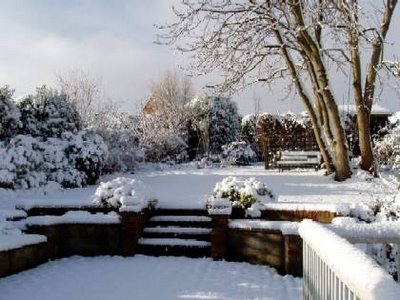
Last week our garden looked like this, for a very short period; a nice picture, but not really news.
The seaside town where we live had the "heaviest snowfall in Britain", no less than 13 cm in two days. The local paper spoke of severe rail disruptions... bus services in chaos... dangerous road conditions, and had a huge front-page picture of the town centre with what looked like a dusting of snow on the rooftops and a perfectly clear main road. The implication was that if all this continued they would soon have to get the helicopters out to drop us emergency supplies.
How this would mystify any Canadian or Finn!
But I think I'd rather live here than in countries that have terrible winters; imagine having to do as my Canadian relatives do and decamp to Phoenix, AZ, when it starts to get cold.
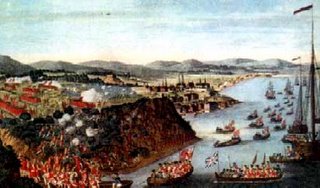 This is a continuation of the previous post, in which I promised to write something of interest to people wanting a change from shovelling snow and eating maple syrup. For a start, here is a picture of the British landing from their boats before the battle of Quebec, on September 17th, 1759. The leaders on both sides, Wolfe and Montcalm, were killed. (There was another Battle of Quebec in December 1775, when the British and Canadian garrison drove off an American attack and ended the threat to the British control of Canada.) But Canadians know all this, of course; that is not what this post is about.
In the English county of Kent there is a small town called Westerham (town square shown below). Winston Churchill and I used to live not far from there, though not in the same house or even in the same direction.
It was the birthplace of General Wolfe, so naturally local pubs, tea-rooms and, for all I know, public conveniences, proudly bear his name.
 On the outskirts of the town there is a large house, converted some years ago into a very good restaurant. It was run by a large and fierce francophone Egyptian called Zarb. I like to think that it was not from chauvinism or to thumb his nose at the locals but only in a spirit of fair play that he called it Le Marquis de Montcalm.
We all resent the huge power of the supermarket chains and deplore the effect they are having on our towns, and we all get in the car and go to them for most of our shopping. Happily, within two or three miles of where we live there is an excellent butcher, an excellent greengrocer and a real baker who actually bakes. Fishing boats go to sea from here so we're all right for fish, though much of what is landed passes through quickly on its way elsewhere, and much of what our fishmongers sell comes in from far away.
Napoleon’s jibe might have been accurate in his day. We are now a nation of huge, efficient, rapacious shopkeepers and an ever-reducing number of small shops, some of which are very valuable and some less so. Here are examples of one of each, in reverse order:
Every day on the way to my office I used to walk past something we called The Silly Shop, because that was what it was, and half a dozen times I went inside. The owner had no idea how to buy or sell anything. He began it as a sort of grocery, but he never had what you wanted: “Baked beans? Sorry sir, just sold the last can”. Later he added a fruit and vegetables corner offering some wrinkled parsnips and a couple of dusty lettuces. Then, with increasing desperation, he branched out, and every week or so it was fascinating to see what his latest idea was; sometimes it filled the shop, at others it left it half empty or still had unsold items from the previous one. He tried everything: videocassettes of films you had never heard of, then “Hardboard Cut to Size”, then piles of very old second-hand books with titles like The Wee Laird of Inversnecky, Vol 4, then date-expired cakes, then “Book Your Holidays Here” and, finally, junk. In the two years of its existence, it never contained anything that anyone would want to buy.
 At the other end of the scale of usefulness and marketing skill there is this shop. Kept by a genial Irishman, it has the dimensions of a good-sized bathroom but somehow fits in stocks of 795 items and has never failed to provide anything we asked for. Long may it prosper, partly because it deserves to and partly because it is 300 yards from our house.
……or so it is announced on a website devoted to the political scene as viewed from this Sussex seaside resort. Whether the world is ready for this initiative, and what the global effect will be, is not yet clear.
Hove, like its neighbour which they describe as “less-glamorous Brighton”, has long been a favourite spot for those intent on a weekend of illicit passion. This is widely known, so on such occasions suggestio falsi as well as suppressio veri often comes into play, and couples arrange for their postcards to be sent off from quite a different town.
Otherwise……..people will say we’re in Hove.
Among the many hairy old institutions we have here in England, few are hairier or older than our most ancient military honour, the post of Lord Warden of the Cinque Ports.
A Royal Charter of 1155 established the original ports (Sandwich, Dover, Hythe, Romney and Hastings), which maintained ships that could be called upon by the Crown in times of strife - there was no navy in those days. In return, the members of the Cinque Ports had the right to:
"soc and sac, tol and team, bloowit and fledwit, pillory, tumbril, infangentheof, outfangentheof, mundbryce waives and strays, flotsam and jetsam and ligan".
This meant that the sailors from these ports could do what they wanted, including wrecking, grounding and plundering other ships. For many years they got away with what amounted to open piracy around the Kent and Sussex coast; they were a sort of legit mafia.
The title of Lord Warden of the Cinque Ports was held by Henry d' Essex in 1155, then by a succession of famous or totally obscure people such as Walerland Teutonicus, Hugh de Bigod, Hamo de Crevequer, the 1st Duke of Wellington, W H Smith (the bookseller), Winston Churchill and Queen Elizabeth the Queen Mother.
Since the latter's death in 2002 the position has remained vacant. Joe Trussler, the speaker of the Cinque Ports, Mayor of Sandwich and clearly a major league dingbat, asked the Queen and the Prime Minister to consider appointing Bill Clinton, because “his appointment would improve relations with the USA and he likes playing golf”.
 However, it has been decided that the new Lord Warden of the Cinque Ports will be Admiral the Lord Boyce, GCB, OBE, who will be installed in office at a session of the Grand Court of Shepway, to be held in Dover on Tuesday 12 April, 2005.
The position, like so many other things in Britain today, has no significance whatsoever other than ceremonial, and we may have every confidence that Lord Boyce will carry out his non-existent duties splendidly. Hello sailor!
Very few Americans know that nearly two hundred years ago their flag flew proudly and defiantly over part of the small seaside town of Hastings in the county of East Sussex in England.
Nowadays Hastings is known for its battle (which actually did not take place there at all), as a small fishing port, as the place where John Logie Baird did much of the work that led to the development of television (or would have done if Marconi had not invented a much better system), for its winos and druggies and for its thriving artistic community which has nurtured the talents, if that is the right word, of many deservedly little-known figures such as Goswell Frand and Godfrey Horsecroft.
The present Victorian town centre was once part of the sea: it was the Saxon and Norman harbour of the rich and important Cinque Port and town of Hastings. The great storms of the thirteenth century changed the coastline dramatically, destroying the harbour and the prosperity of the town. Over the following five hundred years the harbour was gradually transformed into land. This lay empty until 1800, when enterprising merchants built warehouses, rope walks and dwellings on the former waste beach, which they occupied until 1835.
At some time during that period, the Corporation of Hastings attempted to take control of the area. The inhabitants rioted and raised the flag of the United States of America as a symbol of their independence, and thus the area became known as THE AMERICA GROUND.
Sadly, this Declaration of Independence was not as successful as the better-known one. The Government claimed the site as it had once been sea and therefore belonged to the Crown, and in 1835 it was cleared and lay empty until it was leased and then developed from 1850 as The Crown Estate (now three streets, mostly of shops, in the centre of the town).

It would not do to make too much of this transatlantic link, and it is not even known whether any contemporary American ever heard about their flag being raised in Hastings. But on the site there is a mural (occasionally floodlit) commemorating the events of those years, and a plaque was unveiled in 2001 by a very junior US Vice-Consul, with celebrations featuring schoolboys re-enacting it all, the Town Crier proclaiming something or other and, inexplicably, bungee jumping in the town centre.
[Whether the contemporary US flag featured in the mural is quite correct is not clear; it should have had 24 stars. It was about that time (1831) that it was first called “Old Glory”.
The full story of The America Ground is HERE but switch your sound off before going to this site so as to avoid hearing one of those awful MIDI files beeping “Yankee Doodle"]
P.S. I shall be pleased to welcome personally any Americans who come to Hastings with their wives and daughters to visit the site of The America Ground, and to accept an invitation from them to dinner at either of the town’s excellent restaurants, during which I can tell them more about the town and about myself.
Goswell Frand

 I am posting this because I feel that OMF should give the warning wider publicity;. Also, I have never actually seen anyone walking out with a ferret but if I do I shall not hesitate to accost him (or her) and point out the irresponsibility of her (or his) actions. As we all know, even those of us who are not on Facebook, this type of distemper affects dogs as well as ferrets; it can be fatal or lead to many nasty conditions such as vesicular/pustular lesions on the abdomen, and we all know how painful they can be.