
Earlier in the month I published a post about Renoir's film La Bête Humaine and my happy discovery on the net of a song from it together with the lyrics. That recording was only one out of hundreds of French songs contained in a remarkable website which offers weeks of nostalgia to any francophile, or at least those who are out of puberty, for most of the songs are old and many of them ancient; some are unforgettable and others are deservedly forgotten; some are sung by famous singers and some by unknowns (outside France).
The site is here, but it is unwise to log on to it unless you have time to spare, for it is difficult to look up a single song: one thing leads to another...
Here are a few. Pour yourself a Dubonnet, light a Gauloise and relax.
Gitane
Mon coeur est un violon
(both sung by Luis Mariano: I had forgotten how good he was)
Les Feuilles Mortes
(sung by Yves Montand)
Amapola
Ma ritournelle
(both sung with incomparable elegance by Tino Rossi)
Le café au lait au lit
(written and sung by Pierre Dudan—who he? It's a very silly song)
C'est si bon
(sung by Fernand Gignac, not Eartha)
Les pieds de ma soeur
(sung by Claude Gauthier; exactly the sort of thing one would expect from a 1930s song with this intriguing title)
By the way, the song which I mentioned in a post earlier in the month, which became in French Les Adieux du Soldat, was Silver Threads Among the Gold. It has one of the cheeriest lines of any love ballad: "...life is fading fast away... "
Here's John McCormack.
Showing posts with label francophilia. Show all posts
Showing posts with label francophilia. Show all posts
Friday, 30 October 2009

Thursday, 22 October 2009
A soldier's farewell to his mother
What is the English title of the old song known to the French as Les adieux du soldat?
It goes:
C'est l'adieu, petite mère
De ton gars qui va partir
Il prévoit la peine amère
Que ton coeur devra souffrir
Mais je sais que ta vaillance
Portera ce gros chagrin
Mets en Dieu ta confiance
Pour garder ton benjamin
...and was originally a poem by Eben E Rexford set to music by Hart Pease Danks in 1872; it has been sung from that day to this by hundreds of tenors and barbershop quartets, and is still a popular peace anthem in Sweden as Varför skola människor strida? (Why do men fight?)
You may think you don't know the tune, but you do, you do. I shall remind you of the English title next week.
It goes:
C'est l'adieu, petite mère
De ton gars qui va partir
Il prévoit la peine amère
Que ton coeur devra souffrir
Mais je sais que ta vaillance
Portera ce gros chagrin
Mets en Dieu ta confiance
Pour garder ton benjamin
...and was originally a poem by Eben E Rexford set to music by Hart Pease Danks in 1872; it has been sung from that day to this by hundreds of tenors and barbershop quartets, and is still a popular peace anthem in Sweden as Varför skola människor strida? (Why do men fight?)
You may think you don't know the tune, but you do, you do. I shall remind you of the English title next week.
Friday, 24 July 2009
La Grande Traversée
 Tomorrow will be the centenary of Louis Blériot's crossing of the Channel in his eleventh contraption.
 No doubt the Daily Mail will be making much of this anniversary, as it was this paper which offered the £1,000 prize for the first powered crossing; they will probably try to give the impression that modern aviation began when Blériot won it. The French will certainly pay appropriate tribute. But we might all join in saluting the exploit of this magnificent man in his flying machine.
He looks rather unhappy sitting in the cockpit in this photo but once he was on his way his thoughts, as he recorded later, were joyful: It's splendid. I'm frightened of failing but I'm confident. The engine purrs perfectly, the wind is carrying me.
Here you can read in a beautifully presented PowerPoint file the story of his life and all about his earlier attempts at building powered aircraft, and you can click through some fascinating photos of these, of the cross-channel flight and of his later contribution to the development of aviation. He died aged 64 in 1936.
 This is Blériot XI, made of ash, bamboo, steel tubes and rubber sheets, in which he crossed the Channel on 25th July 1909, covering the 38 km in 37 minutes at a height of 80 to 100 metres.
Sunday, 24 May 2009
Funny how things work out
 As I mentioned the other day, I used to review West End plays from time to time for a chain of provincial weekly newspapers, and once I was sent to Les Trois Mousquetaires at the Piccadilly Theatre. This was a burlesque of 17th century swashbucklers devised by Roger Planchon's company, which had transferred from the Edinburgh Festival for a brief season in London.
[By coincidence, just after I had written the above but before I had posted it, I read that Roger Planchon has died aged 77.]
It was based on Dumas' play and had much of his plot going at a terrific clip, with the Cardinal Duc de Richelieu concocting villainy and an omelette simultaneously, Sa Grace le Duc de Buckingham bathing and being murdered in a barrel and of course the Musketeers, killing the wrong people and generally making pests of themselves. Around these, and a fatuous Louis Treize and his Queen with assorted hangers-on, revolved an engaging farce; for good measure, parodies of Brecht and Claudel were thrown in.
At one point Buckingham shouts, pointlessly, "My kingdom for a horse!", but apart from that it was all in French. I had been taught the language at school for eight years, but when I went to France for the first time I had found that I didn't know enough of it to buy a pack of cigarettes, let alone follow a play, so I thought I'd better get someone to come with me to help.
A French friend of mine was living in England at the time and introduced me to his sister, who had come over to stay with him for a while. She had previously lived over here as a child and gone to the Lycée Française in London, so I knew that she would be able to translate into English for me when necessary and I asked her to come to the play with me. She accepted the invitation, the evening passed off very agreeably and it was a long time before she returned to France.
Reader, I married her.
Tuesday, 12 May 2009
The Man with Three Balls
The French were a little hasty in congratulating themselves on escaping the worst effects of the credit crunch through their aversion to credit cards and their generally prudent attitude towards debt, but it was without a trace of schadenfreude that I read of the recent increase in demand for pawnbrokers' services in Paris—30% in the last year—where in the Marais, among the designer shops, Parisians are furtively using them. Five hundred a day are pawning possessions, and these are not just the poor but also the well-heeled, raising cash on clocks, jewellery, stamp collections and paintings. Next week Le Crédit Municipal will hold its first auction of pawned grand cru wines.
They still use a euphemism which dates from the nineteenth century, chez ma tante, whereas we were talking of uncle in the middle of the seventeenth. The New York Times recently republished an 1855 article noting that "on this side of the water we have not the art of cloaking unpleasant things so skilfully; in the two great Old-World cities, there is a pleasant sort of romance woven about 'my aunt' and 'my uncle'".
.
They still use a euphemism which dates from the nineteenth century, chez ma tante, whereas we were talking of uncle in the middle of the seventeenth. The New York Times recently republished an 1855 article noting that "on this side of the water we have not the art of cloaking unpleasant things so skilfully; in the two great Old-World cities, there is a pleasant sort of romance woven about 'my aunt' and 'my uncle'".
.
Friday, 10 April 2009
Métropolitain
Living in Paris in the early years of the twentieth century can't have been much fun. The Métro was being built and most of it wasn't tunnelled like the London Underground but by various cut-and-cover methods, particularly using steel caissons which could be assembled on the surface and then lowered into a trench. They even froze the Seine at one point so that they could bury a caisson under it. The construction was supervised over three decades by a one-armed man called Fulgence Bienvenüe.

1900-1905: Final assembly of a caisson to be buried in the place St-Michel

1900-1910: Digging a trench in the avenue de l'Opéra
That this was possible was due to the work of Georges-Eugène Haussmann who, under a commission by Napoleon III, created a new Paris with wide tree-lined boulevards and extensive gardens which replaced the narrow twisting streets of the old Paris. Thus, much of the Métro could simply run in straight lines down the centre of the wide roads. But of course this meant that for years Paris was a building site. From these two photos you can get an idea of how awful this must have been for the residents.
Better still, open this PowerPoint file which has more photos of Paris with the work going on. You don't have to click through all 85 of them, but they are worth a look. And if you have your loudspeakers switched on you will hear Le Trou de Mon Quai, "une p'tite chansonnette métropolitaine", a manic but charming ditty written and recorded in 1906 by someone called Dranem who cackles away as if he was having a really good time amid all the suffering of his fellow-citizens.

1900-1905: Final assembly of a caisson to be buried in the place St-Michel

1900-1910: Digging a trench in the avenue de l'Opéra
That this was possible was due to the work of Georges-Eugène Haussmann who, under a commission by Napoleon III, created a new Paris with wide tree-lined boulevards and extensive gardens which replaced the narrow twisting streets of the old Paris. Thus, much of the Métro could simply run in straight lines down the centre of the wide roads. But of course this meant that for years Paris was a building site. From these two photos you can get an idea of how awful this must have been for the residents.
Better still, open this PowerPoint file which has more photos of Paris with the work going on. You don't have to click through all 85 of them, but they are worth a look. And if you have your loudspeakers switched on you will hear Le Trou de Mon Quai, "une p'tite chansonnette métropolitaine", a manic but charming ditty written and recorded in 1906 by someone called Dranem who cackles away as if he was having a really good time amid all the suffering of his fellow-citizens.
Thanks to Thierry Fournier for the link
Saturday, 6 December 2008
Paris Belle Epoque
 My friend Thierry Fournier has lived in England for 57 years, and, together with his wife Ginette, is completely attuned to the twenty-first century zeitgeist of the Home Counties; nevertheless they remain cent pour cent lyonnais and parisienne respectively.
The other day Thierry sent me a link to this website*. It is a slide show of magnificent black and white photos of twenty-four great buildings of Paris, published as postcards between 1902 and 1904.
 The clothes and the traffic have changed but many of the buildings have not. This one, sadly, is no more; called the Palais du Trocadéro, it was constructed in 1878 for the third Paris World Fair and in its garden the completed head of the Statue of Liberty was on display. It was pulled down in 1937 when the present Palais de Chaillot was built.
[The website* is a PowerPoint file. Before you run it you might want to switch off your loudspeakers; if you do not, while clicking through the pictures you will have to listen to Charles Trenet warbling the title song from a terrible 1941 musical called La Romance de Paris, with its "whimsical gallic appeal... enchanting airs and loveable characters".]
Saturday, 4 October 2008



Thursday, 4 September 2008
Police constables and personal computers
...and political correctness; it's a handy abbreviation with several uses and there is one more which will be kept for a later post.
We keep colloquial abbreviations like that one for things which are prevalent or familiar, but everything must be named; some semanticists suggest that if a thing has no name it cannot exist. This was one of the principles of Orwell's Newspeak, and there is a story, probably apocryphal, that during the second world war the Académie française banned the word défaitisme because the concept was un-French.
However, we can always use the original foreign words for non-native concepts, so that we might invite a friendly judoka to join us in the dojo for some randori. Similarly, the French refer to le binge-drinking, classifying it as an English vice like sadomasochism, or putting mint sauce on roast lamb. We all accepted that French children grew up with the right attitude to alcohol, mastering the art of moderate drinking fom the age of six, and it was certainly true that public vomiting was rarely to be seen in French towns. Long-term adult drinking was another matter: in 2005 a government study classified 5 million French people as "excessive drinkers", and estimated that alcohol was directly responsible for 23,000 deaths in France and indirectly a further 22,000.
But it seems that this is changing, and that there is a trend among French youth to drink more, to drink in the streets, and to drink in order to get drunk. They have a long way to go to catch us up with these sad practices, but the omens are not good: measures are being taken to try to arrest the trend among the young (e.g. a video entitled Boire trop featuring rape, fighting and collapsing in a coma), but if these are not successful it may be that in a few years tourists strolling along the trottoirs of Montmartre will have to be careful where they tread.
At any rate, they no longer use our term for it exclusively: they have coined la biture express and la défonce minute, though the awesome power of our language may mean that they will go on talking of le binge-drinking for a while yet.
We keep colloquial abbreviations like that one for things which are prevalent or familiar, but everything must be named; some semanticists suggest that if a thing has no name it cannot exist. This was one of the principles of Orwell's Newspeak, and there is a story, probably apocryphal, that during the second world war the Académie française banned the word défaitisme because the concept was un-French.
However, we can always use the original foreign words for non-native concepts, so that we might invite a friendly judoka to join us in the dojo for some randori. Similarly, the French refer to le binge-drinking, classifying it as an English vice like sadomasochism, or putting mint sauce on roast lamb. We all accepted that French children grew up with the right attitude to alcohol, mastering the art of moderate drinking fom the age of six, and it was certainly true that public vomiting was rarely to be seen in French towns. Long-term adult drinking was another matter: in 2005 a government study classified 5 million French people as "excessive drinkers", and estimated that alcohol was directly responsible for 23,000 deaths in France and indirectly a further 22,000.
But it seems that this is changing, and that there is a trend among French youth to drink more, to drink in the streets, and to drink in order to get drunk. They have a long way to go to catch us up with these sad practices, but the omens are not good: measures are being taken to try to arrest the trend among the young (e.g. a video entitled Boire trop featuring rape, fighting and collapsing in a coma), but if these are not successful it may be that in a few years tourists strolling along the trottoirs of Montmartre will have to be careful where they tread.
At any rate, they no longer use our term for it exclusively: they have coined la biture express and la défonce minute, though the awesome power of our language may mean that they will go on talking of le binge-drinking for a while yet.
Wednesday, 27 August 2008
Cuckold
This is an unsatisfactory word, since it applies not to one who has cuckolded somebody else, but to one who was passively cuckolded. I think the verb is at fault, not the noun—why not use cuckoldise, or cuckoldate?
You might say that there is a parallel case in dupe: a dupe is someone who's duped just as a cuckold is someone who's cuckolded. (Like cuckold, dupe derives from a French word for a bird, in this case the hoopoe.)
French troops in the first world war used to impress the British by singing a popular song the chorus of which contained the assertion: "Il est cocu, le chef de gare". Sadly, I have been unable to discover the rest of this interesting story about the infidelity of the stationmaster's wife.
The French word occurs again in one of Georges Brassens' songs, Le Mauvais Sujet Repenti, in which a rotten salaud has acquired une maladie honteuse from the girlfriend who provides him with his income, and:
Après des injections aiguës d'antiseptique,
J'abandonnai l'métier d'cocu systématique.
I do not know whether this rather witty description of a pimp's function is widely used, or whether Brassens coined it*.
[My Harrap gives bastard, bugger, sod or louse for an English salaud (I suppose rotter is only in Wodehouse nowadays), but in Swedish he's a lortgris or a snuskpelle, and in Dutch a stinker. Just thought I'd mention it.]
*[Céline has kindly resolved this doubt for me: see comment below.]
You might say that there is a parallel case in dupe: a dupe is someone who's duped just as a cuckold is someone who's cuckolded. (Like cuckold, dupe derives from a French word for a bird, in this case the hoopoe.)
French troops in the first world war used to impress the British by singing a popular song the chorus of which contained the assertion: "Il est cocu, le chef de gare". Sadly, I have been unable to discover the rest of this interesting story about the infidelity of the stationmaster's wife.
The French word occurs again in one of Georges Brassens' songs, Le Mauvais Sujet Repenti, in which a rotten salaud has acquired une maladie honteuse from the girlfriend who provides him with his income, and:
Après des injections aiguës d'antiseptique,
J'abandonnai l'métier d'cocu systématique.
I do not know whether this rather witty description of a pimp's function is widely used, or whether Brassens coined it*.
[My Harrap gives bastard, bugger, sod or louse for an English salaud (I suppose rotter is only in Wodehouse nowadays), but in Swedish he's a lortgris or a snuskpelle, and in Dutch a stinker. Just thought I'd mention it.]
*[Céline has kindly resolved this doubt for me: see comment below.]
Tuesday, 22 July 2008
Psycho Buildings
Having enjoyed the free exhibition at the Hayward Gallery, we still had some time to kill so we forked out for the one you had to pay for. The art works in Psycho Buildings are said to be "by turns visceral, pungent, meditative, absurd, threatening and atmospheric... and probe the ways in which built structures shape our imaginative and physical lives". They might have added "and some are bit of a giggle too", but anyway the exhibits are mostly fascinating and in some cases it is actually possible, with some help from the catalogue, to grasp what the artist is getting at.


One of the exhibits we liked very much, Fallen Star 1/5 is the first chapter of a project in progress by the Korean artist Do Ho Suh which documents the cultural displacement that he experienced in moving from Korea to the USA. He sees his sudden transplantation as analogous to the Kansas cyclone that transports Dorothy to the land of Oz, and presents a 1/5 scale replica of his childhood home crashing into the apartment building he lived in when he first arrived in the United States. Here are photos of the front and the back.
Psycho Buildings is nowhere near as baffling as an exhibition I saw years ago at the Pompidou Centre. It was called, I think, Les Immatériaux (abstract things, intangibles) and seeing it was an unforgettable experience of which I remember nothing at all: this is as it should be, for most of the exhibits were exactly that, empty spaces configured in significant ways or in some cases not configured at all. The whole thing had a sort of profound superficiality, and was the very epitome of all that modern French intellectualism has given to the world.


One of the exhibits we liked very much, Fallen Star 1/5 is the first chapter of a project in progress by the Korean artist Do Ho Suh which documents the cultural displacement that he experienced in moving from Korea to the USA. He sees his sudden transplantation as analogous to the Kansas cyclone that transports Dorothy to the land of Oz, and presents a 1/5 scale replica of his childhood home crashing into the apartment building he lived in when he first arrived in the United States. Here are photos of the front and the back.
Psycho Buildings is nowhere near as baffling as an exhibition I saw years ago at the Pompidou Centre. It was called, I think, Les Immatériaux (abstract things, intangibles) and seeing it was an unforgettable experience of which I remember nothing at all: this is as it should be, for most of the exhibits were exactly that, empty spaces configured in significant ways or in some cases not configured at all. The whole thing had a sort of profound superficiality, and was the very epitome of all that modern French intellectualism has given to the world.
Tuesday, 13 May 2008
Archetypal French melodrama of the thirties
 I have just been watching Le Quai des Brumes, Marcel Carné's 1938 film with Alexis Moncourgé, better known as Jean Gabin, Michèle Morgan and Michel Simon. It was acclaimed for its melancholic realism, downbeat poetry, foetid atmosphere and unity of time, space and action, and as an early exemplar of the doomed lovers syndrome which Hollywood picked up after World War Two. This still from it suggests, perhaps partly because of the dreadful hats, that it was a kind of French Brief Encounter, but of course it was nothing of the sort.
 It's not really all that enjoyable nowadays, not as good as other Gabinerie of the period such as La Grande Illusion, La Belle Equipe and above all Pépé le Moko, with which it shares its ending—a ship sailing off while the hero dies. It is many years since I last saw the film, and I had remembered only Gabin's line which many of us have found worth stealing: T'as de beaux yeux, tu sais, and the bit where he lies in the street with several bullets in him and whispers with his last breath: Embrasse-moi, vite! On est pressé...
The villain was played by Pierre Brasseur, who had apparently been unkind to Michèle Morgan while they were filming. Gabin was much angered by this, and when they came to shoot a scene in which he was required to clout Brasseur twice he did not fake it in the usual way. Thus it was that "...on obtint alors l'une des plus belles paires de claques de l'histoire du cinéma".
Sunday, 13 April 2008
Plaisir d’amour ne dure qu’un moment
Maybe, but the song pointing this out has lasted well; it is a poem by Jean de Florian set to music by J P E Martini (né Schwarzendorf) around two hundred years ago. I have always loved it, and even hearing the dreary Joan Baez sing it in her twee style, missing out the centre section, or Elvis Presley turning it into something quite different, could not spoil it for me.
But when I wanted to get a recording of it I found that the choice was so huge that it took a very long time to choose one to share my life with. Brigitte Bardot, Elizabeth Scharzkopf, Jacques Brel, Richard Clayderman and hundreds of others have rendered it with varying degrees of distinction: iTunes alone offers 150 versions, so I sat down to try out the snippets which you can listen to for nothing.
Not all of them, of course. I felt I would not miss much by skipping the likes of Nana Mouskouri, Marianne Faithfull, Mary Hopkin (in Welsh), Mantovani, André Kostelanetz, the Schwenk-Baum Virtuose Akkordeon and Charlotte Church, though out of curiosity I did dip into a few seconds of Ray Ventura. Also, I tried Ronnie Ronalde, and I have to say that if it's a whistled version you are after, then he's your man.
Finally, I did it by elimination, rejecting those not in good French (which sadly ruled out several pleasing ones such as Tauber's elegant but accented English version), and those with orchestral accompaniments (though Berlioz wrote one in 1859).
This left me with three, all different but each with something to recommend it: Tino Rossi, the second most famous son of Corsica, was more than a Latin lover and cabaret artist, being no mean hand at the art songs of Massenet and Reynaldo Hahn, and his 1955 version of Plaisir d'Amour with harpsichord accompaniment is smooth and seductive. The song is really for a man (the singer gives up everything for the ungrateful Sylvie), but my other two choices were both women. Yvonne Printemps sings it well in an utterly French manner but her recording was made in 1931 and is a bit scratchy with a poor tone. Maggie Teyte's recording is also scratchy but is beautifully sung and has Gerald Moore at the piano, so that was my final choice; it is well worth the 79p I paid.
 From Wikipedia:
Maggie Teyte changed her name from Tate because when she was studying in Paris she found that the French invariably mispronounced it. She became a pupil of the celebrated tenor Jean de Reszke and later, to prepare for her role in Pelléas et Mélisande, was sent to study with Debussy himself, every day for six months. By reputation he was a terror and a martinet, but according to Teyte he rarely corrected her and in fact hardly spoke to her at all.
Despite her early singing successes, she did not easily establish herself in in France and moved to America, performing with the Chicago Opera Company and the Boston Opera Company from 1914-1917, singing in Philadelphia and elsewhere.. Returning to Britain in 1919, she went into semi-retirement until 1930, when she performed as Mélisande and played the title-rôle in Puccini’s Madama Butterfly. After an absence of nearly a decade she had difficulty in reviving her career and ended up performing music hall and variety (24 performances a week) at the Victoria Palace in London. Finally, in 1936, her recordings of Debussy songs accompanied by Alfred Cortot attracted attention, and recordings remained an important factor in her renewed fame, as she gained a reputation in England and the United States as the leading French art song interpreter of her time. She sang at the Royal Opera House in 1936-37 in Hansel und Gretel, as Eurydice in Gluck’s Orfeo ed Euridice, and as Butterfly, and appeared in operetta and musical comedy between the wars.
During World War II, Teyte sang in a series of concerts sponsored by the French Committee of National Liberation for which she received the Gold Cross of Lorraine for services to France. She made her first New York appearances in 1948, including a Town Hall recital followed by performances of Pelléas at the New York City Center Opera. She continued to record and perform in opera until 1951, making her final appearance in the part of Belinda (to Kirsten Flagstad’s Dido) in Purcell's Dido and Aeneas at the Mermaid Theatre in London. Her final concert appearance was at the Royal Festival Hall on April 22, 1956.
In 1958, she was made a Dame Commander of the Order of the British Empire. Also in 1958, her autobiography Star at the Door was published. She died in London at the age of 88.
But when I wanted to get a recording of it I found that the choice was so huge that it took a very long time to choose one to share my life with. Brigitte Bardot, Elizabeth Scharzkopf, Jacques Brel, Richard Clayderman and hundreds of others have rendered it with varying degrees of distinction: iTunes alone offers 150 versions, so I sat down to try out the snippets which you can listen to for nothing.
Not all of them, of course. I felt I would not miss much by skipping the likes of Nana Mouskouri, Marianne Faithfull, Mary Hopkin (in Welsh), Mantovani, André Kostelanetz, the Schwenk-Baum Virtuose Akkordeon and Charlotte Church, though out of curiosity I did dip into a few seconds of Ray Ventura. Also, I tried Ronnie Ronalde, and I have to say that if it's a whistled version you are after, then he's your man.
Finally, I did it by elimination, rejecting those not in good French (which sadly ruled out several pleasing ones such as Tauber's elegant but accented English version), and those with orchestral accompaniments (though Berlioz wrote one in 1859).
This left me with three, all different but each with something to recommend it: Tino Rossi, the second most famous son of Corsica, was more than a Latin lover and cabaret artist, being no mean hand at the art songs of Massenet and Reynaldo Hahn, and his 1955 version of Plaisir d'Amour with harpsichord accompaniment is smooth and seductive. The song is really for a man (the singer gives up everything for the ungrateful Sylvie), but my other two choices were both women. Yvonne Printemps sings it well in an utterly French manner but her recording was made in 1931 and is a bit scratchy with a poor tone. Maggie Teyte's recording is also scratchy but is beautifully sung and has Gerald Moore at the piano, so that was my final choice; it is well worth the 79p I paid.
 From Wikipedia:
 Maggie Teyte changed her name from Tate because when she was studying in Paris she found that the French invariably mispronounced it. She became a pupil of the celebrated tenor Jean de Reszke and later, to prepare for her role in Pelléas et Mélisande, was sent to study with Debussy himself, every day for six months. By reputation he was a terror and a martinet, but according to Teyte he rarely corrected her and in fact hardly spoke to her at all.
Despite her early singing successes, she did not easily establish herself in in France and moved to America, performing with the Chicago Opera Company and the Boston Opera Company from 1914-1917, singing in Philadelphia and elsewhere.. Returning to Britain in 1919, she went into semi-retirement until 1930, when she performed as Mélisande and played the title-rôle in Puccini’s Madama Butterfly. After an absence of nearly a decade she had difficulty in reviving her career and ended up performing music hall and variety (24 performances a week) at the Victoria Palace in London. Finally, in 1936, her recordings of Debussy songs accompanied by Alfred Cortot attracted attention, and recordings remained an important factor in her renewed fame, as she gained a reputation in England and the United States as the leading French art song interpreter of her time. She sang at the Royal Opera House in 1936-37 in Hansel und Gretel, as Eurydice in Gluck’s Orfeo ed Euridice, and as Butterfly, and appeared in operetta and musical comedy between the wars.
During World War II, Teyte sang in a series of concerts sponsored by the French Committee of National Liberation for which she received the Gold Cross of Lorraine for services to France. She made her first New York appearances in 1948, including a Town Hall recital followed by performances of Pelléas at the New York City Center Opera. She continued to record and perform in opera until 1951, making her final appearance in the part of Belinda (to Kirsten Flagstad’s Dido) in Purcell's Dido and Aeneas at the Mermaid Theatre in London. Her final concert appearance was at the Royal Festival Hall on April 22, 1956.
In 1958, she was made a Dame Commander of the Order of the British Empire. Also in 1958, her autobiography Star at the Door was published. She died in London at the age of 88.
Monday, 24 March 2008
Comme d'Habitude
Four years ago I discovered that My Way was a French song and posted a rather feeble note remarking unjustifiably that the French words didn't seem to fit the tune. This month was the thirtieth anniversary of the death of Claude François, who composed the original version, and Marcel Berlins in the Guardian makes some much more pertinent observations.
In French, the singer tells how he tries to carry on as usual while his love is ending. When Paul Anka put English words to it, with Frank Sinatra in mind, he turned a "delicate French song about love, loss and regret into a crass hymn to selfishness, an excuse not to care for anyone else's feelings and a justification for bad and boorish behaviour. The rhythm of the music has changed too, from sentimental to aggressive, from I'm so sad to Screw you".
Yes, indeed. But Berlins reflects that while François may have resented this, he would have been consoled to some extent by the large royalty cheques that flowed in (and are still going to his estate).
You can hear the what the somewhat androgynous Claude made of it here.
In French, the singer tells how he tries to carry on as usual while his love is ending. When Paul Anka put English words to it, with Frank Sinatra in mind, he turned a "delicate French song about love, loss and regret into a crass hymn to selfishness, an excuse not to care for anyone else's feelings and a justification for bad and boorish behaviour. The rhythm of the music has changed too, from sentimental to aggressive, from I'm so sad to Screw you".
Yes, indeed. But Berlins reflects that while François may have resented this, he would have been consoled to some extent by the large royalty cheques that flowed in (and are still going to his estate).
You can hear the what the somewhat androgynous Claude made of it here.
Thursday, 17 January 2008
Shut yer gob!
...or, if you are French, ta gueule!
Urban Dictionary says this is:
a French slang/argot expression: to demand silence in a violent or immediate way: 1. shut up; shut your trap/gob/hole, etcetera. 2. While sufficient when used alone, is frequently combined with a descriptive noun that is usually insulting, vulgar or rude (often all three).
...and helpfully gives some examples of such nouns (and a coarse québécois phrase which was new to me).
Widely useful as the vulgar gueule can be—gueuleton, dégueulasse, amuse-gueule (better than the prissy amuse-bouche)—it crops up less often in French than gob does in English. The OED lists five distinct nouns , of which the oldest, meaning mass or lump, was first recorded in 1382, and three verbs. Also, of course, there are dozens of compounds (gob-stopper, gobshite, gobsmacked...).
The one we are most familiar with means mouth, and was first recorded in 1550: S.T, xxv: Quhair thair gobbis wer ungeird, Thay gat upon the gammis. I have no idea what that means, though it sounds like the first two lines of a rude poem.
I had not intended to get involved with gueules and gobs; I just got sidetracked, as one often does when treading the miry paths of the OED. Having recently posted pieces about some huge meals which might well be considered spew-making or pukogenic, I started idly looking at synonyms for vomit, and one thing led to another. Anyway, the really interesting thing I found—well, interesting to me at any rate—was that there is a French word dégobiller meaning to throw up.
As one of the meanings of gob is to spit then there must surely be a connection here. With the help of Céline, I established that etymologically the French word does not stem from the English. And gob meaning spit, according to the OED, is: Of obscure origin; possibly Gael. and Irish; nothing about a French connection..
But, if we look at gob meaning a mouthful, lump, we find the etymology is: OF. gobe, goube (mod.F. gobbe). In mod.F. only in the special senses of a food-ball for poisoning dogs, feeding poultry, etc., and a concretion found in the stomachs of sheep), related to the vb. gober to swallow.
Leaving aside the question of whether you can really poison dogs and feed poultry with the same gobbe, this shows clearly that the OED etymology for gob (=spit) is probably wrong: we got it from the French.
So there.
Urban Dictionary says this is:
a French slang/argot expression: to demand silence in a violent or immediate way: 1. shut up; shut your trap/gob/hole, etcetera. 2. While sufficient when used alone, is frequently combined with a descriptive noun that is usually insulting, vulgar or rude (often all three).
...and helpfully gives some examples of such nouns (and a coarse québécois phrase which was new to me).
Widely useful as the vulgar gueule can be—gueuleton, dégueulasse, amuse-gueule (better than the prissy amuse-bouche)—it crops up less often in French than gob does in English. The OED lists five distinct nouns , of which the oldest, meaning mass or lump, was first recorded in 1382, and three verbs. Also, of course, there are dozens of compounds (gob-stopper, gobshite, gobsmacked...).
The one we are most familiar with means mouth, and was first recorded in 1550: S.T, xxv: Quhair thair gobbis wer ungeird, Thay gat upon the gammis. I have no idea what that means, though it sounds like the first two lines of a rude poem.
I had not intended to get involved with gueules and gobs; I just got sidetracked, as one often does when treading the miry paths of the OED. Having recently posted pieces about some huge meals which might well be considered spew-making or pukogenic, I started idly looking at synonyms for vomit, and one thing led to another. Anyway, the really interesting thing I found—well, interesting to me at any rate—was that there is a French word dégobiller meaning to throw up.
As one of the meanings of gob is to spit then there must surely be a connection here. With the help of Céline, I established that etymologically the French word does not stem from the English. And gob meaning spit, according to the OED, is: Of obscure origin; possibly Gael. and Irish; nothing about a French connection..
But, if we look at gob meaning a mouthful, lump, we find the etymology is: OF. gobe, goube (mod.F. gobbe). In mod.F. only in the special senses of a food-ball for poisoning dogs, feeding poultry, etc., and a concretion found in the stomachs of sheep), related to the vb. gober to swallow.
Leaving aside the question of whether you can really poison dogs and feed poultry with the same gobbe, this shows clearly that the OED etymology for gob (=spit) is probably wrong: we got it from the French.
So there.
Wednesday, 10 October 2007
Chic alors!
I intended to write something about chic in my last post but one since it would crop up naturally in a piece about a Frenchwoman, but I found that there is more to the word than I had thought. The OED categorises it, rather oddly, as slang, but gives it a lot of space:
Chic
[F. chic, of uncertain origin; it has been variously referred to the German schick tact, skill, and viewed as an abbreviation of chicane.]
A. n. Artistic skill and dexterity; ‘style’, such as gives an air of superior excellence to a person or thing.
1856 LEVER Martins of Cro' M. 321 The French have invented a slang word.. and by the expression ‘Chic’ have designated a certain property, by which objects assert their undoubted superiority over all their counterfeits. 1882 M. E. BRADDON Mt. Royal II. ix. 178 She had no chic. 1887 SIR R. H. ROBERTS In the Shires i. 12 There is an air of chic and high tone about him. 1888 Pall Mall G. 6 Sept. 4/2 Her voice is sweet and her delivery artistic, but she is wanting in what the French call ‘chic’ an untranslatable word, denoting an indispensable quality.
B. adj. [Not so used in French.] ‘Stylish’, in the best fashion and best of taste.
1879 Print. Trades Jrnl. XXVI. 14 What they term ‘Fashionable Chic Note’. 1880 OUIDA Moths I. 44 They are all chic, you know. 1887 Lady 20 Jan. 38/3 The ladies of New York.. think no form of entertainment so chic as a luncheon party.
DRAFT ADDITIONS SEPTEMBER 2007
chic, n. and adj. As the second element in compounds: the style or look associated with a specified lifestyle or subculture (now esp. one which might seem unlikely as a source of inspiration) regarded or appropriated as fashion. Cf. radical chic, punk chic, heroin chic n.
1961 Ironwood (Mich.) Daily Globe 25 July 7/6 (advt.) Deep country chic from our ‘Landed Jantzens’ collection for late summer on. The look: woodsy and casual. 1974 Black World June 33/2 Howard University, which is apparently a hotbed of lumpen, field nigger, proletariat, professional street-nigger chic. 1984 Sounds 29 Dec. 13/6 Add as an accessory a wooden club (for terrace chic). 1987 I. SINCLAIR White Chappell Scarlet Tracings i. 13 His skull was shaven, deathrow chic, and was so massive and burdened with unassimilated information that it tipped aggressively forward, almost onto his chest. 1991 Elle (U.S. ed.) July 112 With that change comes the fast, free, and uncontrived appeal of biker chic. 1995 i-D Nov. 64/1 Our popular culture is shot through with images of junkie chic. 2001 Yahoo! Internet Life July 42/4 When major fashion labels started making laptop bags, we knew geek chic was here to stay.
In spite of last month’s draft additions, the OED still seems to be lagging behind current usage. It was correct to point out that the French don’t use it quite as we do, to mean ‘stylish’, but it is also true is that nowadays this is the meaning we nearly always give to it; the OED’s second, B, definition should come first. A typical use would be the description of one of the gardens at the Chelsea Flower Show, which featured streams of water running along channels covered with steel gratings, as looking like a rather chic sewage farm.
The story of the sign on a tweed jacket in the window of a Paris tailor describing it as très chic, très snob, presque cad is probably apocryphal.
Harrap gives the English equivalent of Chic alors as Fine! or Great! but I think How about that! is nearer.
P.S. I was wrong to include 'chic' under gallicisms here. We adopted it more than 150 years ago.
Chic
[F. chic, of uncertain origin; it has been variously referred to the German schick tact, skill, and viewed as an abbreviation of chicane.]
A. n. Artistic skill and dexterity; ‘style’, such as gives an air of superior excellence to a person or thing.
1856 LEVER Martins of Cro' M. 321 The French have invented a slang word.. and by the expression ‘Chic’ have designated a certain property, by which objects assert their undoubted superiority over all their counterfeits. 1882 M. E. BRADDON Mt. Royal II. ix. 178 She had no chic. 1887 SIR R. H. ROBERTS In the Shires i. 12 There is an air of chic and high tone about him. 1888 Pall Mall G. 6 Sept. 4/2 Her voice is sweet and her delivery artistic, but she is wanting in what the French call ‘chic’ an untranslatable word, denoting an indispensable quality.
B. adj. [Not so used in French.] ‘Stylish’, in the best fashion and best of taste.
1879 Print. Trades Jrnl. XXVI. 14 What they term ‘Fashionable Chic Note’. 1880 OUIDA Moths I. 44 They are all chic, you know. 1887 Lady 20 Jan. 38/3 The ladies of New York.. think no form of entertainment so chic as a luncheon party.
DRAFT ADDITIONS SEPTEMBER 2007
chic, n. and adj. As the second element in compounds: the style or look associated with a specified lifestyle or subculture (now esp. one which might seem unlikely as a source of inspiration) regarded or appropriated as fashion. Cf. radical chic, punk chic, heroin chic n.
1961 Ironwood (Mich.) Daily Globe 25 July 7/6 (advt.) Deep country chic from our ‘Landed Jantzens’ collection for late summer on. The look: woodsy and casual. 1974 Black World June 33/2 Howard University, which is apparently a hotbed of lumpen, field nigger, proletariat, professional street-nigger chic. 1984 Sounds 29 Dec. 13/6 Add as an accessory a wooden club (for terrace chic). 1987 I. SINCLAIR White Chappell Scarlet Tracings i. 13 His skull was shaven, deathrow chic, and was so massive and burdened with unassimilated information that it tipped aggressively forward, almost onto his chest. 1991 Elle (U.S. ed.) July 112 With that change comes the fast, free, and uncontrived appeal of biker chic. 1995 i-D Nov. 64/1 Our popular culture is shot through with images of junkie chic. 2001 Yahoo! Internet Life July 42/4 When major fashion labels started making laptop bags, we knew geek chic was here to stay.
In spite of last month’s draft additions, the OED still seems to be lagging behind current usage. It was correct to point out that the French don’t use it quite as we do, to mean ‘stylish’, but it is also true is that nowadays this is the meaning we nearly always give to it; the OED’s second, B, definition should come first. A typical use would be the description of one of the gardens at the Chelsea Flower Show, which featured streams of water running along channels covered with steel gratings, as looking like a rather chic sewage farm.
The story of the sign on a tweed jacket in the window of a Paris tailor describing it as très chic, très snob, presque cad is probably apocryphal.
Harrap gives the English equivalent of Chic alors as Fine! or Great! but I think How about that! is nearer.
P.S. I was wrong to include 'chic' under gallicisms here. We adopted it more than 150 years ago.
Saturday, 6 October 2007
If you want to get a hat, get a head
My lifelong interest in hats (this will be my 24th post on the subject) stems not from their personal significance but entirely on envy, for I cannot wear them myself. At least, I can, but I look a complete idiot when I put one on. This is because the size of my head (largeish) is out of proportion to the size of my face (medium to smallish), so that any hat with a bit that sticks out (i.e. a brim or the floppy part of a beret) appears to be far too big for me, even if it is fitting so tightly that it will leave a red weal on my forehead when I take it off.
 The French recognise that not everyone looks good in a hat. In fact, they have a phrase to describe a hat-friendly head: tête à chapeau. To illustrate this, here is a picture of our friend Blandine, who is French but has spent a third of her life in England. She clearly has not merely a tête à chapeau, but also what the critic Sarcey ascribed to the actress Réjane, an attribute which suits any headgear: une petite frimousse éveillée (a wide-awake little mug).
 The French recognise that not everyone looks good in a hat. In fact, they have a phrase to describe a hat-friendly head: tête à chapeau. To illustrate this, here is a picture of our friend Blandine, who is French but has spent a third of her life in England. She clearly has not merely a tête à chapeau, but also what the critic Sarcey ascribed to the actress Réjane, an attribute which suits any headgear: une petite frimousse éveillée (a wide-awake little mug).
Monday, 18 June 2007
Happy times in Paris
Between the two world wars many English-speaking expatriates lived in Paris; Samuel Beckett, John Dos Passos, Lawrence Durrell, F. Scott Fitzgerald, Ford Madox Ford, Ernest Hemingway, James Joyce, Henry Miller, Anaïs Nin, Ezra Pound, and Gertrude Stein were among them. Most of them enjoyed themselves in various discreditable ways, or were interestingly miserable.
George Orwell was also one of those, though in his case the misery was not particularly interesting, except to us reading about it now. In 1933 he published Down and Out in Paris and London in which he describes his routine life as one of the working poor in Paris: slaving and sleeping, then drinking on Saturday night until the early hours of Sunday morning—the "one thing that made life worth living" for some of the unmarried men of the quarter. Penniless after leaving a hotel job, he takes another at a new restaurant, the Auberge de Jehan Cottard, where he falls into a daily routine of fighting for a place on the Metro to reach the "cold, filthy kitchen" of the restaurant by seven:
The patron had engaged me as kitchen plongeur; that is, my job was to wash up, keep the kitchen clean, prepare vegetables, make tea, coffee and sandwiches, do the simpler cooking, and run errands. The terms were, as usual, five hundred francs a month and food, but I had no free day and no fixed working hours.
At the Auberge, I learned how things are done in a thoroughly bad restaurant. It is worth describing, for there are hundreds of similar restaurants in Paris, and every visitor feeds in one of them occasionally. I should add, by the way, that the Auberge was not the ordinary cheap eating-house frequented by students and workmen. We did not provide an adequate meal at less than twenty-five francs, and we were picturesque and artistic, which sent up our social standing. There were the indecent pictures in the bar, and the Norman decorations—sham beams on the walls, electric lights done up as candlesticks, 'peasant' pottery, even a mounting-block at the door. The patron and the head waiter were Russian officers, and many of the customers titled Russian refugees. In short, we were decidedly chic.
Nevertheless, the conditions behind the kitchen door were suitable for a pigsty, for this is what our service arrangements were like: The kitchen measured fifteen feet long by eight broad, and half this space was taken up by the stoves and tables. All the pots had to be kept on shelves out of reach, and there was only room for one dustbin. This dustbin used to be crammed full by midday, and the floor was normally an inch deep in a compost of trampled food.
For firing we had nothing but three gas-stoves, without ovens, and all joints had to be sent out to the bakery. There was no larder. Our substitute for one was a half-roofed shed in the yard, with a tree growing in the middle of it. The meat, vegetables and so forth lay there on the bare earth, raided by rats and cats. There was no hot water laid on. Water for washing up had to be heated in pans, and, as there was no room for these on the stoves when meals were cooking, most of the plates had to be washed in cold water. This, with soft soap and the hard Paris water, meant scraping the grease off with bits of newspaper.
We were so short of saucepans that I had to wash each one as soon as it was done with, instead of leaving them till the evening. This alone wasted probably an hour a day. Owing to some scamping of expense in the installation, the electric light usually fused at eight in the evening. The patron would only allow us three candles in the kitchen, and the cook said three were unlucky, so we had only two.
In these conditions the cook and I were expected to serve thirty or forty meals a day, and would later on be serving a hundred. From the first day it was too much for us. The cook's working hours were from eight in the morning till midnight, and mine from seven in the morning till half past twelve the next morning—seventeen and a half hours, almost without a break. We never had time to sit down till five in the afternoon, and even then there was no seat except the top of the dustbin.
George Orwell was also one of those, though in his case the misery was not particularly interesting, except to us reading about it now. In 1933 he published Down and Out in Paris and London in which he describes his routine life as one of the working poor in Paris: slaving and sleeping, then drinking on Saturday night until the early hours of Sunday morning—the "one thing that made life worth living" for some of the unmarried men of the quarter. Penniless after leaving a hotel job, he takes another at a new restaurant, the Auberge de Jehan Cottard, where he falls into a daily routine of fighting for a place on the Metro to reach the "cold, filthy kitchen" of the restaurant by seven:
The patron had engaged me as kitchen plongeur; that is, my job was to wash up, keep the kitchen clean, prepare vegetables, make tea, coffee and sandwiches, do the simpler cooking, and run errands. The terms were, as usual, five hundred francs a month and food, but I had no free day and no fixed working hours.
At the Auberge, I learned how things are done in a thoroughly bad restaurant. It is worth describing, for there are hundreds of similar restaurants in Paris, and every visitor feeds in one of them occasionally. I should add, by the way, that the Auberge was not the ordinary cheap eating-house frequented by students and workmen. We did not provide an adequate meal at less than twenty-five francs, and we were picturesque and artistic, which sent up our social standing. There were the indecent pictures in the bar, and the Norman decorations—sham beams on the walls, electric lights done up as candlesticks, 'peasant' pottery, even a mounting-block at the door. The patron and the head waiter were Russian officers, and many of the customers titled Russian refugees. In short, we were decidedly chic.
Nevertheless, the conditions behind the kitchen door were suitable for a pigsty, for this is what our service arrangements were like: The kitchen measured fifteen feet long by eight broad, and half this space was taken up by the stoves and tables. All the pots had to be kept on shelves out of reach, and there was only room for one dustbin. This dustbin used to be crammed full by midday, and the floor was normally an inch deep in a compost of trampled food.
For firing we had nothing but three gas-stoves, without ovens, and all joints had to be sent out to the bakery. There was no larder. Our substitute for one was a half-roofed shed in the yard, with a tree growing in the middle of it. The meat, vegetables and so forth lay there on the bare earth, raided by rats and cats. There was no hot water laid on. Water for washing up had to be heated in pans, and, as there was no room for these on the stoves when meals were cooking, most of the plates had to be washed in cold water. This, with soft soap and the hard Paris water, meant scraping the grease off with bits of newspaper.
We were so short of saucepans that I had to wash each one as soon as it was done with, instead of leaving them till the evening. This alone wasted probably an hour a day. Owing to some scamping of expense in the installation, the electric light usually fused at eight in the evening. The patron would only allow us three candles in the kitchen, and the cook said three were unlucky, so we had only two.
In these conditions the cook and I were expected to serve thirty or forty meals a day, and would later on be serving a hundred. From the first day it was too much for us. The cook's working hours were from eight in the morning till midnight, and mine from seven in the morning till half past twelve the next morning—seventeen and a half hours, almost without a break. We never had time to sit down till five in the afternoon, and even then there was no seat except the top of the dustbin.
Tuesday, 12 June 2007
Keeping the mud off their balls
 Pétanque is reputed to have been invented in 1907 in the village of La Ciotat near Marseille. The name is derived from the term pés tanqués, which in the Franco-Provençal dialect means "stuck feet", because in Pétanque the feet have to remain fixed together within a (small) circle. Pétanque has become so popular that the term Jeu de Boules (game of balls) is often used to refer to it, even though Pétanque is only one of several variants of boules. Many French villages have a special stadium for the game called a Boulodrome.
In recent years we too have taken to the Jeu de Boules in a big way, and a crack team of retired accountants from Much Wenlock is said to be hot favourite for the next World Championships.
I am indebted to an anonymous correspondent who has informed me that the French, always eager to express their affection for Anglo-Saxons and their admiration for our sporting prowess, have paid us a pretty compliment by adopting an English name for one of the accessories used for the game, the thin mat which often needs to be laid down at Boulodromes when the heavy rain so common in the south of France causes the pitch to become too wet for play and may cause pés tanqués. This useful piece of kit comes in sections which are zipped together to cover the entire area, and they call the whole thing a complete Boul’-sheet.
Saturday, 12 August 2006
Feet and parcels
I knew about bouillabaisse, but until last week I had never encountered Pieds et Paquets, which is another Provençal delicacy, consisting of mutton tripe rolled and cooked with sheep's feet. Quite nice really, though not something you’d want to eat often.
 The taste was nothing out of the ordinary, much like any other sort of mutton stew, but I was intrigued by the shape of the various bits in the pot. The parcels were easy enough to cut up and eat, but the feet were bifurcated lumps, as I suppose one would expect, sheep being cloven-footed. After you’ve got the little bit of meat and some gelatinous matter off them, you are left with two small-finger-sized bones, a curious sight. I brought a pair home with me hoping to have fun by asking my friends to identify them, but sadly they got thrown away with the rest of the rubbish at the bottom of my suitcase.
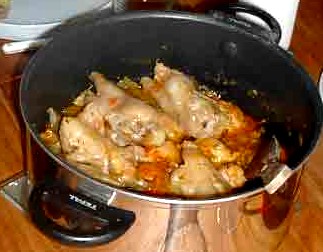 The taste was nothing out of the ordinary, much like any other sort of mutton stew, but I was intrigued by the shape of the various bits in the pot. The parcels were easy enough to cut up and eat, but the feet were bifurcated lumps, as I suppose one would expect, sheep being cloven-footed. After you’ve got the little bit of meat and some gelatinous matter off them, you are left with two small-finger-sized bones, a curious sight. I brought a pair home with me hoping to have fun by asking my friends to identify them, but sadly they got thrown away with the rest of the rubbish at the bottom of my suitcase.
Subscribe to:
Posts (Atom)