
It occurs to me that since it became possible earlier this year to consult a whole range of hugely estimable reference books online, free, I am making insufficient use of the opportunity, particularly with regard to the greatest of them, the Oxford English Dictionary. I have continued to write using, mostly, words we all know and understand; this is boring for me and shows contempt for my readers, suggesting that few among them can be bothered to look anything up.
It is time I abandoned all prorogation on this matter: I must rache and start using some grown-up words, though it would be Panglossian of me to imagine that this will achieve any kind of consuccination. Some will no doubt frample delightedly all the interesting words I may use; others, particularly the kind of young people who practise labretifery, may fear abrasure and will make no comment, remaining obmutescent, struck with jactitation and obambulating wildly. These fools deserve an inguinal kick or even a fast punch in the chel.
But then, I’m just a digamous old deipnosophist; who cares what I think?
[One of the words above doesn't exist, or if it does the OED hasn't picked it up yet.]
Thursday, 31 August 2006

Tuesday, 29 August 2006
Now Thank We All Our God
It is salutary to be reminded that the consolations and guidance of religion are available not only to us fortunate Anglicans but also to those of other persuasions.
This composite photo comes from a heart-warming piece entitled War-Torn Middle East Seeks Solace In Religion which appeared in last week's edition of a highly esteemed American journal which is said to be President Bush's favourite bedside reading.
This composite photo comes from a heart-warming piece entitled War-Torn Middle East Seeks Solace In Religion which appeared in last week's edition of a highly esteemed American journal which is said to be President Bush's favourite bedside reading.

Sunday, 27 August 2006
How he would have enjoyed this!
 It has recently been revealed that in some rural areas of China it has been common practice to hold a striptease show at funerals in order to boost the number of mourners, as large crowds are seen as a mark of honour. Sadly, local officials have ordered a halt to such “obscene performances” and arrested the leaders of five striptease troupes. A hotline has been opened for the reporting, for a reward, of “funeral misdeeds”.
Clearly the shows had always been successful in pulling in the crowds, following the principle expressed in a remark said to have been made at the hugely well-attended funeral of the Hollywood mogul Louis B Mayer*:
"It only proves what they always say—give the people what they want to see and they'll come out for it."
*(or possibly that of Harry Cohn, of whom Hedda Hopper said “You had to stand in line to hate him”.)
Friday, 25 August 2006
Just simmer down, will you?
An angry email came pouring in this morning complaining that I have failed to comply with that clause of the OMF Charter in which there is an undertaking to update the blog every two days or so.
Things have come to a pretty pass if a man can’t have a quiet couple of days offline overseas (well, over-Solent) without being subjected to a torrent of vile abuse. Pishtush to that, say I.
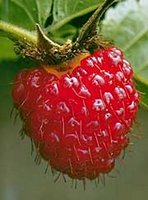
Google Images offers 163,000 pictures of raspberries. I thought this was the nicest.
Things have come to a pretty pass if a man can’t have a quiet couple of days offline overseas (well, over-Solent) without being subjected to a torrent of vile abuse. Pishtush to that, say I.
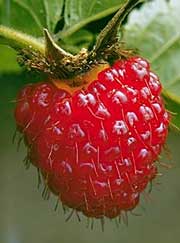
Google Images offers 163,000 pictures of raspberries. I thought this was the nicest.
Sunday, 20 August 2006
The Feminist Geological Association
It is well known that we British have established more organisations which enable like-minded people to get together than any other nation. There is no hobby, interest, occupation, speciality, creed, recreation or proclivity, however esoteric, which does not have a club, association, society or group with a membership open (often exclusively) to its followers, adherents, fans, supporters or aficionados.
There are the national bodies, of course, sometimes affiliated to world-wide federations, but below these come the smaller groups, provincial or local, which flourish everywhere; few Dorset villages are without their own Vole-Fanciers Society, no SW3 postcode does not have a 4x4 Owners Club. There must be thousands of these, some with hundreds of members and perhaps some with only a President, Treasurer and two members neither of whom want to be Secretary..
It was only recently that I realised that there are some groups which cater for more than one hobby, creed, etc. I cannot imagine why I had never, until the other day, heard of the Gay Birders Club, for it was formed in 1994 and has 300 members. I will eschew silly jokes about camping in a bird sanctuary, and whether it is the birds or the members who are gay, but it is reasonable to wonder why there is a need for such a club. Fortunately, the club’s website answers this clearly:
With such a friendly all-inclusive atmosphere, the Club attracts—and welcomes—members with all levels of birding expertise. Whether you enjoy seeing rarities, which in the UK have included GBC ticks such as Lanceolated Warbler, Grasshopper Warbler and Black-headed Bunting, or just want to get the chance to see favourites like Puffin, Golden Eagle and Kingfisher, the Club can provide you with the opportunity.
Some people wonder why there is a need for a Gay Birders Club; indeed it is not obvious until you participate in your first event. Keener birdwatchers have found it suddenly brings together two very important parts of their life. They can go birding with other people and not worry about conversation which strays into non-birding matters. Other members knew they were interested in birds, but did not want to get involved in their local bird club because they felt uncomfortable with the attitudes of straight birdwatchers. They suddenly found their interest could develop in a supportive, non-competitive environment. Events bring together not only people of mixed birding abilities but at different stages of coming out. …..All mailing is done in plain envelopes.
Having absorbed this, my mind, which has the same propensity for divagation as that of a Grasshopper Warbler, immediately leapt into speculation about what other groups catering for two or more disparate interests might exist. Is there, for example, an Insurance Brokers Philatelic Society? A Mormon Clay Pigeon Group? A LibDem Model Railway Club?
These may not actually exist, but no doubt there are others equally intriguing. Sadly, I could not think of a way to get Google to find them for me.
There might even be trebles: perhaps there is an organisation offering scorbutic Trotskyite postmen a chance to get together with others?
No, that would be silly.
There are the national bodies, of course, sometimes affiliated to world-wide federations, but below these come the smaller groups, provincial or local, which flourish everywhere; few Dorset villages are without their own Vole-Fanciers Society, no SW3 postcode does not have a 4x4 Owners Club. There must be thousands of these, some with hundreds of members and perhaps some with only a President, Treasurer and two members neither of whom want to be Secretary..
It was only recently that I realised that there are some groups which cater for more than one hobby, creed, etc. I cannot imagine why I had never, until the other day, heard of the Gay Birders Club, for it was formed in 1994 and has 300 members. I will eschew silly jokes about camping in a bird sanctuary, and whether it is the birds or the members who are gay, but it is reasonable to wonder why there is a need for such a club. Fortunately, the club’s website answers this clearly:
With such a friendly all-inclusive atmosphere, the Club attracts—and welcomes—members with all levels of birding expertise. Whether you enjoy seeing rarities, which in the UK have included GBC ticks such as Lanceolated Warbler, Grasshopper Warbler and Black-headed Bunting, or just want to get the chance to see favourites like Puffin, Golden Eagle and Kingfisher, the Club can provide you with the opportunity.
Some people wonder why there is a need for a Gay Birders Club; indeed it is not obvious until you participate in your first event. Keener birdwatchers have found it suddenly brings together two very important parts of their life. They can go birding with other people and not worry about conversation which strays into non-birding matters. Other members knew they were interested in birds, but did not want to get involved in their local bird club because they felt uncomfortable with the attitudes of straight birdwatchers. They suddenly found their interest could develop in a supportive, non-competitive environment. Events bring together not only people of mixed birding abilities but at different stages of coming out. …..All mailing is done in plain envelopes.
Having absorbed this, my mind, which has the same propensity for divagation as that of a Grasshopper Warbler, immediately leapt into speculation about what other groups catering for two or more disparate interests might exist. Is there, for example, an Insurance Brokers Philatelic Society? A Mormon Clay Pigeon Group? A LibDem Model Railway Club?
These may not actually exist, but no doubt there are others equally intriguing. Sadly, I could not think of a way to get Google to find them for me.
There might even be trebles: perhaps there is an organisation offering scorbutic Trotskyite postmen a chance to get together with others?
No, that would be silly.
Friday, 18 August 2006
A choice of viewing…
I don’t think I shall ever want to pay money to get satellite television when there is more good stuff on the terrestrial channels than anyone could possibly watch.
One evening last week, for example, there was an exhilarating prom concert on BBC2 with Ashkenazi conducting The European Youth Orchestra in Shostakovitch’s Fourth Symphony, a Mozart Violin Concerto, and something fairly unexhilarating by Alfred Schnittke.
 And if that didn’t appeal, over on Channel Four that old rascal Tony Benn, lively and shameless as ever at eighty-one, was interviewing (one at a time) the interviewers Jon Snow, John Humphreys. Nick Robinson and Jeremy Paxman. Actually he wasn’t particularly good at it and his interviewees more than held their own, but it was fascinating to watch five consummate broadcasters doing their thing.
Meanwhile on Five there was four hours of assorted moderately intelligent crime series: NCIS (twice), CSI and Law and Order.
So there was no need whatsoever to watch the programme on BBC1 that evening, where: “Abs grows increasingly jealous of Greg’s relationship with Nina, and is upset when his girlfriend organises a house party without telling him”. You would never guess from the synopsis that this is a soap about a hospital A&E Department, would you?
One evening last week, for example, there was an exhilarating prom concert on BBC2 with Ashkenazi conducting The European Youth Orchestra in Shostakovitch’s Fourth Symphony, a Mozart Violin Concerto, and something fairly unexhilarating by Alfred Schnittke.
 And if that didn’t appeal, over on Channel Four that old rascal Tony Benn, lively and shameless as ever at eighty-one, was interviewing (one at a time) the interviewers Jon Snow, John Humphreys. Nick Robinson and Jeremy Paxman. Actually he wasn’t particularly good at it and his interviewees more than held their own, but it was fascinating to watch five consummate broadcasters doing their thing.
Meanwhile on Five there was four hours of assorted moderately intelligent crime series: NCIS (twice), CSI and Law and Order.
So there was no need whatsoever to watch the programme on BBC1 that evening, where: “Abs grows increasingly jealous of Greg’s relationship with Nina, and is upset when his girlfriend organises a house party without telling him”. You would never guess from the synopsis that this is a soap about a hospital A&E Department, would you?
Wednesday, 16 August 2006
On sale at top pharmacies
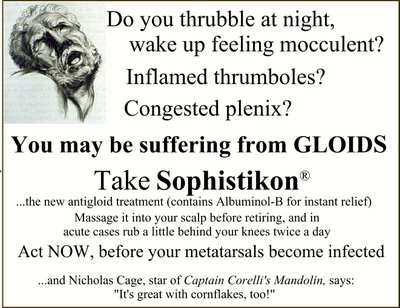
It has been suggested to me that Other Men's Flowers would be more in tune with the contemporary zeitgeist if it contained advertising. I could not, of course, accept paid advertisements as these would compromise my objectivity, and anyway no-one would want to give me money for them, but here is one which I post in a spirit of pure altruism, without hope of financial benefit. If by doing so I bring succour (or, in the case of Americans, succor) to those afflicted by this distressing malady then I shall consider myself amply rewarded.

Monday, 14 August 2006
Anything they can do…
MACHO, n, acronym. The initial letters of Massive Compact Halo Object. A relatively dark, dense object, such as a brown dwarf, a low-mass star, or a black hole. [OED]
 As an adjective, macho has nothing to do with brown dwarfs or black holes, though it may describe a dense object. It means ostentatiously or notably manly or virile; assertively masculine or tough; producing an impression of manliness or toughness. [OED again]
So why isn’t there a word for assertively feminine, hey? Perhaps it’s not needed because the female equivalent of macho man—the militant feminist—does not assert her femininity. She just maintains that there is no such thing: women could (and would) do anything—say, build bridges, play rugger, kill each other—with as much gusto (and success) as men, had they not been subjected to millennia of social conditioning, oppression and insufficient protein.
Most people believe that there are such things as feminine attributes and that they are mostly rather admirable ones, so it is impossible to imagine a word to describe someone who notably displays them which would not be complimentary, unlike macho, which is always used pejoratively. An ostentatiously masculine man is generally considered contemptible, but what word could one use to characterise a woman who is excessively gentle, sensitive, generous, kind, selfless…and doesn’t care who knows it? I suppose a real macho feminist would say wet.
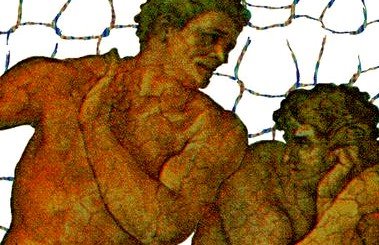 As an adjective, macho has nothing to do with brown dwarfs or black holes, though it may describe a dense object. It means ostentatiously or notably manly or virile; assertively masculine or tough; producing an impression of manliness or toughness. [OED again]
So why isn’t there a word for assertively feminine, hey? Perhaps it’s not needed because the female equivalent of macho man—the militant feminist—does not assert her femininity. She just maintains that there is no such thing: women could (and would) do anything—say, build bridges, play rugger, kill each other—with as much gusto (and success) as men, had they not been subjected to millennia of social conditioning, oppression and insufficient protein.
Most people believe that there are such things as feminine attributes and that they are mostly rather admirable ones, so it is impossible to imagine a word to describe someone who notably displays them which would not be complimentary, unlike macho, which is always used pejoratively. An ostentatiously masculine man is generally considered contemptible, but what word could one use to characterise a woman who is excessively gentle, sensitive, generous, kind, selfless…and doesn’t care who knows it? I suppose a real macho feminist would say wet.
Saturday, 12 August 2006
Feet and parcels
I knew about bouillabaisse, but until last week I had never encountered Pieds et Paquets, which is another Provençal delicacy, consisting of mutton tripe rolled and cooked with sheep's feet. Quite nice really, though not something you’d want to eat often.
 The taste was nothing out of the ordinary, much like any other sort of mutton stew, but I was intrigued by the shape of the various bits in the pot. The parcels were easy enough to cut up and eat, but the feet were bifurcated lumps, as I suppose one would expect, sheep being cloven-footed. After you’ve got the little bit of meat and some gelatinous matter off them, you are left with two small-finger-sized bones, a curious sight. I brought a pair home with me hoping to have fun by asking my friends to identify them, but sadly they got thrown away with the rest of the rubbish at the bottom of my suitcase.
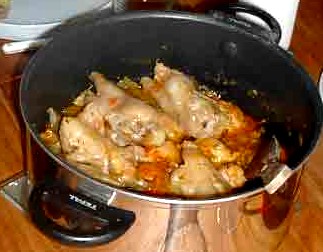 The taste was nothing out of the ordinary, much like any other sort of mutton stew, but I was intrigued by the shape of the various bits in the pot. The parcels were easy enough to cut up and eat, but the feet were bifurcated lumps, as I suppose one would expect, sheep being cloven-footed. After you’ve got the little bit of meat and some gelatinous matter off them, you are left with two small-finger-sized bones, a curious sight. I brought a pair home with me hoping to have fun by asking my friends to identify them, but sadly they got thrown away with the rest of the rubbish at the bottom of my suitcase.
Thursday, 10 August 2006
Sonata, Partita and Cicada
I wrote exactly two years ago about the pleasures of listening to music al fresco but did not mention any of the things which might detract from one’s enjoyment, like rain or wind or aircraft noise; I discovered another last week.

We went to a piano recital in the grounds of the Château Florens in La Roque d’Anthéron (not a special journey, you understand, we just happened to be hanging around down there). It was given by a 25-year-old pianist called David Fray who played some Beethoven and some Bach rather well. At least, the loud bits sounded quite good, but quieter passages were drowned by the appalling racket made by a bunch of rowdy cicadas; generally, it was like listening to a very old and scratchy recording, or being among an audience most of whom were unwrapping packets of sweets.
Either Fray was one of those pianists whose normal posture involved hunching over the keyboard with his hair almost brushing the keys, or he was trying to hear what he was playing. Anyway, he didn’t seem to be enjoying himself much and gave a rather grumpy encore.
But the weather was lovely and it was an enjoyable evening.
There are thousands of species of cicada (this one is an Apache cicada; they don't get those in Provence). The males make their noise—among the loudest of all insect-produced sounds—by vibrating their tymbals (not by rubbing bits of themselves together like grasshoppers). Apparently, Japanese Haiku poets like to write about them.

We went to a piano recital in the grounds of the Château Florens in La Roque d’Anthéron (not a special journey, you understand, we just happened to be hanging around down there). It was given by a 25-year-old pianist called David Fray who played some Beethoven and some Bach rather well. At least, the loud bits sounded quite good, but quieter passages were drowned by the appalling racket made by a bunch of rowdy cicadas; generally, it was like listening to a very old and scratchy recording, or being among an audience most of whom were unwrapping packets of sweets.
Either Fray was one of those pianists whose normal posture involved hunching over the keyboard with his hair almost brushing the keys, or he was trying to hear what he was playing. Anyway, he didn’t seem to be enjoying himself much and gave a rather grumpy encore.
But the weather was lovely and it was an enjoyable evening.
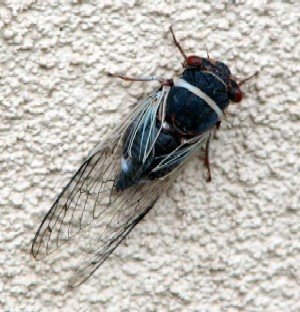
There are thousands of species of cicada (this one is an Apache cicada; they don't get those in Provence). The males make their noise—among the loudest of all insect-produced sounds—by vibrating their tymbals (not by rubbing bits of themselves together like grasshoppers). Apparently, Japanese Haiku poets like to write about them.
Saturday, 29 July 2006
Abroad is bloody
“Don’t go abroad,” George VI is alleged to have advised, “…abroad’s bloody”.]
In a piece* published in the New York Times Jan Morris notes that:
Travel, which was once either a necessity or an adventure, has become very largely a commodity, and from all sides we are persuaded into thinking that it is a social requirement too—not even just a way of having a good time, but something that every self-respecting citizen ought to undertake, like a high-fibre diet, say, or a deodorant.
Morris, the greatest living travel writer, understands that not everyone feels the urge to see the world:
Consider the advantages of purely vicarious travel—travelling, so to speak, at home. Readers sometimes thank me for my books because, having read them, they feel they need never go to the places they describe. I sympathize entirely with their point of view, even when, as occasionally happens, it is less than kindly expressed. ''You have quelled in me all desire,'' a woman wrote to me once, ''to visit the city of Venice. I hope you're satisfied".
If you stay at home, read the best travel books, and watch TV selectively, you can have nearly all the pleasures of travel without ever having to stand in line at the check-in counter. A flick of the page, and you are off that Patagonian Express and on to that Mississippi barge—pour yourself a coffee, and there is the Snow Leopard before your eyes—a martini or two, and all the sensualities of the East will be there around you, scented and salacious in your very apartment! (Almost all, anyway.)
Great minds have been fostered entirely by staying close to home. Moses never got further than the Promised Land. Da Vinci and Beethoven never left Europe. Shakespeare hardly went anywhere at all— certainly not to Elsinore or the coast of Bohemia.
Actually there is a great deal to be said, even by a professional traveller like me, against travelling at all.
Indeed, she should know. I went overseas about twice a month for thirty years, so I've done abroad, but mostly I did not go for pleasure. The nice thing about working trips is that you are not under the terrible pressure to enjoy yourself that you feel when you are on holiday: when you’re having a good time you think “and I’m being paid as well”, and when you’re not you can tell yourself “oh well, at least I’m being paid for this misery”. Nowadays, holidays abroad I can do without.
Having said all that, tomorrow we’re off to Provence for ten days.
[*It's O.K. To Stay At Home]
In a piece* published in the New York Times Jan Morris notes that:
Travel, which was once either a necessity or an adventure, has become very largely a commodity, and from all sides we are persuaded into thinking that it is a social requirement too—not even just a way of having a good time, but something that every self-respecting citizen ought to undertake, like a high-fibre diet, say, or a deodorant.
Morris, the greatest living travel writer, understands that not everyone feels the urge to see the world:
Consider the advantages of purely vicarious travel—travelling, so to speak, at home. Readers sometimes thank me for my books because, having read them, they feel they need never go to the places they describe. I sympathize entirely with their point of view, even when, as occasionally happens, it is less than kindly expressed. ''You have quelled in me all desire,'' a woman wrote to me once, ''to visit the city of Venice. I hope you're satisfied".
If you stay at home, read the best travel books, and watch TV selectively, you can have nearly all the pleasures of travel without ever having to stand in line at the check-in counter. A flick of the page, and you are off that Patagonian Express and on to that Mississippi barge—pour yourself a coffee, and there is the Snow Leopard before your eyes—a martini or two, and all the sensualities of the East will be there around you, scented and salacious in your very apartment! (Almost all, anyway.)
Great minds have been fostered entirely by staying close to home. Moses never got further than the Promised Land. Da Vinci and Beethoven never left Europe. Shakespeare hardly went anywhere at all— certainly not to Elsinore or the coast of Bohemia.
Actually there is a great deal to be said, even by a professional traveller like me, against travelling at all.
Indeed, she should know. I went overseas about twice a month for thirty years, so I've done abroad, but mostly I did not go for pleasure. The nice thing about working trips is that you are not under the terrible pressure to enjoy yourself that you feel when you are on holiday: when you’re having a good time you think “and I’m being paid as well”, and when you’re not you can tell yourself “oh well, at least I’m being paid for this misery”. Nowadays, holidays abroad I can do without.
Having said all that, tomorrow we’re off to Provence for ten days.
[*It's O.K. To Stay At Home]
Friday, 28 July 2006
Awful old grub
A recent survey of changing food tastes has shown that many classic British dishes are set to disappear from the nation’s larder. No surprise there then, and good riddance to some of those mentioned. Anyway, I’m not sure that some of them were ever “classic”: squirrel casserole? boiled haddock heads stuffed with suet? Just because some miserable peasants were obliged to eat these things when the mouldy black rot had got their turnips and they had nothing else doesn’t really make them, as some maintain, “a powerful link to a bygone culinary era", with their recipes staying in the cookbooks for ever.
But of course some simple traditional dishes really should be preserved in the modern cook’s repertoire lest future children never have the chance of appreciating them: one such is English Toast, a good and almost forgotten recipe for which I published a couple of years ago. When this appeared two elderly readers were kind enough to post comments sharing their memories of clever variations on this old favourite, and these are included here.
But of course some simple traditional dishes really should be preserved in the modern cook’s repertoire lest future children never have the chance of appreciating them: one such is English Toast, a good and almost forgotten recipe for which I published a couple of years ago. When this appeared two elderly readers were kind enough to post comments sharing their memories of clever variations on this old favourite, and these are included here.
Wednesday, 26 July 2006
Incentivise
I’ve seen this word a couple of times recently and assumed it was a recent American import; it certainly sounds like it, though of course they would spell it with a zee in that quaint way they have. Not so: the first use of it in print, as far as the OED knows, was as far back as 1968, and that was in the Guardian, of all places.
It means, as one might guess, ...to motivate or encourage (a person, esp. an employee or customer) by providing a (usually financial) incentive. Also: to make (a product, scheme, etc.) attractive by offering an incentive for purchase or participation.
So it’s a slightly specialised variant of motivate, and is a word we can well do without. I can, anyway.
It means, as one might guess, ...to motivate or encourage (a person, esp. an employee or customer) by providing a (usually financial) incentive. Also: to make (a product, scheme, etc.) attractive by offering an incentive for purchase or participation.
So it’s a slightly specialised variant of motivate, and is a word we can well do without. I can, anyway.
Monday, 24 July 2006
Sad News from Nepal
Last January I commiserated with God-King Gyanendra for the pudding basin he was obliged to wear on his head on ceremonial occasions.
The hot news from Kathmandhu is that by popular demand he is to be stripped of the major powers derived from his God-head and Kingship, and will in future be permitted to carry out only three ceremonial duties: accepting the credentials of new ambassadors, visiting a girl-goddess at the temple where he was formerly patron, and receiving a priest who flashes at him a bejewelled undergarment in a holy ceremony. None of these sound much fun except possibly the second.
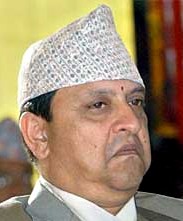 There is perhaps some compensation for the poor fellow in that he may no longer have to wear that silly plumed thing on his head. However, ordinary Nepali hats do little for one’s dignity, and he probably won’t regard its replacement as much of an improvement.
The hot news from Kathmandhu is that by popular demand he is to be stripped of the major powers derived from his God-head and Kingship, and will in future be permitted to carry out only three ceremonial duties: accepting the credentials of new ambassadors, visiting a girl-goddess at the temple where he was formerly patron, and receiving a priest who flashes at him a bejewelled undergarment in a holy ceremony. None of these sound much fun except possibly the second.
 There is perhaps some compensation for the poor fellow in that he may no longer have to wear that silly plumed thing on his head. However, ordinary Nepali hats do little for one’s dignity, and he probably won’t regard its replacement as much of an improvement.
Saturday, 22 July 2006
The Royals As I Knew Them
Two of Private Eye's regular features—OBN (Order of the Brown Nose) and Pseuds Corner—consist of egregious examples of, respectively, sycophancy and pretentiousness.
The Sunday Times, which is nowadays a kind of down-market version of Hello! but not so lively, prints in its review section today a long article of which almost every paragraph is a prime candidate for one of these features. It is written by an extremely dim royal lackey, a former equerry to the late Queen Mother.
There is much fascinating detail about the corgis, who were apparently “…rather like the Queen in the way they seemed to carry with them this touch of formality, if dogs can have such a thing. This was echoed in the Queen's demeanour. She was the Queen and she was never really off duty. Instead, she had to adhere to a clearly defined role that carried with it certain standards of behaviour and attitude” . Gripping stuff, and there is more: “…the Queen seemed to be closer to her dogs than she was to Philip”; not everyone could have found them so lovable, for “I saw them really go for some people. They would bite their ankles and things like that”.
I imagine that the writer of this drivel believes he is being frank yet respectful about the royals, and cannot see that the anecdotes he tells probably make them sound more crass, selfish and greedy than they really are; certainly he describes well the unutterable tedium of living amongst them. It seems some of them had a propensity for doing comic German accents, and they were “…sticklers for etiquette but also had this slightly wicked side”. There are many stories of them coming out with memorable remarks at moments of crisis: “…It took only about 10 seconds for the back of the Queen’s sister’s head to start blazing away….The Queen, in slight amusement, turned and said , ‘Oh look, Margo’s on fire!’ ”. I just love the delicacy of the Queen's slight amusement—I bet Philip was rolling about on the floor.
But not all was excitement and the smell of burning hair; there were heart-warming gestures: “…the Queen, if I ever turned up at one of her dinner parties [does he mean that sometimes he didn’t bother to go?], would always make a beeline for me and say: ‘Colin, how are you? It’s great to see you’ ”.
And there were other memories to treasure: on one occasion Princess Margaret made him take her swimming.
These and other delights are in a book by one Major Colin Burgess, enticingly called Behind Palace Doors. The bits I have quoted cannot give a true picture of the banality of what he writes and “The whole situation was bonkers” is typical of the juvenile way he expresses himself.
There must be a shortage of rights on the market at the moment: this is very poor stuff indeed even by the standards of Sunday Times serialisations.
The Sunday Times, which is nowadays a kind of down-market version of Hello! but not so lively, prints in its review section today a long article of which almost every paragraph is a prime candidate for one of these features. It is written by an extremely dim royal lackey, a former equerry to the late Queen Mother.
There is much fascinating detail about the corgis, who were apparently “…rather like the Queen in the way they seemed to carry with them this touch of formality, if dogs can have such a thing. This was echoed in the Queen's demeanour. She was the Queen and she was never really off duty. Instead, she had to adhere to a clearly defined role that carried with it certain standards of behaviour and attitude” . Gripping stuff, and there is more: “…the Queen seemed to be closer to her dogs than she was to Philip”; not everyone could have found them so lovable, for “I saw them really go for some people. They would bite their ankles and things like that”.
I imagine that the writer of this drivel believes he is being frank yet respectful about the royals, and cannot see that the anecdotes he tells probably make them sound more crass, selfish and greedy than they really are; certainly he describes well the unutterable tedium of living amongst them. It seems some of them had a propensity for doing comic German accents, and they were “…sticklers for etiquette but also had this slightly wicked side”. There are many stories of them coming out with memorable remarks at moments of crisis: “…It took only about 10 seconds for the back of the Queen’s sister’s head to start blazing away….The Queen, in slight amusement, turned and said , ‘Oh look, Margo’s on fire!’ ”. I just love the delicacy of the Queen's slight amusement—I bet Philip was rolling about on the floor.
But not all was excitement and the smell of burning hair; there were heart-warming gestures: “…the Queen, if I ever turned up at one of her dinner parties [does he mean that sometimes he didn’t bother to go?], would always make a beeline for me and say: ‘Colin, how are you? It’s great to see you’ ”.
And there were other memories to treasure: on one occasion Princess Margaret made him take her swimming.
These and other delights are in a book by one Major Colin Burgess, enticingly called Behind Palace Doors. The bits I have quoted cannot give a true picture of the banality of what he writes and “The whole situation was bonkers” is typical of the juvenile way he expresses himself.
There must be a shortage of rights on the market at the moment: this is very poor stuff indeed even by the standards of Sunday Times serialisations.
Thursday, 20 July 2006
Tuesday, 18 July 2006
Roast Lamb
 Writing about roast pork a few months ago, I found myself diverted to lamb: Charles Lamb, that is. Then, after reading the essay on roast pig, I was inspired to re-read some of his other essays, and was reminded not only what a marvellous writer he was, but how I have been trying for years—without much success—to mimic his style. I would have liked to have been described, as Lamb has been, in these terms*: [
…A gentle, amiable and tender-hearted misanthrope.
…His jokes would be the sharpest things in the world, but that they are blunted by his good-nature.
…His bantering way with strangers was often employed by him as a mode of trying their powers of mind.
…[His essay ‘The superannuated man’] looks charming on the surface and is beautifully written and is really perfectly horrible and disgusting.
…Lamb's combination of levity and seriousness …a challenge to the flexibility and sense of nuance in his readers
…The forgiving friendliness of his manner …and the odd combination of the colloquial and the erudite in his prose style
…His impressions against religion are unaccountably strong, and yet he is by nature pious.
Typically, in an essay called “Imperfect Sympathies”, he examines his own wide-ranging racial and religious prejudices with a frank and disarming apologia:
…I confess that I do feel the differences of mankind, national or individual, to an unhealthy excess ...In a certain sense, I hope it may be said of me that I am a lover of my species. I can feel for all indifferently, but I cannot feel towards all equally. …I can be a friend to a worthy man, who upon another account cannot be my mate or fellow. I cannot like all people alike.
…I have been trying all my life to like Scotchmen, and am obliged to desist from the experiment in despair.
…I have, in the abstract, no disrespect for Jews. They are a piece of stubborn antiquity, compared with which Stonehenge is in its nonage. They date beyond the pyramids. But I should not care to be in habits of familiar intercourse with any of that nation. I confess that I have not the nerves to enter their synagogues.
…In the Negro countenance you will often meet with strong traits of benignity. I have felt yearnings of tenderness towards some of these faces that have looked out kindly upon one in casual encounters in the streets and highways. I love what Fuller beautifully calls these "images of God cut in ebony." But I should not like to associate with them, to share my meals and my good-nights with them—because they are black.
…I love Quaker ways, and Quaker worship. I venerate the Quaker principles. It does me good for the rest of the day when I meet any of their people in my path. …But I cannot like them …"to live with them." I am all over sophisticated—with humours, fancies, craving hourly sympathy. I must have books, pictures, theatres, chit-chat, scandal, jokes, ambiguities, and a thousand whim-whams, which their simpler taste can do without. I should starve at their primitive banquet.
One can see why he was admired and loved, though not by everyone. Who could be unmoved by this confession, from an 1815 letter to Southey?
"Anything awful makes me laugh. I misbehaved once at a funeral."
*Source: Peter Swaab, ‘Lamb, Charles (1775–1834)’, Oxford Dictionary of National Biography, Oxford University Press, 2004 [http://www.oxforddnb.com/view/article/15912, accessed 16 July 2006]
Sunday, 16 July 2006
Nothing to laugh about
 Making an impression by wearing a ridiculous hat is not as easy as you might think. It’s not just a matter of putting some jokey piece of kit on your head: there are rules to be observed if you do not want to appear merely silly. There must, as I pointed out in connection with King Gyanendra’s pudding basin, be a strong element of incongruity in the hat’s design but still some mad logic about it. In other words, it must be foolish but not just for the sake of foolishness.
Also, there must be absolutely no suggestion that you are just fooling about and enjoying making a spectacle of yourself; the merest hint of amusement on your part will ruin the effect. It is essential that your expression makes it clear that you are not happy about looking a complete idiot: dignified sadness is the thing to aim at.
The Uzbek model pictured here clearly understands this, and the thing she is wearing introduces an element of mystery which makes her get-up even more appealing. What is it? What does it mean?
Friday, 14 July 2006
Men’s and women’s sana in corpore sano
An early rulebook of a sport in which I was involved professionally for some years had a preamble which contained the following charming statement: Throughout these rules, wherever the masculine gender is used it shall be held to embrace the feminine. This was later revised to read clumsily, as something like Where we say “he” we mean “he or she” and so on; obviously if one allows women to join in chaps’ games it must be made clear to them that the rules apply to them as well, otherwise they might try to take advantage.
The Guardian stylebook advises its writers that the word mankind should be avoided and humankind or humanity used instead. The 1926 Fowler’s Modern English Usage merely notes how the word should be pronounced differently to distinguish its two meanings ....with the accent on the second syllable for the ordinary sense of the human race but on the first for the special sense of the males of a family &c.
Those were innocent days. In 1968, according to the OED, the word sexism first entered the language, meaning “the assumption that one sex is superior to the other and the resultant discrimination practised against members of the supposed inferior sex, esp. by men against women; also conformity with the traditional stereotyping of social roles on the basis of sex”, and since then things have become much more complicated.
The modern Fowler (or at any rate Burchfield’s third edition, the best I can do) finds it necessary to provide numerous articles on particular instances of sexist language as well as an extensive essay on the topic in general:
….Feminists and others sympathetic to their views, from about the 1970s onwards, have attacked what they take to be male-favouring terminology of every kind and have scoured the language for suitable evidence and for gender-free substitutes. Their argument hinges on the belief that many traditional uses of the language discriminate against women or render them ‘invisible’ and for these reasons are unacceptable ….When reviewing the Handbook [of Non-Sexist Writing, 1981] the Irish writer Brigid Brophy complained about the ‘leaden literalness of mind’ [of the authors] and ‘their tin ear and insensitivity to the metaphorical content of language’ ….Other writers show in their works that they propose to ignore the shrillest of the advice of feminists ….In English Today (1985) the sociolinguistic scholar Jenny Cheshire concluded ‘There is a built-in masculine bias in English and this does have very serious implications for both the women and the men who use the language. And this bias will not disappear unless there is some measure of conscious reform in the language’
But where is the evidence that ‘conscious reform’ will be accepted by the English-speaking public? None of the significant changes to the language in the past century has come about by ‘conscious reform’. And none will in future unless the whole community singly and collectively decides, not by edict or proclamation, and not even by a vote in the House of Commons, to allow new fashions to be regarded as standard, or at any rate irreversible.
All that sounds unexceptionable, if a bit stuffy, but that was in 1998; some later writers may be more inclined to deplore the inherent sexism of the generic masculine. But most people (good non-gender-specific word, that) can probably see no real alternative.
The Guardian stylebook advises its writers that the word mankind should be avoided and humankind or humanity used instead. The 1926 Fowler’s Modern English Usage merely notes how the word should be pronounced differently to distinguish its two meanings ....with the accent on the second syllable for the ordinary sense of the human race but on the first for the special sense of the males of a family &c.
Those were innocent days. In 1968, according to the OED, the word sexism first entered the language, meaning “the assumption that one sex is superior to the other and the resultant discrimination practised against members of the supposed inferior sex, esp. by men against women; also conformity with the traditional stereotyping of social roles on the basis of sex”, and since then things have become much more complicated.
The modern Fowler (or at any rate Burchfield’s third edition, the best I can do) finds it necessary to provide numerous articles on particular instances of sexist language as well as an extensive essay on the topic in general:
….Feminists and others sympathetic to their views, from about the 1970s onwards, have attacked what they take to be male-favouring terminology of every kind and have scoured the language for suitable evidence and for gender-free substitutes. Their argument hinges on the belief that many traditional uses of the language discriminate against women or render them ‘invisible’ and for these reasons are unacceptable ….When reviewing the Handbook [of Non-Sexist Writing, 1981] the Irish writer Brigid Brophy complained about the ‘leaden literalness of mind’ [of the authors] and ‘their tin ear and insensitivity to the metaphorical content of language’ ….Other writers show in their works that they propose to ignore the shrillest of the advice of feminists ….In English Today (1985) the sociolinguistic scholar Jenny Cheshire concluded ‘There is a built-in masculine bias in English and this does have very serious implications for both the women and the men who use the language. And this bias will not disappear unless there is some measure of conscious reform in the language’
But where is the evidence that ‘conscious reform’ will be accepted by the English-speaking public? None of the significant changes to the language in the past century has come about by ‘conscious reform’. And none will in future unless the whole community singly and collectively decides, not by edict or proclamation, and not even by a vote in the House of Commons, to allow new fashions to be regarded as standard, or at any rate irreversible.
All that sounds unexceptionable, if a bit stuffy, but that was in 1998; some later writers may be more inclined to deplore the inherent sexism of the generic masculine. But most people (good non-gender-specific word, that) can probably see no real alternative.
Wednesday, 12 July 2006
A blank, my lord.
I can't imagine how civilisation first flourished in the Middle East, or China, or anywhere really hot, because there is nothing like brilliant sunshine for addling the brain and crippling the creative instinct.
So it is with me on this summer day. I shall not let concealment, like a worm i’ the bud, feed on my damask cheek, but confess straight away that this morning I can think of nothing to write and cannot even be bothered to search for something good which someone else has written and which I can copy.
I hope regular readers of OMF will not be gumple-foisted with me.
So it is with me on this summer day. I shall not let concealment, like a worm i’ the bud, feed on my damask cheek, but confess straight away that this morning I can think of nothing to write and cannot even be bothered to search for something good which someone else has written and which I can copy.
I hope regular readers of OMF will not be gumple-foisted with me.
Subscribe to:
Comments (Atom)