 Writing about roast pork a few months ago, I found myself diverted to lamb: Charles Lamb, that is. Then, after reading the essay on roast pig, I was inspired to re-read some of his other essays, and was reminded not only what a marvellous writer he was, but how I have been trying for years—without much success—to mimic his style. I would have liked to have been described, as Lamb has been, in these terms*: [
…A gentle, amiable and tender-hearted misanthrope.
…His jokes would be the sharpest things in the world, but that they are blunted by his good-nature.
…His bantering way with strangers was often employed by him as a mode of trying their powers of mind.
…[His essay ‘The superannuated man’] looks charming on the surface and is beautifully written and is really perfectly horrible and disgusting.
…Lamb's combination of levity and seriousness …a challenge to the flexibility and sense of nuance in his readers
…The forgiving friendliness of his manner …and the odd combination of the colloquial and the erudite in his prose style
…His impressions against religion are unaccountably strong, and yet he is by nature pious.
Typically, in an essay called “Imperfect Sympathies”, he examines his own wide-ranging racial and religious prejudices with a frank and disarming apologia:
…I confess that I do feel the differences of mankind, national or individual, to an unhealthy excess ...In a certain sense, I hope it may be said of me that I am a lover of my species. I can feel for all indifferently, but I cannot feel towards all equally. …I can be a friend to a worthy man, who upon another account cannot be my mate or fellow. I cannot like all people alike.
…I have been trying all my life to like Scotchmen, and am obliged to desist from the experiment in despair.
…I have, in the abstract, no disrespect for Jews. They are a piece of stubborn antiquity, compared with which Stonehenge is in its nonage. They date beyond the pyramids. But I should not care to be in habits of familiar intercourse with any of that nation. I confess that I have not the nerves to enter their synagogues.
…In the Negro countenance you will often meet with strong traits of benignity. I have felt yearnings of tenderness towards some of these faces that have looked out kindly upon one in casual encounters in the streets and highways. I love what Fuller beautifully calls these "images of God cut in ebony." But I should not like to associate with them, to share my meals and my good-nights with them—because they are black.
…I love Quaker ways, and Quaker worship. I venerate the Quaker principles. It does me good for the rest of the day when I meet any of their people in my path. …But I cannot like them …"to live with them." I am all over sophisticated—with humours, fancies, craving hourly sympathy. I must have books, pictures, theatres, chit-chat, scandal, jokes, ambiguities, and a thousand whim-whams, which their simpler taste can do without. I should starve at their primitive banquet.
One can see why he was admired and loved, though not by everyone. Who could be unmoved by this confession, from an 1815 letter to Southey?
"Anything awful makes me laugh. I misbehaved once at a funeral." *Source: Peter Swaab, ‘Lamb, Charles (1775–1834)’, Oxford Dictionary of National Biography, Oxford University Press, 2004 [http://www.oxforddnb.com/view/article/15912, accessed 16 July 2006]
 Making an impression by wearing a ridiculous hat is not as easy as you might think. It’s not just a matter of putting some jokey piece of kit on your head: there are rules to be observed if you do not want to appear merely silly. There must, as I pointed out in connection with King Gyanendra’s pudding basin, be a strong element of incongruity in the hat’s design but still some mad logic about it. In other words, it must be foolish but not just for the sake of foolishness.
Also, there must be absolutely no suggestion that you are just fooling about and enjoying making a spectacle of yourself; the merest hint of amusement on your part will ruin the effect. It is essential that your expression makes it clear that you are not happy about looking a complete idiot: dignified sadness is the thing to aim at.
The Uzbek model pictured here clearly understands this, and the thing she is wearing introduces an element of mystery which makes her get-up even more appealing. What is it? What does it mean?
An early rulebook of a sport in which I was involved professionally for some years had a preamble which contained the following charming statement: Throughout these rules, wherever the masculine gender is used it shall be held to embrace the feminine. This was later revised to read clumsily, as something like Where we say “he” we mean “he or she” and so on; obviously if one allows women to join in chaps’ games it must be made clear to them that the rules apply to them as well, otherwise they might try to take advantage.
The Guardian stylebook advises its writers that the word mankind should be avoided and humankind or humanity used instead. The 1926 Fowler’s Modern English Usage merely notes how the word should be pronounced differently to distinguish its two meanings ....with the accent on the second syllable for the ordinary sense of the human race but on the first for the special sense of the males of a family &c.
Those were innocent days. In 1968, according to the OED, the word sexism first entered the language, meaning “the assumption that one sex is superior to the other and the resultant discrimination practised against members of the supposed inferior sex, esp. by men against women; also conformity with the traditional stereotyping of social roles on the basis of sex”, and since then things have become much more complicated.
The modern Fowler (or at any rate Burchfield’s third edition, the best I can do) finds it necessary to provide numerous articles on particular instances of sexist language as well as an extensive essay on the topic in general:
….Feminists and others sympathetic to their views, from about the 1970s onwards, have attacked what they take to be male-favouring terminology of every kind and have scoured the language for suitable evidence and for gender-free substitutes. Their argument hinges on the belief that many traditional uses of the language discriminate against women or render them ‘invisible’ and for these reasons are unacceptable ….When reviewing the Handbook [of Non-Sexist Writing, 1981] the Irish writer Brigid Brophy complained about the ‘leaden literalness of mind’ [of the authors] and ‘their tin ear and insensitivity to the metaphorical content of language’ ….Other writers show in their works that they propose to ignore the shrillest of the advice of feminists ….In English Today (1985) the sociolinguistic scholar Jenny Cheshire concluded ‘There is a built-in masculine bias in English and this does have very serious implications for both the women and the men who use the language. And this bias will not disappear unless there is some measure of conscious reform in the language’
But where is the evidence that ‘conscious reform’ will be accepted by the English-speaking public? None of the significant changes to the language in the past century has come about by ‘conscious reform’. And none will in future unless the whole community singly and collectively decides, not by edict or proclamation, and not even by a vote in the House of Commons, to allow new fashions to be regarded as standard, or at any rate irreversible.
All that sounds unexceptionable, if a bit stuffy, but that was in 1998; some later writers may be more inclined to deplore the inherent sexism of the generic masculine. But most people (good non-gender-specific word, that) can probably see no real alternative.
I can't imagine how civilisation first flourished in the Middle East, or China, or anywhere really hot, because there is nothing like brilliant sunshine for addling the brain and crippling the creative instinct.
So it is with me on this summer day. I shall not let concealment, like a worm i’ the bud, feed on my damask cheek, but confess straight away that this morning I can think of nothing to write and cannot even be bothered to search for something good which someone else has written and which I can copy.
I hope regular readers of OMF will not be gumple-foisted with me.
John Julius Norwich, in one of his collections of short literary items sent out to his friends at Christmas, includes this, from the American magazine Field and Stream, November 1959:
Although written many years ago, Lady Chatterley’s Lover has just been re-issued by Grove Press, and this fictional account of the day-by-day life of an English game-keeper is still of considerable interest to outdoor-minded readers, as it contains many passages on pheasant-raising, the apprehending of poachers, ways to control vermin, and other chores and duties of the professional game-keeper.
Unfortunately, one is obliged to wade through many pages of extraneous matter in order to discover and savour these sidelights on the management of a Midland shooting estate, and in this reviewer’s opinion the book cannot take the place of J. R. Miller’s Practical Gamekeeper.
Smoking guns were first talked about in the middle of the last century, there was a famous tape so described in 1974, and Iraq was said to have been full of them a few years ago.
Just lately John Prescott’s activities have brought out a fresh crop. Yesterday smoking guns were mentioned on TV four times, by three different commentators. All these idiots used the phrase as if it meant the impending threat of a discreditable revelation, thus turning a merely boring cliché into a totally meaningless one. Clearly their minds were in neutral when they spoke; a moment’s thought would have made them realise that a smoking gun has just been fired and so has already carried out its threat.
Actually the phrase means, obviously, a piece of incontrovertible incriminating evidence.
 Over the past five years many large organisations have moved their call centres abroad; apparently this can bring savings of up to 50% in operating costs.
Some, discovering that their customers don’t much like finding that they are speaking to someone in another country, are closing their Indian call centres (Powergen is one). Whether this will help them is doubtful, for their customers’ dissatisfaction with the quality of the service might still apply: companies running poorly performing call centres abroad will run the same in the UK, and vice versa.
From time to time I raise a telephone query with a financial services organisation and it is answered efficiently from the other side of the world by a lovely voice with perfect diction; today it was Ruchita who spoke to me, and if ever there were an excuse for using the word dulcet, her tone provides it. I cannot be the only caller who finds it soothing at any time of the day (or night) to listen to her or someone like her gliding gently through a prescribed script before getting down to the more intimate personal matters regarding my account.
So I would not be at all pleased if this company brought its call centre operation back to England or, worse, transferred it to some other distant country such as Scotland or Ireland where the natives' way with our common language is less pleasing. My only sadness is that although Ruchita and her colleagues all sound as if they are beautiful, which some of them probably are, and as if they have first class honours degrees, which some of them probably do, they are likely to be earning a—by our standards—derisory wage.
I once rebuked a friend for misquoting the line about the mills of God, but was chastened to find on looking it up that I had quite the wrong idea about the source: Blake, I had vaguely thought, or 1st Corinthians, or something of that kind. Not at all: the line is from a translation of the Sinngedichte of Friedrich von Logau ("Gottesmuhlen mahlen langsam....").
How about that? And how many people know the menacing second line?
Though the mills of God grind slowly, yet they grind exceeding small;
With patience He stands waiting, with exactness grinds He all.
....and if you say it out loud, tum-ti tum-ti tum-ti tum-ti, you can tell that the translator was Longfellow, as in:
And the gentle Mudjekeewis/Raven head submissive bowed/Takes her hankie very slowly/Blows her nose exceeding loud.
One of the marvellous things about our language is the rightness of our words. Quite often they look or sound like the thing they represent: splodge or splotch, for example, explains itself; French has the feeble grosse tache.
The sound ock (or, in Scotland, och) is unpleasant, so many of the words that end with it have connotations which are either distasteful or, at best, uninteresting. The OED has 2,075 words ending in ock or och; here are a few of the two-syllable ones:
cheslock, a woodlouse; burdock, a coarse, weedy plant; castock, the stem of a cabbage; buttock, a rounded fleshy protuberance of the rump; luddock, another buttock; fussock, a fat, unwieldy woman; hemlock, a poison; pibroch, the sound of the bagpipes, cadlock, wild rape; carlock, which is made from the bladder of a sturgeon; fitchock, a term of contempt; dunnock, a rather dull bird; kittock, a woman of loose character; daddock, rotten or decayed wood; mullock, rubbish; brattock, a tiny brat; lobcock, a blundering fool; ale-pock, an ulcer caused by drinking; gralloch, the offal of a deer or, as a verb, to disembowel……
Nothing among those to give much pleasure to anyone. And, of course, there’s not a lot of joy to be had from pillocks or bollocks, is there?
Perhaps after all this nastiness I should end on a jollier note by mentioning bummock, which according to the OED is “a large brewing of ale for a merry meeting”. Cheers!
[No suggestions for additions to the list or exceptions, please. It was a happy hour with the OED but I’m bored with this topic now.]
I know it’s lazy to publish a post containing a link to an item in a newspaper without any comment. However, I was much taken with a report about the development, by one Pambuk Samboon of the Tokyo Institute of Technology, of a device that can record a smell and play it back to you, but I have absolutely nothing to say about it.
I can’t even be bothered to name the source, since I have cited it or linked to it some 35 times in the last three years.
“Her English is too good,” he said, “that clearly indicates that she is foreign
For whereas other girls are taught their native language, Englishwomen aren(‘t)….”
Thus did Zoltan Karpathy imagine, wrongly, that he had discovered Eliza Doolittle’s secret. In the period in which My Fair Lady is set, girls—other than upper class ones—weren’t taught anything much about our language. Nowadays they are taught just as much as boys, and may master it rather better. But it remains true that non-native-English-speakers who have had to learn the language sometimes seem to acquire a command of grammar and syntax (if not pronunciation) which puts to shame those who were fortunate enough to have merely absorbed it with their mothers’ milk.
[“…And although she may have studied with an expert dialectician and grammarian,
I.….can…..tell…..that.….she.....was.….born.….HUNGARIAN!”]
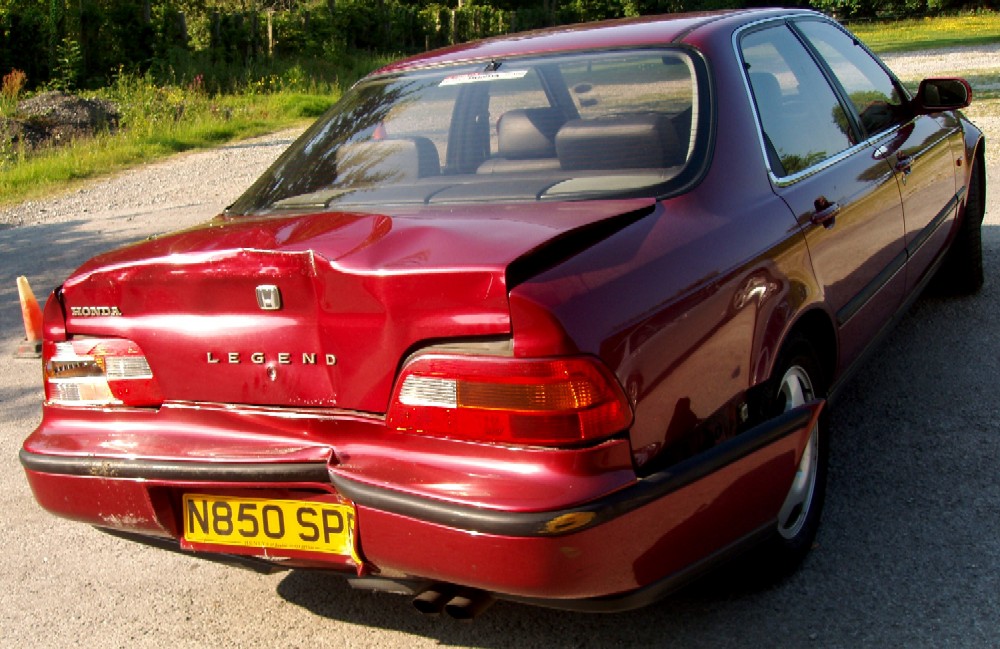
 It wasn’t my fault, no-one was hurt, and absolutely everyone involved, especially me, acted with commendable calm and forbearance. Even the owner of the four-ton gatepost which had come off worse than my car shook me by the hand and expressed the desire to meet me again one day under happier circumstances. It was pleasant to find that civilised behaviour has not become quite as obsolete as one sometimes fears.
No great harm was done, but a brief holiday in Devon had to become even briefer and now I must buy another car. Coming closely after sport, fashion, antiques and the price of houses, motor cars—my own or anyone else’s—rank high among the subjects I never want to spend any time talking about, but for once here goes.
The car was an early model of a range which never captured the market it was aimed at: the sort of people who buy that sort of car saw that driving one of these would do irreparable harm to their image, suggesting that they were employed by a cheapskate company and lacked the clout to demand a Mercedes, Jaguar or BMW. So the value of the few that were sold dropped quickly and dramatically, and used ones are rare and very cheap.
This was one reason why I acquired this car seven years ago; the other reason was that it was clearly a perfect match for its driver, being large, solid, comfortable, unsporting, unfashionable, unprestigious, unexciting, giving little trouble and with enormous consumption. Anyway, I am looking for another one just the same.
God , wasn’t that post boring? I promise that Other Men's Flowers will never again feature this topic.
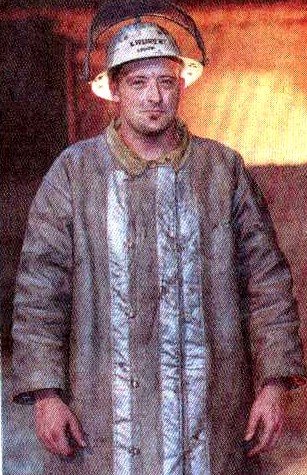
Football has been driven from everyone’s mind by an announcement from Luxembourg stating that the board of the pan-European steel group Arcelor will decide on Sunday whether to recommend acceptance of a takeover bid from Mittal Steel. Earlier in the week the Guardian had racked up the widespread excitement over this extraordinary development by illustrating their report with this picture.
 Selecting it must have been difficult; clearly the Pictures Editor was keen to avoid the one usually used to enliven such news items, which shows a great bucket thing pouring out molten steel amid showers of sparks, and chose instead a low-key approach intended to intrigue readers, who will be asking themselves:
Who is this man? What's his game? Why is he wearing a fireproof smock and a hat clearly made from thin card? Is that a gleam of wry amusement in his eye or is he just fed up after a long day in the slag vats?
These questions will provoke heated argument in the pubs and clubs over this weekend while the huge plasma screens flicker unwatched.
I normally take the feeds from around twenty websites or blogs, though I look at the updates only occasionally, in idle moments.
I was depressed today when I logged on to my reader to find that no less than nine of them, all of which I had previously believed were being written by people with whom I had something in common, and which I had found to contain generally interesting or amusing matter, featured comments about the World Cup, as if the writers felt that they needed to add to the millions of words on the subject which are currently sloshing around the media. And, what’s more, some of them are women, a species I generally admire for their immunity to male obsessions.
Of course, male and female lads alike have every right to go into print with their thoughts on football, if that is what turns them on. Farewell, and every good wish for the future to those nine; time to thin out my feed subscriptions.
 We live near the centre of a town far from the noise of tractors and the stench of broiler chicken houses; our road is quiet and we have many wild residents and visitors: badgers, foxes, squirrels and so on. We see the last two often, swanning around as if they own the place (the vixen above is particularly bold), but have never actually seen the badgers, having failed so far to carry out our plan to sit out in the dark, silent and downwind of the sett, in the hope of seeing them gambol or mate or whatever it is badgers get up to at night. When we first realised they were there we asked the local badger society about them and the man got hold of the wrong end of the stick, thinking that we wanted to know how to kill them, but when we explained that they were welcome he told us about leaving out trays of peanuts and so on. We never got round to this either, but they seem to be thriving.
And then there are the birds: assorted finches, blue tits, sparrows, dunnocks, starlings, blackbirds, wrens, robins, magpies and unidentified others. I don’t find them a big thrill myself but my wife acquired some binoculars so that she can watch them lashing into the copious banquets she provides while chirruping about in a neurotic sort of way (the birds, I mean). They can't be very bright, because our fat and lazy cat has already presented us with the corpses of two of them.
But the incontinent seagulls (properly, herring gulls) are another matter; I wish we could poison the filthy beasts, like Tom Lehrers’s pigeons:
We’ll murder them all amid laughter and merriment,
Except for a few we take home to experiment…
The other day an internet friend in Wisconsin kindly sent me a copy of a book with this title. It is a fascinating and exhaustive treatise about the origin of the names used for things we eat, thus combining two of my main interests: words and food.
The author, Martha Barnette, is a journalist but also clearly a serious etymologist, and the derivations she lists have been carefully researched, but this does not inhibit her from including a bit of folk etymology when it’s amusing and at least possible, if not proven. She gives caveats for these: for example, she says “many etymologists believe” that pumpernickel comes from the German for devil’s fart; well, maybe, but the OED makes no mention of this and gives the origin as uncertain, while noting that before 1663 the word referred to a lout or booby. And lampoon, “many etymologists believe”, comes from lampons!, meaning let’s drink, a common exhortation in boozy French songs, while the OED says rather sniffily that French etymologists believe this, but prefers to derive it from lamponner, to ridicule, which indeed seems more likely.
But there's no doubt about carpaccio, a dish in which the main ingredient is served, usually raw, in extremely thin slices: the OED confirms that it comes from "...Vittore Carpaccio (c1460-1525), Venetian painter, who used a distinctive red colour similar to that of raw beef. The dish is said to have been created by Giuseppe Cipriani of Harry's Bar in Venice in 1961, inspired by an exhibition of Carpaccio's work at the Doge's Palace".
The OED gives as alternative spellings: hullo, hallo, halloo, halloa and others (some used only as verbs) and a rather perfunctory etymology mentioning only the Old French haloer.
Most variants are pronounced more or less the same, but effete and pretentious English people have developed a different way of greeting their effete and pretentious friends: Hellair!
No, nothing to do with hormones; as Damon Runyon would say, that is not such a topic as I am wishing to give the large hallo to.
It is evidence of the prevalence of the High Rising Terminal that this is the first of the ten meanings of these three letters listed by Wikipedia. Hampton Roads Transit, Hrvatska Radiotelevizija and the others need not detain us because it is the High Rising Terminal that is by far the most interesting of the ten, unless you are postmenopausal, transgendered, an inhabitant of Virginia, or deeply involved in Croatian broadcasting.
I didn’t know, until I read a review of Anne Karpf’s new book The Human Voice, that this HRT is the technical name for a rising intonation at the end of a sentence—“upspeak”, or “uptalk”.
Apparently it is uncertain where it originated or is most commonly used: Sydney? Southern California? Bristol? Northern Ireland?—but it was noted as early as World War II in Australia, New Zealand and England. And the sort of people who use it most?—teenagers, women, fans of Australian soaps… oh, and people in rural North Dakota and Minnesota who have come under the influence of the Norwegian language (how's that again?).
And various functions for it have been suggested: it may encourage the addressee to participate in the conversation, or it may exhibit the speaker’s insecurities about the statement; but recently it has been shown that assertive speakers (peer group leaders) are more likely to use HRT than junior members of the group since it indicates that the speaker is not finished yet, and thus perhaps discourages interruption. Which of these accounts for George W Bush’s extensive use of it is uncertain.
This speech habit is unattractive and misleading. Now that is a clear and resolute declaration: apply HRT to the last word and it becomes a feeble query, inviting the response: "No it isn't".
 O Sole Mio is a nice old song if you like that sort of thing, and it is a great pity that a generation has grown up all over the world which associates it not with ardent Neapolitans but with a sweet fatty gunk called Cornetto.
  This irritated me enough to make me complain about it twenty years ago, with possibly some small result, and again last month, with none.
The other day I wrote to the Advertising Standards Authority suggesting that a phrase in the recently re-cycled jingle was misleading. Their reply assured me that “the ASA is extremely careful to monitor any broadcast advertising that may be misleading”.
However, they also explained that a manufacturer who misleads the public is not breaching their code: for the ASA to act there must be “serious viewer detriment” and lots of complaints about it. They went on: “…we could not justify any further [further?] intervention but we will continue to monitor any future audience response… sorry if you are disappointed… thank you for raising this matter…”
I replied:
Thank you for your reply of 25th May.
When Walls first started to use a version of this commercial, some twenty years ago, the jingle went “….Delicious ice cream from Italy.” I had some correspondence about this at the time but I do not know whether or not it that was that which caused Walls to change it to “…of Italy”.
I do not think this is much less misleading than their first try. I mentioned in my letter to you the possibility that, in response to your query, Walls might say that it just means “Italian style”, only in order to pre-empt any attempt on their part to justify their words in this way, not to suggest that if that was what they mean then their claim is honest.
I guess that few consumers, or even the manufacturers, have any idea what “Italian style” means. The authoritative website Made in Italy Online says
“What is the art of Italian-style ice cream and what are the ingredients? …it can have either a fruit or a custard base…For ice cream with a custard base, it is the custard that is common to all the varieties, and the different flavors are added to it: chocolate, vanilla, hazelnut, etc. To make the custard only fresh eggs and fresh skimmed milk should be used…”.
If Walls were to claim that “of Italy” means “Italian-style” then, when the product is manufactured outside Italy with ingredients very different from what is described above, the claim is clearly false, and the words of the jingle are clearly misleading, though suggestio falsi rather than a downright lie. However, I note that you appear to believe that this is of no concern to the ASA unless there is “serious viewer detriment”. This is disappointing.
I note that you do not intend to raise the matter with the manufacturers, though you will “monitor any future audience response”. I can well appreciate that you are not keen to tangle with Unilever, the multinational which owns Walls, and you are unlikely to receive any substantial volume of complaints because very few people realise what Walls are claiming, so I must accept that as far as the ASA is concerned the matter is closed. So it must be for me, though I shall be publishing our correspondence on the internet and elsewhere. Yours, etc.
So that's that.
 I had always assumed that the chant often used as a prelude or accompaniment to mindless violence was derived from this lovely old hymn, but apparently not.
Anyway, ‘ere we go: the World Cup has started. My wife has announced her intention of following it all closely, so it is fortunate that we have more than one TV set.
I am pleased to see that Gary Younge in the Guardian will be giving advice on Who to Cheer for When the Football Doesn’t Matter. This to me means all the time, so I shall read the articles carefully. I mean, I don’t want to have nothing to say when people engage me in conversation on the current topic to which I am totally indifferent; almost nobody I know wants to talk about anything else and it would be frustrating to have to remain mumchance for the next few weeks. But if I can comment from time to time on where my sympathies lie at least I can appear to be taking an interest.
Take yesterday’s Germany v Costa Rica, for example. Costa Rica is “a tiny strip of Central America that has no army, universal health care and a recently-elected centre-left government led by a president who refused to let the US use his country as a base for the Contras in 1980”. Sounds good to me, so they had my support and I was sorry to hear later that they lost.
Today things were more complicated. I know England is a greater nation (or part of a nation) than Paraguay—the most corrupt and impoverished country in South America—and I don’t need a bunch of millionaire louts to prove it to me by kicking a ball about, so I shan’t much mind who wins.

 Writing about roast pork a few months ago, I found myself diverted to lamb: Charles Lamb, that is. Then, after reading the essay on roast pig, I was inspired to re-read some of his other essays, and was reminded not only what a marvellous writer he was, but how I have been trying for years—without much success—to mimic his style. I would have liked to have been described, as Lamb has been, in these terms*: [