


More than once while waiting at an airport I have agreed to give five minutes of my time to some nice girl who approaches me with a clipboard, even though I know her questions will be extremely boring ones about where I’m going and why and how often I do it (travel by air, that is). I’m an inveterate early inchecker so often have some time to kill after doing everything it is possible to do in a departure lounge.
I give a polite refusal to other requests for polling interviews – in the street or on the phone – because in those situations there is always something better to do than trying to formulate opinions on matters to which I am totally indifferent.
However, although I resent being asked to spend my time in this way without being offered so much as a little sticker for my lapel, I am always willing to turn an honest – or for that matter a dishonest – penny, and for some months now I have been submitting myself to regular internet polls in return for a small honorarium. For one thing, each one takes only a few minutes, and I can choose times to do them when I am waiting for something else – for the kettle to boil, or while I listen to some unpleasant music-on-hold. And 50p a go is not to be sneezed at, although I won’t get a cheque until I am due £50, which will be in mid-2006.
A huge range of subjects is covered, sometimes more than one in a single poll; some are matters of vital importance to the country or the world and others are unutterably trivial. Oddly, the former kind are easier than the latter: when asked my opinion of Tony Blair’s premiership on a scale of 1 (Outstandingly brilliant) to 10 (Disastrous), my mouse hand moves like lightning. Some of the political themes, though, are more difficult: given a list of policies and asked to arrange them in the order in which you think they are prioritised by the Liberal Democrats calls for a great deal of deep thought.
The dreariest polls are those, presumably being carried out on behalf of retailers or manufacturers, which ask you to state your preferences in, or attitudes to, a great number of products with most of which you are unfamiliar. Happily, there is always an option which covers several answers you might want to give, such as “Absolutely no view”, “Don’t understand what you mean”, “Never heard of it”, “Can’t be bothered to answer this one” and, particularly, “Oh, for goodness’ sake!”. They allow you to say simply “Don’t know”.
Saturday, 23 July 2005

Wednesday, 20 July 2005
Kasant’s 30p each
Writing a post the other day, I wanted to avoid the cliché credit where credit’s due and thought of fair dos instead. But this looked odd – I was tempted to put in an apostrophe or even an e – so I looked it up. The OED told me that it does indeed mean fair treatment and that the first recorded use was in 1859.
Fine. But what’s this? In the quotations it appears variously as [fair] doos, dew, do’s, dos and do, but in the heading to the entry it appears as fair do’s. Why did they select the spelling with the greengrocer's (or florist's) apostrophe?
Fine. But what’s this? In the quotations it appears variously as [fair] doos, dew, do’s, dos and do, but in the heading to the entry it appears as fair do’s. Why did they select the spelling with the greengrocer's (or florist's) apostrophe?
Monday, 18 July 2005
For once, a helpful response
Anyone who has used one of these computer things is aware that suppliers of software, not mentioning any names, are generally arrogant, incompetent, avaricious, and contemptuous of their customers; to excoriate* them publicly is always a pleasure as well as a duty. Encountering a modicum of courtesy and efficiency in dealings with one of them is therefore an experience worth recording:
A program which I had been using happily for eighteen months suddenly stopped working, possibly due to the excessive zeal of Data Execution Prevention or some other arcane Windows function. Since I am advanced in years I knew I did not have enough time left to get some help from Microsoft**, so without much hope I emailed the manufacturers of the program.
Within twenty-four hours the problem had been solved by three exchanges of emails, the final one from them being a thankyou to me for thanking them.
So take a bow the manufacturers of Pivot Pro®. (I would have said fair do’s for them, but I have realised that this phrase raises a question which I must take up with the publishers of the Oxford English Dictionary, and I shall report on this in a later post.)
[*The sole purpose of this uninteresting post, of course, was to enable me to fulfil a long-standing ambition to use the word excoriate.]
[**Note: The name Microsoft and lots and lots of other words (though not excoriate) belong entirely to the Microsoft Corporation and are registered, copyrighted, etc., in the US and lots of other places. Misusers will be prosecuted with the utmost rigour of the law and may God have mercy on your soul. This note is ©Microsoft Corporation®.]
A program which I had been using happily for eighteen months suddenly stopped working, possibly due to the excessive zeal of Data Execution Prevention or some other arcane Windows function. Since I am advanced in years I knew I did not have enough time left to get some help from Microsoft**, so without much hope I emailed the manufacturers of the program.
Within twenty-four hours the problem had been solved by three exchanges of emails, the final one from them being a thankyou to me for thanking them.
So take a bow the manufacturers of Pivot Pro®. (I would have said fair do’s for them, but I have realised that this phrase raises a question which I must take up with the publishers of the Oxford English Dictionary, and I shall report on this in a later post.)
[*The sole purpose of this uninteresting post, of course, was to enable me to fulfil a long-standing ambition to use the word excoriate.]
[**Note: The name Microsoft and lots and lots of other words (though not excoriate) belong entirely to the Microsoft Corporation and are registered, copyrighted, etc., in the US and lots of other places. Misusers will be prosecuted with the utmost rigour of the law and may God have mercy on your soul. This note is ©Microsoft Corporation®.]
Friday, 15 July 2005
London, 14th July 2005
My son lives and works in Central London. I had this from him this morning:
TWO MINUTES' SILENCE
I thought some of you with connections here might be interested in what it was like today in London. I'm not a HUGE fan of group letters or necessarily of mass public outpourings of anything. However, my email won't send to more than 25 people at a time so at least you know you're in the top 25 of People I Know Who Might Be Interested.
Orchestrated public displays of grief can so easily be empty but I was affected by today's in a way I wasn't expecting and in fact wasn't connected with grief and that's what I wanted to write down before the feeling was forgotten. When I was growing up I remember having it explained that one of the great intractables about terrorism was that it could not be ignored but the greater the response, the greater the fuel for the perpetrator. It was with the second half of that in mind that I viewed today's occasion with ill-ease - what greater response could there be than one in which EVERYONE participated and so what further fuel would that mean? It was what actually happened that made me feel differently.
Picture the scene. A small street in Soho in central London. Restaurants, cafés, bars, hairdressers, a post office, a FEDEX office, a pub, small apartments and LOTS of offices all squeezed together on top of each other. A place which hums all day every day and where the working hours are late for everyone and a lunch break is still not very fashionable. Also a place where racial and religious harmony doesn't even need to be discussed because everyone is in the minority. You can walk twenty paces and hear as many languages. And all morning it was just like that. Life entirely as normal. Delivery drivers and traffic wardens yelling at each other, road works, a different mobile phone ring tone for every hour of the day. At 11.45 it seemed that everyone doing anything in the street started to move outside. Then at five to midday it was as though some sound operator in the sky began slowly fading the levels until just on midday the quiet arrived and we could hear (only just) two miles away the bells of Westminster ring. A van stopped. Another van came swinging round, the driver realising and coasting to a halt just before the bells chimed the hour. And looking around there were suddenly what must have been a thousand people in this small insignificant street just standing. Just being.
There may have been some tears but I didn't see or hear any. There may have been some anger, but I didn't sense any. For me what it made it so powerful and is why I am writing it down before I forget is the absence of emotion. In this I found an answer to the question of how to respond without responding. We did nothing. 1,000 blank faces saying "Whatever you do to us means nothing". Nothing whatsoever. I can imagine those who threaten us hearing the rhetoric of political leaders and being stoked in their feelings. But I cannot imagine anyone seeing such a mass outpouring of dispassionate unimpressedness feeling the same effect.
Perhaps you will have seen today's footage of the Queen - the gold standard in British blankness. On this one day it so happens I think her famously vacant visage really did both lead and reflect the nation's position.
Someone knew when the two minutes had passed and there was a small round of applause and then we melted slowly away. And the day continued exactly as usual. I cannot think of a better message. You may hit us as hard as your powers allow and still the "best" you will ever get will be limited to two minutes of utter nothingness.
This in no way of course negates the anguish of those more directly caught up. And I am not going trot out some rhetoric about a greater sense of community or how we are changed forever. Today I felt overwhelmingly that as a city we are not changed one little bit. When the media tell you that London is changed forever, question that. Because I think today was actually all they'll ever get from us. We're not blasé. We just won't play by their rules. We need only two minutes to make that perfectly clear.
TWO MINUTES' SILENCE
I thought some of you with connections here might be interested in what it was like today in London. I'm not a HUGE fan of group letters or necessarily of mass public outpourings of anything. However, my email won't send to more than 25 people at a time so at least you know you're in the top 25 of People I Know Who Might Be Interested.
Orchestrated public displays of grief can so easily be empty but I was affected by today's in a way I wasn't expecting and in fact wasn't connected with grief and that's what I wanted to write down before the feeling was forgotten. When I was growing up I remember having it explained that one of the great intractables about terrorism was that it could not be ignored but the greater the response, the greater the fuel for the perpetrator. It was with the second half of that in mind that I viewed today's occasion with ill-ease - what greater response could there be than one in which EVERYONE participated and so what further fuel would that mean? It was what actually happened that made me feel differently.
Picture the scene. A small street in Soho in central London. Restaurants, cafés, bars, hairdressers, a post office, a FEDEX office, a pub, small apartments and LOTS of offices all squeezed together on top of each other. A place which hums all day every day and where the working hours are late for everyone and a lunch break is still not very fashionable. Also a place where racial and religious harmony doesn't even need to be discussed because everyone is in the minority. You can walk twenty paces and hear as many languages. And all morning it was just like that. Life entirely as normal. Delivery drivers and traffic wardens yelling at each other, road works, a different mobile phone ring tone for every hour of the day. At 11.45 it seemed that everyone doing anything in the street started to move outside. Then at five to midday it was as though some sound operator in the sky began slowly fading the levels until just on midday the quiet arrived and we could hear (only just) two miles away the bells of Westminster ring. A van stopped. Another van came swinging round, the driver realising and coasting to a halt just before the bells chimed the hour. And looking around there were suddenly what must have been a thousand people in this small insignificant street just standing. Just being.
There may have been some tears but I didn't see or hear any. There may have been some anger, but I didn't sense any. For me what it made it so powerful and is why I am writing it down before I forget is the absence of emotion. In this I found an answer to the question of how to respond without responding. We did nothing. 1,000 blank faces saying "Whatever you do to us means nothing". Nothing whatsoever. I can imagine those who threaten us hearing the rhetoric of political leaders and being stoked in their feelings. But I cannot imagine anyone seeing such a mass outpouring of dispassionate unimpressedness feeling the same effect.
Perhaps you will have seen today's footage of the Queen - the gold standard in British blankness. On this one day it so happens I think her famously vacant visage really did both lead and reflect the nation's position.
Someone knew when the two minutes had passed and there was a small round of applause and then we melted slowly away. And the day continued exactly as usual. I cannot think of a better message. You may hit us as hard as your powers allow and still the "best" you will ever get will be limited to two minutes of utter nothingness.
This in no way of course negates the anguish of those more directly caught up. And I am not going trot out some rhetoric about a greater sense of community or how we are changed forever. Today I felt overwhelmingly that as a city we are not changed one little bit. When the media tell you that London is changed forever, question that. Because I think today was actually all they'll ever get from us. We're not blasé. We just won't play by their rules. We need only two minutes to make that perfectly clear.
Monday, 11 July 2005
Skipping the exposition
There are several ways of starting a story which avoid the tedium of setting a scene, introducing characters and generally footling about with a prologue before cracking on with the action. You can choose to tell a yarn which has absolutely no scene to be set and practically no characters (“In the beginning God created the heaven and earth...”), or you can, if you are a really great writer, coin an opening sentence which seizes the reader’s attention immediately and sets the tone of what follows (“It is a truth universally acknowledged that…”).
Harriet Wilson (1789-1846) kicked off her memoirs in medias res, making it clear that she was not going to waste her time on background information: “I shall not say how or why I became, at the age of fifteen, the mistress of the Earl of Craven”.
This seems to me to be an admirably crisp non-introduction and I shall start the same way in telling a story of tribulation nobly borne and an agonising dilemma resolved by an entirely satisfactory compromise.
I shall not say why it was that last Friday Anne and I decided to drive to Manchester to a performance by a music school orchestra and choir. Nor will I explain in detail why what is normally a five-hour journey took nine hours (A22/M3/M25/M1/M6 says it all).
We arrived at the concert hall, hungry and exhausted and an hour late, just as the first half ended. The performance was being recorded and we would not be allowed in after the interval was over, so we ran to a nearby Italian restaurant and asked for two gins-and-tonics and something – anything – they could give us to eat in fifteen minutes.
They did their best and the gin came at once, but by the time a plateful of spaghetti carbonara and one of linguine alla salmone landed in front of us there were five minutes to go before the doors would be shut. For me the decision was easy: the second half was to be Michael Tippett’s A Child of Our Time and, admirable a work though this is, after a day’s driving and on an empty stomach I was sure I would not be able to give it the attention it deserved. But Anne is of sterner stuff and we agreed amicably that she would run off to the concert after a couple of forkfuls.
Now in relaxed mood, I chomped my way through my spaghetti and the rest of Anne's linguine, with a glass of a modest Pinot Bianco. The waiters clustered around me solicitously, clearly believing that they had witnessed a major domestic upset or perhaps even the tragic end of a relationship, an impression no doubt reinforced when I called for a cognac to round off my lonely meal. When leaving I felt obliged to try to explain to them that all was well and that we were both having happy though regrettably separate evenings, but they did not really understand and clearly felt I was putting a brave face on some great sorrow. So later, on our way back to our hotel, we made sure they saw us chatting merrily as we walked past the restaurant.
Harriet Wilson (1789-1846) kicked off her memoirs in medias res, making it clear that she was not going to waste her time on background information: “I shall not say how or why I became, at the age of fifteen, the mistress of the Earl of Craven”.
This seems to me to be an admirably crisp non-introduction and I shall start the same way in telling a story of tribulation nobly borne and an agonising dilemma resolved by an entirely satisfactory compromise.
I shall not say why it was that last Friday Anne and I decided to drive to Manchester to a performance by a music school orchestra and choir. Nor will I explain in detail why what is normally a five-hour journey took nine hours (A22/M3/M25/M1/M6 says it all).
We arrived at the concert hall, hungry and exhausted and an hour late, just as the first half ended. The performance was being recorded and we would not be allowed in after the interval was over, so we ran to a nearby Italian restaurant and asked for two gins-and-tonics and something – anything – they could give us to eat in fifteen minutes.
They did their best and the gin came at once, but by the time a plateful of spaghetti carbonara and one of linguine alla salmone landed in front of us there were five minutes to go before the doors would be shut. For me the decision was easy: the second half was to be Michael Tippett’s A Child of Our Time and, admirable a work though this is, after a day’s driving and on an empty stomach I was sure I would not be able to give it the attention it deserved. But Anne is of sterner stuff and we agreed amicably that she would run off to the concert after a couple of forkfuls.
Now in relaxed mood, I chomped my way through my spaghetti and the rest of Anne's linguine, with a glass of a modest Pinot Bianco. The waiters clustered around me solicitously, clearly believing that they had witnessed a major domestic upset or perhaps even the tragic end of a relationship, an impression no doubt reinforced when I called for a cognac to round off my lonely meal. When leaving I felt obliged to try to explain to them that all was well and that we were both having happy though regrettably separate evenings, but they did not really understand and clearly felt I was putting a brave face on some great sorrow. So later, on our way back to our hotel, we made sure they saw us chatting merrily as we walked past the restaurant.
Wednesday, 6 July 2005
Absolutely secure
I rather wish I'd booked a room at Gleneagles for this week, though I suppose they wouldn't have let me stay. Not that I would have wanted to rub shoulders with any of the G8 leaders, but it must be wonderfully relaxing to be cocooned there in such safety.
A 5½ mile steel fence, 11,000 police, 200 dogs, 60 horses, 2500 vehicles, a heat-seeking inflatable and Chinooks clattering overhead. Sounds to me like very good value for the £100 million that it's costing us.
It seems there is much sympathy for the proprietor of Auchterardy's celebrated pie shop, who had some special G8 pies baking when there was a bomb scare and he had to get out and leave the oven doors open. Let us hope that he has made another batch and that they will sell like, well, hot pies.
A 5½ mile steel fence, 11,000 police, 200 dogs, 60 horses, 2500 vehicles, a heat-seeking inflatable and Chinooks clattering overhead. Sounds to me like very good value for the £100 million that it's costing us.
It seems there is much sympathy for the proprietor of Auchterardy's celebrated pie shop, who had some special G8 pies baking when there was a bomb scare and he had to get out and leave the oven doors open. Let us hope that he has made another batch and that they will sell like, well, hot pies.
Thursday, 30 June 2005
Another sensational hat
If you don’t believe in God, there’s not much point in blasphemy. Similarly, now that the Windsors are not universally admired and respected and there's no risk of being sent to the Tower, lèse majesté has lost its savour. Lately the Queen’s acquisition of an iPod has inspired a great number of laboured suggestions – WePod, OnesPod, MyHusbandAndIPod and so on – but it fell to Private Eye to give us a picture of the dear old love with a speech balloon:
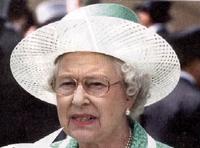
“It stores tunes and plays your favourite music wherever you go… it’s called the Grenadier Guards.”

“It stores tunes and plays your favourite music wherever you go… it’s called the Grenadier Guards.”
Sunday, 26 June 2005
Calling me names
I have had many appellations over the years, and it would be pleasant to recall here some of the more complimentary titles that were granted me: for example, the one I was given during the year I spent in Egypt, which, roughly translated from the Arabic, meant The Great White Lord Who Speaks With Tongue of Silver, or the one by which I used to be known on the Left Bank: Celui Qui Chante Comme Un Ange.
However, the sad truth is that no-one ever actually gave me either of those titles, or indeed any others which I care to remember, except for one.
When I was very young an old woman with a terrifying hat called Mrs Fairman (the old woman, not the hat) used to visit us every few months. I suppose she was what we would now call a traveller. Anyway, she used to give my mother a few coppers for old clothes; she must have known some really desperate people who would want to buy the sort of clothes that were no more use to us.
Her name for me was My-Pigeon-Lor’-Love-‘im-Gaw’-Bless-‘im. I was not impressed by the pious wish, but felt proud to be called by a lovely long name like that: it must surely have meant I was a very important person, though it later occurred to me that she probably applied it to all the little boys she met on her rounds.
She didn’t use it merely to refer to me in the third person, but also to address me by, and her enthusiastic greeting was always the same: ‘Allo, My-Pigeon-Lor’-Love-‘im-Gaw’-Bless-‘im, and ‘ow’s My-Pigeon-Lor’-Love-‘im-Gaw’-Bless-‘im? Say this rhythmically in a Cockney whine with the pitch rising to the second ‘im and then falling away to the fourth, and you will see why it made me feel warm all over. And sometimes I got a rather grubby toffee too.
.
However, the sad truth is that no-one ever actually gave me either of those titles, or indeed any others which I care to remember, except for one.
When I was very young an old woman with a terrifying hat called Mrs Fairman (the old woman, not the hat) used to visit us every few months. I suppose she was what we would now call a traveller. Anyway, she used to give my mother a few coppers for old clothes; she must have known some really desperate people who would want to buy the sort of clothes that were no more use to us.
Her name for me was My-Pigeon-Lor’-Love-‘im-Gaw’-Bless-‘im. I was not impressed by the pious wish, but felt proud to be called by a lovely long name like that: it must surely have meant I was a very important person, though it later occurred to me that she probably applied it to all the little boys she met on her rounds.
She didn’t use it merely to refer to me in the third person, but also to address me by, and her enthusiastic greeting was always the same: ‘Allo, My-Pigeon-Lor’-Love-‘im-Gaw’-Bless-‘im, and ‘ow’s My-Pigeon-Lor’-Love-‘im-Gaw’-Bless-‘im? Say this rhythmically in a Cockney whine with the pitch rising to the second ‘im and then falling away to the fourth, and you will see why it made me feel warm all over. And sometimes I got a rather grubby toffee too.
.
Friday, 24 June 2005
Keepynge fytt
It is hard to imagine anyone in the eighteenth century doing exercises, with their wigs falling off and their crinolines getting all rumpled. But it seems that there was some realisation even in those days that there were benefits to be obtained from correct bearing and movement, for Samuel Johnson’s dictionary, published in 1755, includes the word posturemaster. It is true that he defines it as one who teaches or practises artificial contortions of the body, but if he had disapproved of such activities he would have said “unnatural” rather than “artificial”: to those of the Doctor’s habits and inclinations, almost any strenuous movement would have been considered an artificial contortion.
Today, of course, we know that exercises and good posture are essential to maintain health and mobility into old age, and most of us have at least heard of Pilates, Alexander, aerobics, medau, tai chi and yoga, even if we are unable or unwilling to become more closely involved with them.
 My sister studied and taught all these things until she retired the other day, and continues to practise them. Here she is just before her eighty-fourth birthday, in the fifth position of the Salute to the Sun, known as the Downward Facing Dog pose:
Actually I don't think they worked too hard at it in the eighteenth century; one of the illustrative quotations in the OED, from Addison, 1712, is: "...a kind of Posture-Master. This Artist is to teach them how to nod judiciously, to shrug up their Shoulders in a dubious case..."
I have been very keen on these particular exercises all my life, and still do them almost daily: they are a great deal easier than the sort of thing my sister does.
Today, of course, we know that exercises and good posture are essential to maintain health and mobility into old age, and most of us have at least heard of Pilates, Alexander, aerobics, medau, tai chi and yoga, even if we are unable or unwilling to become more closely involved with them.
 My sister studied and taught all these things until she retired the other day, and continues to practise them. Here she is just before her eighty-fourth birthday, in the fifth position of the Salute to the Sun, known as the Downward Facing Dog pose:
Actually I don't think they worked too hard at it in the eighteenth century; one of the illustrative quotations in the OED, from Addison, 1712, is: "...a kind of Posture-Master. This Artist is to teach them how to nod judiciously, to shrug up their Shoulders in a dubious case..."
I have been very keen on these particular exercises all my life, and still do them almost daily: they are a great deal easier than the sort of thing my sister does.
Wednesday, 22 June 2005
Split personality
This is an obsolete name for what was later called MPD (multiple personality disorder), which in turn has now been re-named DID (dissociative identity disorder), in which a patient may appear to have a number of different personas each with his or her own behaviour patterns.
 A recent TV documentary, Being Pamela, examined what may be a case of this, and the perceptive and witty Guardian writer Catherine Bennett in her column last week suggested that such a disorder might explain Cherie Blair’s seemingly inconsistent conduct:
One day, she might appear in the character of a devout young mother, peering shyly from a giant mantilla as she explains the importance of the Virgin Mary…..
…In an instant, she might switch to a different persona, a bleating New Age devotee of homeopathy, crystals and mud-covered rebirthing...
Then again into a highly toxic property developer, determined that nothing will stand between her and a brace of luxury flats, until, in another shift of persona...
...she forgets both flats and financial adviser and morphs into an eBay-addicted shopoholic with a fondness for brazen sexual innuendo, whose favourite programme, Supermarket Sweep, would be anathema to Mrs Blair in the most rational of her guises…
…as the brilliant human rights lawyer and hammer of sexist discrimination: Cherie Booth QC.
(The remainder of the article Is there more than one Cherie Blair? suggests a different diagnosis of her case.)
 A recent TV documentary, Being Pamela, examined what may be a case of this, and the perceptive and witty Guardian writer Catherine Bennett in her column last week suggested that such a disorder might explain Cherie Blair’s seemingly inconsistent conduct:
One day, she might appear in the character of a devout young mother, peering shyly from a giant mantilla as she explains the importance of the Virgin Mary…..
…In an instant, she might switch to a different persona, a bleating New Age devotee of homeopathy, crystals and mud-covered rebirthing...
Then again into a highly toxic property developer, determined that nothing will stand between her and a brace of luxury flats, until, in another shift of persona...
...she forgets both flats and financial adviser and morphs into an eBay-addicted shopoholic with a fondness for brazen sexual innuendo, whose favourite programme, Supermarket Sweep, would be anathema to Mrs Blair in the most rational of her guises…
…as the brilliant human rights lawyer and hammer of sexist discrimination: Cherie Booth QC.
(The remainder of the article Is there more than one Cherie Blair? suggests a different diagnosis of her case.)
Monday, 20 June 2005
Pass the sick-bag
An overcast and rather depressing Monday morning was not brightened for me when I discovered what the Oxford University Press has chosen as its OED Online Word of the Day.
To make it worse, not a single one of my friends, relatives or correspondents has seen fit to make me privy this morning to any interesting, inspiring or significant thoughts which they may have had over the weekend, so that my email today featured only offers from a clergyman's widow in Nigeria, Canadian vendors of oil stocks, and sundry manufacturers of pharmaceuticals in which I have no interest, plus the OED’s 1,685-word message listing in detail, with copious quotations dated from 1386 to 1978, all six uses of the word vomit in its fourteen spellings.
To make it worse, not a single one of my friends, relatives or correspondents has seen fit to make me privy this morning to any interesting, inspiring or significant thoughts which they may have had over the weekend, so that my email today featured only offers from a clergyman's widow in Nigeria, Canadian vendors of oil stocks, and sundry manufacturers of pharmaceuticals in which I have no interest, plus the OED’s 1,685-word message listing in detail, with copious quotations dated from 1386 to 1978, all six uses of the word vomit in its fourteen spellings.
Sunday, 19 June 2005
Taking people apart
 Answering a question on May 31 about criticism made by Amnesty International regarding the treatment of detainees at Guantanamo Bay, George W Bush said:
In terms of, umm – you know, the – the detainees, we've had thousands of people detained. We've investigated every single complaint against the detainees. It seemed like to me they based some of their decisions on, on the word of, uhh – and the allegations – by people who were held in detention, people who hate America, people that had been trained in some instances to disassemble – that means not tell the truth. And so it was an absurd report. It just is. And, uhh, you know – yes, sir.
The word Dubya is looking for here (and not finding) is dissemble. That doesn't stop him from acting like he's giving the media pool a vocabulary lesson, though.
….from DubyaSpeak
Friday, 17 June 2005
No Orchids for Miss Farnsbarns
 I seem to have been posting a succession of serious and wordy items this month. For a change, here is a nice picture of Jesus riding a diplodocus, sidesaddle:
(Picture courtesy of Answers in Genesis, Kentucky)
I have absolutely nothing to say about this picture, except that it must have been a rather small diplodocus or a very large Jesus.
Wednesday, 15 June 2005
OED
All over the world, distinguished consultants, advisers and contributors are working on amendments and additions to the Oxford English Dictionary,
"the accepted authority on the evolution of the English language over the last millennium…. an unsurpassed guide to the meaning, history, and pronunciation of over half a million words, both present and past…. traces the usage of words through 2.5 million quotations from a wide range of international English language sources, from classic literature and specialist periodicals to film scripts and cookery books”.
And anyone can join in. In the OED newsletter there are regular appeals for documentary evidence which is lacking, in particular the dates of the earliest authenticated use of words or phrases. They’re working on the letter P at the moment, and among the items listed in June are:
to piss on from a great height (v.: to humiliate utterly) 1992
poo(h) (n.: faeces, as a count noun) 1981
poo(h) (v.: to defecate) 1975
So if you have proof of the use of any of these earlier than the dates they give, let them know (at oed3@oup.com) and you could be contributing to the greatest work of scholarship in English since Samuel Johnson’s dictionary was published.
I have chosen the above three from this month’s appeals because there’s nothing like a bit of scatological research to help the day wind down, but of course such expressions are not the norm.
Among the appeals for June is also:
pork scratchings (n.) 1982
I would have thought that these existed in the nineteenth century, but surprisingly it seems the OED researchers haven’t yet found a reference to them before 1982. Can anyone help?
It’s no use just telling them that your grandfather used to talk about them all the time: there has to be a quotable document in which they are mentioned. Oh, and the editors already know about anything you can find with Google.
The BBC in conjunction with the OED is having its own word hunt on the same principle in preparation for a series on BBC2 next year. They’re looking for the earliest uses of – for example – bonk. The OED already lists six quotations for this (in the sense that you’re thinking), but has nothing before 1975. One of the more recent sources cited is the Daily Telegraph for 29th October 1986 with the quotation:
“Fiona..has become so frustrated that she has been bonking the chairman of the neighbouring constituency's Conservative association.”
Here is the full OED entry for bonk, which runs to 500 words. But you can't go on from there to the other half-million entries in the OED unless you have a subscription to the full OED Online, which will cost you £195 a year plus VAT (or $295 over there; the OED has a New York-based Editorial Unit to keep an eye on North American English, and are currently working on updates to the entries for pardner, Parker House roll, pat-down, pasta-fazool, and patootie).
"the accepted authority on the evolution of the English language over the last millennium…. an unsurpassed guide to the meaning, history, and pronunciation of over half a million words, both present and past…. traces the usage of words through 2.5 million quotations from a wide range of international English language sources, from classic literature and specialist periodicals to film scripts and cookery books”.
And anyone can join in. In the OED newsletter there are regular appeals for documentary evidence which is lacking, in particular the dates of the earliest authenticated use of words or phrases. They’re working on the letter P at the moment, and among the items listed in June are:
to piss on from a great height (v.: to humiliate utterly) 1992
poo(h) (n.: faeces, as a count noun) 1981
poo(h) (v.: to defecate) 1975
So if you have proof of the use of any of these earlier than the dates they give, let them know (at oed3@oup.com) and you could be contributing to the greatest work of scholarship in English since Samuel Johnson’s dictionary was published.
I have chosen the above three from this month’s appeals because there’s nothing like a bit of scatological research to help the day wind down, but of course such expressions are not the norm.
Among the appeals for June is also:
pork scratchings (n.) 1982
I would have thought that these existed in the nineteenth century, but surprisingly it seems the OED researchers haven’t yet found a reference to them before 1982. Can anyone help?
It’s no use just telling them that your grandfather used to talk about them all the time: there has to be a quotable document in which they are mentioned. Oh, and the editors already know about anything you can find with Google.
The BBC in conjunction with the OED is having its own word hunt on the same principle in preparation for a series on BBC2 next year. They’re looking for the earliest uses of – for example – bonk. The OED already lists six quotations for this (in the sense that you’re thinking), but has nothing before 1975. One of the more recent sources cited is the Daily Telegraph for 29th October 1986 with the quotation:
“Fiona..has become so frustrated that she has been bonking the chairman of the neighbouring constituency's Conservative association.”
Here is the full OED entry for bonk, which runs to 500 words. But you can't go on from there to the other half-million entries in the OED unless you have a subscription to the full OED Online, which will cost you £195 a year plus VAT (or $295 over there; the OED has a New York-based Editorial Unit to keep an eye on North American English, and are currently working on updates to the entries for pardner, Parker House roll, pat-down, pasta-fazool, and patootie).
Saturday, 11 June 2005
Rant
We English have always excelled at the intemperate expression of our prejudice, anger or contempt, and simple amateurs like Disgusted of Tunbridge Wells can often out-perform top non-English practitioners such as Ian Paisley.
We have many words to describe the kind of thing we do so well: diatribe (“pompous and abusive writing”), tirade (“long vehement speech of censure”), Philippic (“bitter invective”) and so on. Then there is rant, which appears often on the internet and usually refers to a violent attack on some triviality. It is rarely used elsewhere as a noun but sometimes crops up as a verb, frequently paired with rave, as in the song They’re Digging Up Grandpa’s Grave to Build a Sewer: “…Won’t them ‘igh class people rant and rave…”
When the word features in an author's description of his weblog it is a fair indication – as is the appearance of other four-letter words – that what follows is probably not worth reading. Nevertheless, many writers of blogs like to boast that they are offering their personal rants, as if these are to be savoured. They might be less inclined to do this if they were aware of Samuel Johnson’s definition of the word: High sounding language unsupported by dignity of thought.
I will stop there, before this becomes a rant.
We have many words to describe the kind of thing we do so well: diatribe (“pompous and abusive writing”), tirade (“long vehement speech of censure”), Philippic (“bitter invective”) and so on. Then there is rant, which appears often on the internet and usually refers to a violent attack on some triviality. It is rarely used elsewhere as a noun but sometimes crops up as a verb, frequently paired with rave, as in the song They’re Digging Up Grandpa’s Grave to Build a Sewer: “…Won’t them ‘igh class people rant and rave…”
When the word features in an author's description of his weblog it is a fair indication – as is the appearance of other four-letter words – that what follows is probably not worth reading. Nevertheless, many writers of blogs like to boast that they are offering their personal rants, as if these are to be savoured. They might be less inclined to do this if they were aware of Samuel Johnson’s definition of the word: High sounding language unsupported by dignity of thought.
I will stop there, before this becomes a rant.
Thursday, 9 June 2005
OMF
In an informal context (like down the pub) I sometimes permit close friends to refer to this blog by its initials. One might think that these form a fairly uncommon or even unique group of letters but of course on the internet nothing is uncommon and if you search with Google for websites containing the letters OMF you will get 353,000 references, including 18,700 in the UK alone.
It may be that my OMF is among these somewhere, along with the websites devoted to Optically Magnified Facets, the Oscar Moore Foundation, and the “comprehensive news portal for dental professionals” which tells you all you need to know about Oral & MaxilloFacial surgery, but the websites that Google’s clever algorithms bring to the top seem mostly to concern an organisation founded in 1865 by the splendidly hirsute Hudson Taylor....
....which is still looking for “called, creative, committed co-workers to glorify God through the urgent evangelisation of Asias billions”.
As this is not really for me – I find the climate in most Asian countries very trying – I did not read far enough to find out what their OMF actually stands for.
However, if you put "Other Men's Flowers" into Google, you get 4,360 results. The 1st, 2nd, 3rd, 6th and 7th places in the list are taken by this blog, with Lord Wavell and Michel de Montaigne tagging along behind, so that’s all right.
It may be that my OMF is among these somewhere, along with
 the websites devoted to Optically Magnified Facets, the Oscar Moore Foundation, and the “comprehensive news portal for dental professionals” which tells you all you need to know about Oral & MaxilloFacial surgery, but the websites that Google’s clever algorithms bring to the top seem mostly to concern an organisation founded in 1865 by the splendidly hirsute Hudson Taylor....
....which is still looking for “called, creative, committed co-workers to glorify God through the urgent evangelisation of Asias billions”.
As this is not really for me – I find the climate in most Asian countries very trying – I did not read far enough to find out what their OMF actually stands for.
However, if you put "Other Men's Flowers" into Google, you get 4,360 results. The 1st, 2nd, 3rd, 6th and 7th places in the list are taken by this blog, with Lord Wavell and Michel de Montaigne tagging along behind, so that’s all right.
Tuesday, 7 June 2005
The Olympic dream
Interesting that my friend Teddy III in Boston doesn’t even mention New York when he writes in his blog about the venue for 2012. He's probably right: the current view is that Paris remains ahead of London and the rest are nowhere. A couple of days ago it was front-page news that the IOC report said nice things about London, but today there are only small paragraphs listing the even nicer things that were said about Paris.
But such reports are always written in code, of course; it was nice to read that the authors recognised that London’s bid “enjoys strong support from the Queen”, but this actually means “we had a very nice dinner at Buckingham Palace”.
But such reports are always written in code, of course; it was nice to read that the authors recognised that London’s bid “enjoys strong support from the Queen”, but this actually means “we had a very nice dinner at Buckingham Palace”.
Sunday, 5 June 2005
Not even for the crossword
The other day the Daily Telegraph cheerfully published a piece by the criminal liar Jonathan Aitken rejecting the claim by a former CIA man to be Deep Throat, a claim which was almost immediately proved to be absolutely authentic.
In recent years the Telegraph has become an even lousier newspaper than it has been for most of its history and is making increasingly desperate efforts to keep its place as the house broadsheet of the right, the Times having given up this role nowadays by declining into relentless triviality and an obsession with the extremely rich. The Telegraph's attempts to excite the public about the Tory leadership are not likely to succeed, and they now seem to be pursuing the Hello! market, with a recent issue devoting a quarter of its front page and a half of page three to pictures of Princess Michael’s bedroom.
Its arts coverage is more inept and ill-informed than ever, though I doubt if it will ever exceed the crassness of a comment by their literary critic which I saw quoted on the back of the paperback edition of Thurber’s The Middle-Aged Man on the Flying Trapeze: “His humour corresponds closely with Charlie Chaplin’s, with some of the madness of Harpo Marx”. Well, yes, sums up Thurber perfectly; the words of the other two were just as memorable, weren’t they?
I’ve often thought that Noel Coward’s tap-dancing corresponds closely with Billy Connolly’s, with some of the controversial thrust of Danny Kaye’s novels.
In recent years the Telegraph has become an even lousier newspaper than it has been for most of its history and is making increasingly desperate efforts to keep its place as the house broadsheet of the right, the Times having given up this role nowadays by declining into relentless triviality and an obsession with the extremely rich. The Telegraph's attempts to excite the public about the Tory leadership are not likely to succeed, and they now seem to be pursuing the Hello! market, with a recent issue devoting a quarter of its front page and a half of page three to pictures of Princess Michael’s bedroom.
Its arts coverage is more inept and ill-informed than ever, though I doubt if it will ever exceed the crassness of a comment by their literary critic which I saw quoted on the back of the paperback edition of Thurber’s The Middle-Aged Man on the Flying Trapeze: “His humour corresponds closely with Charlie Chaplin’s, with some of the madness of Harpo Marx”. Well, yes, sums up Thurber perfectly; the words of the other two were just as memorable, weren’t they?
I’ve often thought that Noel Coward’s tap-dancing corresponds closely with Billy Connolly’s, with some of the controversial thrust of Danny Kaye’s novels.
Friday, 3 June 2005
Telling it like it is
coprolalia, n. Cursing, uttering obscenities, the explosive utterance of swearwords or more elaborate sexual, aggressive or insulting statements (e.g. racial slurs). It is neither intentional nor purposeful, and is not necessarily directed towards anyone. Coprolalia is considered a complex vocal tic and is undoubtedly the most striking, socially distressing, and dramatic symptom of Tourette’s Syndrome. Contrary to popular perceptions, the majority of Tourette’s syndrome patients never exhibit this symptom; it occurs in as few as 5-15% of patients.”
It must indeed be socially distressing, both for the person who exhibits it and for his or her relatives and friends; it is cause for sympathy and certainly no laughing matter. That having been said, I don’t think there is any reason why I shouldn't recount an incident which gave me much pleasure; those involved (apart from me) are long since dead.
Near the factory where I worked there was a block of flats, and a middle-aged woman would often lean out of an upper window and shout mildly obscene insults at passers-by; there seemed little harm in this, and most of her targets would give her a cheery wave and carry on walking past.
One day I was passing the flats with my boss, whose name was Joe, and for once she was not at her window but following us in the street. She overtook us and when she was a dozen paces ahead she stopped, turned round, looked Joe straight in the eye and said, “You soppy-lookin’ ole bugger!”.
There was nothing at all menacing about her, and Joe was only slightly taken aback. This was in the days when most men wore hats, so he politely raised his and we all walked on.
The point of the story, of course, is that her comment, though uncalled-for, was a perfectly fair one; Joe was a very able General Manager, a scratch golfer and no doubt a much-loved husband and father, but there was no getting away from it: he was a soppy-lookin' ole bugger.
It must indeed be socially distressing, both for the person who exhibits it and for his or her relatives and friends; it is cause for sympathy and certainly no laughing matter. That having been said, I don’t think there is any reason why I shouldn't recount an incident which gave me much pleasure; those involved (apart from me) are long since dead.
Near the factory where I worked there was a block of flats, and a middle-aged woman would often lean out of an upper window and shout mildly obscene insults at passers-by; there seemed little harm in this, and most of her targets would give her a cheery wave and carry on walking past.
One day I was passing the flats with my boss, whose name was Joe, and for once she was not at her window but following us in the street. She overtook us and when she was a dozen paces ahead she stopped, turned round, looked Joe straight in the eye and said, “You soppy-lookin’ ole bugger!”.
There was nothing at all menacing about her, and Joe was only slightly taken aback. This was in the days when most men wore hats, so he politely raised his and we all walked on.
The point of the story, of course, is that her comment, though uncalled-for, was a perfectly fair one; Joe was a very able General Manager, a scratch golfer and no doubt a much-loved husband and father, but there was no getting away from it: he was a soppy-lookin' ole bugger.
Wednesday, 1 June 2005
Boring professionally
One more bore, and then I will find another topic.
This time, I am the bore. I cannot really claim to be a top rank bore because I don’t have the necessary determination: of course, like most people, I am sometimes very boring, but usually I become aware of the symptoms in my victims – the glazed eyes, the drumming fingers – and drop the subject or cut the anecdote short. But there was a period in my life when inspiring boredom was a useful skill.
I was working for an international sports federation which had Biennial General Meetings; these took place every two years, as is so often the case with BGMs, and were usually held in some remote and unglamorous spot – Pyongyang, it might be, or Novi Sad, or Birmingham. Delegates from a hundred or more countries attended and simultaneous translation in six or more languages was provided. Politics played a major part in our deliberations; I have pointed out elsewhere why this is just as likely with sports federations as with other international bodies.
It sometimes happened, therefore, that a crisis would arise which, if not dealt with skilfully, might cause a breakdown. Perhaps one delegation had suffered a real or imaginary slight: sides would be taken, the Soviet bloc would be angrily whispering among themselves, there would be an inflammatory speech from a Chinese delegate and a possibility that a least one of the two Koreas or one of the two Germanys, or all four, would walk out in a huff.
Sometimes in such a situation the Chairman would give me my cue by saying something like, "I think the Secretary-General has a point he’d like to make…”
I would put on my special boring secretarial spectacles (or, if I was already wearing them, take them off) and start droning away in my special boring secretarial voice. Almost immediately, the tension would ease; delegates would start pouring themselves glasses of water, looking through their documents to see what time lunch was, or just sitting back and thinking about their plans for the evening.
It would not be many minutes before the Chairman could interrupt me and say “Thank you. Let’s press on, shall we? Number Fourteen on your agenda….” and it would be a very determined delegate who could remember what the row had been about and insist on re-starting it.

The Great Hall of the People, outside.....

... the BGM inside.....

...me on the extreme right, about to be very boring indeed.
.
This time, I am the bore. I cannot really claim to be a top rank bore because I don’t have the necessary determination: of course, like most people, I am sometimes very boring, but usually I become aware of the symptoms in my victims – the glazed eyes, the drumming fingers – and drop the subject or cut the anecdote short. But there was a period in my life when inspiring boredom was a useful skill.
I was working for an international sports federation which had Biennial General Meetings; these took place every two years, as is so often the case with BGMs, and were usually held in some remote and unglamorous spot – Pyongyang, it might be, or Novi Sad, or Birmingham. Delegates from a hundred or more countries attended and simultaneous translation in six or more languages was provided. Politics played a major part in our deliberations; I have pointed out elsewhere why this is just as likely with sports federations as with other international bodies.
It sometimes happened, therefore, that a crisis would arise which, if not dealt with skilfully, might cause a breakdown. Perhaps one delegation had suffered a real or imaginary slight: sides would be taken, the Soviet bloc would be angrily whispering among themselves, there would be an inflammatory speech from a Chinese delegate and a possibility that a least one of the two Koreas or one of the two Germanys, or all four, would walk out in a huff.
Sometimes in such a situation the Chairman would give me my cue by saying something like, "I think the Secretary-General has a point he’d like to make…”
I would put on my special boring secretarial spectacles (or, if I was already wearing them, take them off) and start droning away in my special boring secretarial voice. Almost immediately, the tension would ease; delegates would start pouring themselves glasses of water, looking through their documents to see what time lunch was, or just sitting back and thinking about their plans for the evening.
It would not be many minutes before the Chairman could interrupt me and say “Thank you. Let’s press on, shall we? Number Fourteen on your agenda….” and it would be a very determined delegate who could remember what the row had been about and insist on re-starting it.
The Great Hall of the People, outside.....
... the BGM inside.....
...me on the extreme right, about to be very boring indeed.
.
Subscribe to:
Posts (Atom)