Saturday, 31 December 2005

Happy Nouvelle Année!

When terseness is called for the French can be extremely, well, terse; there are examples HERE and HERE. But they can also express themselves in a way which would sound ridiculously flowery and over the top in English, but doesn’t, somehow, in French.
Here is part of an email received this week from a French friend called Claire. She apologised for sending it out to 62 addresses ("Bon, je sais, les mails communs, c'est pas très cool"), but excused this on the grounds that she was about to leave for three weeks in Vietnam and hadn’t packed and, besides, she thought it wasn't so wrong to package her good wishes "pour vous qui avez un point commun: moi!". Claire also confessed that she hadn’t composed it herself, but had received it from a friend last year.
Anyway, we loved it:
Je vous souhaite à tous, et à tous ceux qui vous sont chers, des bonheurs qui tiennent dans la poche, comme des grands qui nécessitent un A380 (plein de petits, ça fait un tas d'A380...); je vous souhaite la santé qui vous permette de marcher, de chanter, de courir et de profiter; je vous souhaite la prospérité pour rendre la vie un peu plus simple; je vous souhaite des amis, des vrais, des qui tiennent chaud l'hiver et sont toujours là l'été; je vous souhaite une famille, qu'on vous l'ait donnée ou que vous l'ayez choisie; je vous souhaite des rêves, des projets, des espoirs, avec plein de concrétisations derrière, et puis des rêves qu'on ne réalise pas forcément mais qui restent dans un coin de la tête, longtemps; je vous souhaite de vivre, de ne pas perdre de temps, de prendre et de donner, parce qu'on peut quitter le jeu n'importe quand; je vous souhaite des bonnes nouvelles, des sourires et des fous rires; je vous souhaite d'avoir toujours "assez de musique dans votre coeur pour faire danser votre vie".
Prenez soin de vous et que la vie vous soit douce.
Bonne année 2006 et plein de bisous, à chacun d'entre vous.

[A380 is the 555-seat Airbus]


I append a version in Babelfish English. As a translation this is fairly pathetic, but it does have a certain mystic charm and will serve as my own New Year message to everyone:
Wish you with all, and all those which are expensive to you, of happinesses which hold in the pocket, as the large ones which requires A380 (full with small, that made a heap of A380...); I wish you the health which enables you to go, to sing, run and profit; I wish you prosperity to make the life a little simpler; I wish you friends, truths, which hold hot the winter and are the summer always there; I wish you a family, that it be given to you or that you chose it; I wish you dreams, projects, hopes, with full with concretizations behind, and then dreams which one does not carry out inevitably but which remains in a corner of the head, a long time; I wish you food, not to waste time, to take and give, because one can leave the play any time; I wish you good news, smiles and insane laughter; I wish you to have always "enough music in your heart to make dance your life". Take care of you and that the life is soft for you. Good year 2006 and full with kisses, with each one among you.

Wednesday, 28 December 2005

Joke

There is a website devoted to the "Spenser" novels by the American author Robert B. Parker. Spenser is described as "the most attractive and resourceful private investigator since Raymond Chandler’s Philip Marlowe" but for Los Angeles read Boston.
The site was created by Mike Loux many years ago and has been carried on by Bob Ames since 1999. It is vast in scope and includes an Annotated Gumshoe section in which the devoted authors have attempted to locate the source of every allusion—and there are a huge number—in the books.
There was one which they were unable to identify and for ten years they have been inviting visitors to the site to provide them with the answer; the reference occurs in three of the books and is clearly the punch line of a joke—but what was the joke? I haven't read any of the books but when I came across the website I realised that I actually knew the joke and was very happy to end their search. This is it.

Monday, 26 December 2005

Following her around

I am in general much less than fascinated by the world of nature and not an avid reader of Country Diaries and the like, but my interest was held by a note in the Guardian about a project for tracking a 2m long female leatherback turtle by means of a satellite device. I do hope she gets safely back to Dingle, Co Kerry, after her current migration to some tropical coast where she will lay eighty eggs every ten days for two months.

Saturday, 24 December 2005

Season's Greetings


"Look, if it means having to wear this stupid hat then I say the hell with Christmas."


And grandfathers don't have much choice either.
I do possess a rather spectacular false nose which I was urged to wear but I didn't because it made me look rather silly.


And forget the reindeer: it's a sign of the times that nowadays Father Christmas has to be preceded by three heavies.

Thursday, 22 December 2005

Ho ho ho, indeed


This crook was conned into dressing himself up like this, which took up time he would otherwise have spent sending out scam emails.
[419 Eater]

Tuesday, 20 December 2005

Naming the relatives

I often reflect on the richness of our language compared with others, and enjoy irritating those who do not have it as their mother tongue by going on about it. Not only do we have vast numbers of synonyms which aren't really synonyms at all because they have subtly different connotations, but we have many words (nice, home...) the precise meanings of which simply cannot be conveyed in some world languages.

But the sociologist and columnist Anne Karpf, in an essay entitled "What do you call your step-grandson's ex?" reminds us that some languages of less than world stature are, in one field at least, ahead of us:
[People] talk of the nuclear or minimal family...but our sphere of connectivity has widened rather than contracted with the increase in divorce and second marriage. Even if the bonds are mainly dutiful (the guilt-tripping great-aunt, the first cousin's sulky teenage daughter) or even negative, in some sense they're how we position ourselves in the world.
The trouble is that, compared with other cultures, we lack the words to describe them. [The Sudanese have] eight different terms for "cousin" depending on how you're related. Nor will plain old "uncle" do. Instead, they distinguish linguistically between the father's brother and the mother's brother...
... Latin has a word for living with a mother's brother (which translates clumsily as avunculocality), and another for living with a father's sister (amitalocality). In India your husband's brother's wife is charmingly called your co-sister...
...To my mind the most serious absence is a word describing the relationship between two sets of in-laws... Here Yiddish comes into its own with mekhuteneste... It's no accident that the cultures that have a term for your son or daughter's in-laws (the Greeks call them symbetheros, in Spanish consuegros) are those that recognise this as a significant relationship extending beyond an annually shared sherry trifle.
So when I next complain about the length of my Christmas shopping list I shall remind myself that it expresses bonds and affinities without which I would be the poorer (although, at this time of year, obviously also the richer). Yiddish, naturally, has a word for it, one that expresses both affection and resigned irritation. Mishpokhe means family, including the most remote kin.


Anna McColl, in a piece on the Random House website covers similar ground in more detail, saying that English is notoriously poor in kinship terms:
...In English, the sex of nearer kinfolk is important: mother/father; sister/brother; aunt/uncle. In Malay, however, the age is the primary distinction; there are different terms for elder (brother/sister/cousin) and younger (brother/sister/cousin), but there's just one generic word for a sibling or cousin. Likewise, until the nineteenth century Hungarian had terms for older sibling or younger sibling but no word for 'brother' or 'sister'... ...Latin had separate terms for 'father's brother', 'father's sister', 'mother's brother', and 'mother's sister', but modern Romance languages have reduced this to two terms for 'aunt' and 'uncle'. In Njamal, an Australian Aboriginal language, a man can use the same term for 'father's father' and 'daughter's son's wife's sister', the important distinction being that both are two generations away. Some Native American languages have different words for 'sister (of a man)' and 'sister (of a woman)'

[And in Japanese, men's speech is different from young women's speech, while in Greek, the sister of the father of Carlos is the translation of what they called their production of "Charlie's Aunt". However, I'm not at all sure that these footnotes are relevant to this topic. Or to anything, really]

Monday, 19 December 2005

Who the hell are Betty and Fred?

Christmas cards are such a lovely way of renewing old friendships!

Sunday, 18 December 2005

Goodwill to all men, for four weeks only

At this time of year, if you repel chuggers they may hit you with: "But it's Christmas!"

From an essay by Nicholas Fearn in The Guardian...the plight of the poor and needy is no worse at Christmas than at any other time...There is something profoundly mistaken in our acceptance that morality can take the form of a holiday. After all, the real holiday here is the 11 months of the year when it is more or less acceptable to look after number one, yet no-one talks of an extended "season of selfishness"...
...If there is such a thing as a season of goodwill that begins officially on a certain day, ushered in by a wave of televised celebrity appeals for charity, there must of necessity be another day, some time between Christmas Day and New Year, when all this comes to an official end. We wait in vain for newsreaders to announce the relaxation of festive requirements and a return to our default stinginess...
...Christmas is not the only manifestation of our irrational observance of "seasons": for example, you shouldn't make someone cry on their birthday; you should be especially kind to your partner on Valentine's Day; annoying people is fine on April Fools' Day, as is terrorising them at Halloween...
...The Season of Goodwill does more than merely highlight the lack of fellow feeling that is the norm throughout the rest of the year, it also works to make it permissible. The question of how much we should give to those less fortunate than ourselves does not have an easy answer, but as to whether we should make December a special time of giving, the answer is certainly "no".

Friday, 16 December 2005

419 Eater

Last February I posted a note about the now famous website of a man who works hard—and has a lot of fun—in wasting the time of the crooks who are still making millions from internet scams. It is extraordinary that there are so many people with money who are stupid and greedy enough to believe that the widow of a Nigerian cabinet minister only needs a bit of help from them to get hold of her $120 million inheritance and that she will let them keep 20% of it for their trouble.

I had another look at the website the other day and it is still going strong. The scam-baiter who publishes it has stopped using his skill to con money from the con-men because although they richly deserve to be cheated there are legal risks even if you are giving the money to charity. He has developed a variety of approaches by email and telephone which give the scammers hope that their appeal is going to be successful and then leads them on to make expensive phone calls and compose long emails before they realise—or he tells them—that they have been fooled.

In a recent example, the scambaiter didn’t really want to be bothered with one scammer so he just replied to the first email by telling him that he was a liar. However this scammer wasn’t put off and returned with further lies, which has led to a very lengthy and enjoyable correspondence. The scammer was persuaded to have himself tattooed and to send a photograph with the promise of a large grant from a fictional charitable foundation.
This all began early in October and in mid-November he was still making every effort to carry out the increasingly difficult tasks being set him.

The account of all this is illustrated with the photos sent in by the scammer, in which he looks a harmless lad, but do not feel sorry for him. The scammers browbeat others into having their photos used; they themselves are evil and sometimes violent men. One particularly despicable trick they pull is to appeal for funds to aid victims of some major disaster.

When they spend time responding to spoofs that means that they are distracted from other attempts to rob gullible people, so tricking them is a praiseworthy activity. However, this salutary website warns that it can be a dangerous game and calls for great care to avoid getting into a nasty situation.

Wednesday, 14 December 2005

Gastro-porn

I used to think this was a silly word, but after glancing through some current glossy supplements I realise that is a necessary one as it accurately describes a modern phenomenon. The parallelism of food and sex, of course, has always been obvious, but nowadays they have become comparable also in the sense that the depiction of both is a major source of obscene material for the media and the internet.

This was not always the case; food writing often used to be of literary as well as practical value, but since Elizabeth David's day illustration has taken over, as if a full-page colour picture of an avocado is interesting or informative.


And the accompanying text is always profoundly depressing. Last weekend one food supplement alone featured the gratuitous information that stripper Dita Von Teese likes asparagus and lobster after she's done her show at the Café de Paris (and did you know that nipple covers are known as pasties in the trade?), that pomegranates are the latest thrilling wonderfood from Beverly Hills to Brighton, that sheeps' lungs, boiled and inflated, are a big thing with the Uyghurs of Kashgar (Xinjiang) and that one supermarket this Christmas is offering a Four-Bird Roast—a deboned goose stuffed with deboned turkey, guinea fowl and the breasts from two ducks. A snip at £200, as it serves fifteen and is a doddle to carve.


Those who can't afford this, as they have already joined with a friend to pool their Pensioner's Winter Heating Allowances and share a £400 bottle of the Glenlivet Cellar Collection 1972, can make their own multi-bird roast by following the recipe given in the same supplement by some double-barrelled fool: you start with a goose stuffed into a turkey then, he says re-assuringly, you don't need all the smaller birds to be different: you can use, say, three pheasants and five pigeons.


All that is crude and vulgar pornography.

There was once a Persian imam who ordered his cooks to stuff an olive inside a lark, that inside a chicken, that inside a peacock, that inside a sheep, and finally that inside a camel.. The whole was rubbed with rare herbs and spices by sloe-eyed virgins and then cooked for five days on a cedar-wood fire while classical dastgâh music was played by two hundred musicians.Then the imam fed the flesh to his dogs and ate the olive.

Now that was style.

Monday, 12 December 2005

I meant "generous"

I mentioned some time ago that comments on anything written in Other Men's Flowers are welcome, especially those that consist entirely of fulsome praise, but I have now discovered that this was the wrong word to use.
According to The Guardian stylebook, the word means "cloying, excessive, disgusting by excess..., so fulsome praise should not be used in a complimentary sense". The OED gives six obsolete meanings and only one which is not: "Now chiefly used in reference to gross or excessive flattery, over-demonstrative affection, or the like", and a modern Collins dictionary has "Excessive or insincere, esp in an offensive or distasteful way".
That is not at all what I had in mind.

I noticed that on the same page in the stylebook is the entry for fuck. This merely covers a rather piffling aspect by advising "Do not describe this as a good, old-fashioned Anglo-Saxon word, because, first, there is no such thing as an Anglo-Saxon word (they spoke Old English) and, more important, its first recorded use dates from 1278".
Elsewhere in the stylebook, under swearwords, there is a typically laid-back piece recommending caution, while noting that The Guardian is more liberal in this matter than any other newspaper, and that asterisks are a cop-out and should not be used.
I am rather proud that I contributed part of one of the entries in this stylebook (not an entry referring to the above).

Saturday, 10 December 2005

Paper chase

Sunday newspapers nowadays are substantial affairs, and only a very devoted reader (or an extremely idle person) can make more than a token effort to read a high proportion of their content.
We take two, and the following is a typical load, weighing 4½ lb, that comes through our letterbox with a thump:
Two main sections (broadsheet, totalling 62 pages)
Two sports sections (broadsheet, totalling 46 pages)
Two travel sections (tabloid, totalling 56 pages)
Two review sections (broadsheet, totalling 36 pages)
Music Monthly (glossy tabloid, 86 pages)
Two business sections (broadsheet, totalling 26 pages)
Comic (tabloid, 12 pages)
Two colour supplements (glossy tabloids, totalling 230 pages)
Money (1 broadsheet, 1 tabloid, totalling 30 pages)
Home (tabloid, 48 pages)
Driving (tabloid, 32 pages)
Books, films, theatre, TV (tabloid, 88 pages)
Appointments (broadsheet, 14 pages)
Style (glossy tabloid, 100 pages)
…and another 40 or so pages of advertising supplements

For me, the Sunday task is lightened somewhat by the fact that I have no interest at all in sport, jobs, property, gardening, mortgages, cars, pop music, fashion or the funnies, so that of the 906 pages listed above about 400 can go straight into the recycling box without even being unfolded. And of course much of the text of the remaining sections need not be read as it is of little interest, being written only to fill the spaces between the advertisements.
Even so, it is usually Wednesday or Thursday before the chore is finished. This leaves little time to get to grips with our daily paper, the Saturday edition of which has also now become a pile of print almost as monstrous.The only weeks I can really keep up with the newspapers are those when I go to London: the train takes an hour and forty minutes each way.

Thursday, 8 December 2005

Stand by for combat

Last Tuesday I spent half an hour in the Strangers Gallery of the House of Commons behind the new glass screen which has been fitted to discourage the throwing into the chamber of paper darts, toilet rolls, bombs, etc., and listened to some less than thrilling replies to questions about about the new quangos being set up to reduce the number and cost of quangos (or something like that).
I had to be in the Palace of Westminster on that day for a reason quite unconnected with parliament, and of course everyone is telling me that I was unlucky not to have been there yesterday when the new Leader of the Opposition faced the PM for the first time.
I must say that I am unable to share the feeling of happy anticipation (among the media) about the prospect of exciting exchanges at Prime Minister’s Question Time now that (they say) TB’s new opponent is fractionally less dreary than any of those he has had in recent years. This may well be true, though hardly likely to fill us with a resolve not to miss anything these two repellent characters may say to each other.
We may well merely feel, as we did at the time of the Al Fayed/Hamilton legal battle, that it's such a pity that they can’t both lose.

Tuesday, 6 December 2005

The height of sybaritism

Our house is comfortable enough, but outstandingly so in only one respect. We have a luxury, particularly valuable during cold spells, which is rarely to be found, I imagine, even in the homes of the most privileged: by chance rather than by design, a loo roll holder is mounted immediately over a radiator, so that the paper that comes off it is warm.

Sunday, 4 December 2005

Must 'ave civil words, Bill


"Civil words!" cried the girl, whose passion was frightful to see. "Civil words, you villain! Yes, you deserve 'em from me. I thieved for you when I was a child not half as old as this!" pointing to Oliver. "I have been in the same trade, and in the same service, for twelve years since. Don't you know it? Speak out! Don't you know it?"

Fagin was right, of course, we must have them. English is rich in civil words for uncivil things: there is a list here of “minced oaths” (words or phrases used to avoid swearing: Blimey!). There are also lists of phrases in other sub-groups, including: Popular Fallacies, Biblical, Shakespeare, Misheard Song Lyrics and Made in the USA (e.g. Full as an Alabama tick). You can look up euphemisms generally in a Phrase Dictionary which provides an A-Z index. All these riches and many more are to be found in The Phrase Finder, one of those websites where you drop in for a quick browse and then realise after a bit that it’s 3am.

Friday, 2 December 2005

A fondly remembered name

You can tell just by looking at the photo that here is a boring, conceited, talentless prat, can’t you?
His name is Nicholas Parsons. He hasn’t been on television for a while and I was surprised, though not wildly excited, to see that he is still around; in an interview for one of the colour supplements the other day he revealed that he is having 35 of his suits sold on eBay for charity and “with my name on them they go for more”. He takes the Tube sometimes and “I’m not self-conscious, even when people start nudging each other and talking about me”. I suppose he imagines they’re saying “Look! There’s Nicholas Parsons, the famous actor and star of radio and TV!”, whereas of course they’re actually saying “Look! There’s that boring, conceited, talentless prat who used to be on the telly”.
But thanks to the Two Ronnies, his name will not be forgotten. They claimed to have found one of his admirers, and the joint opening announcement of one of their shows was:

Good evening, it’s great to be back again, isn’t it?

Yes indeed, and in a packed programme tonight I interview a lady who likes Nicholas Parsons…


…and I interview a parson who likes knickerless ladies…

Wednesday, 30 November 2005

My career in opera

The longest singing career ever was probably that of Danshi Toyotaki of Hyogo, Japan, who sang in Musume Gidayu for 91 years from the age of seven. A friend of mine was still singing in public in his ninetieth year, but he’s not a contender because he didn’t have lessons and start singing seriously until his seventies. Several of the great prima donnas of the past, and some tenors or baritones, carried on, in most cases with declining greatness, for many decades; I have not searched the internet to find out who sang on the longest, but I expect some knowledgeable friend will tell me. However, when it comes to the record for the shortest career ever on the operatic stage, then if you count abortive attempts there is no doubt that I am the holder.

I have been a keen bath singer since early childhood and have once or twice sung publicly in a jokey sort of way (and I don’t mean karaoke), not being too inhibited by the lack of anything in the nature of a voice. It might be said of me, as Bernard Miles said of one of his characters, that I have a belly-full of music but a bad road out.

So I was immensely flattered when I was invited to take part in a performance of Tosca in a country house venue in Sussex. It was no small scale production: there were distinguished internationally known singers as the soprano Tosca and the bass-baritone Scarpia. The husband of the soprano was directing, and as friends of mine the two of them thought I might like to fill in as they were a bit short in the chorus department.

I had some misgivings but took it very seriously from the start. The soprano tested me with a few scales and gave me some hints about what to do with my diaphragm, how to breathe and so on, and then told me that I would probably be all right. One problem was that I can’t really read music, and I went to the trouble of driving down to Dorset for some practice with my niece who is a musician so that I could get most of the notes more or less right from memory.

[The picture is not of this production, which was in modern dress; we were to be dressed as Mafia hoods.]

Then rehearsals began. The director was very kind and helpful to me, as were my colleagues in the chorus, talented amateurs or semi-professionals, but I became increasingly unhappy. In my mature years I am no longer much afraid of making a fool of myself because life has already done it, but I began to realise that I was just not going to be any good, even in an undemanding chorus role.

So I went to my friends and said I am very sorry, but I just can’t do it. If they had been angry and complained about me leaving them one short in the chorus at the last minute I wouldn’t have blamed them, but the final embarrassment was that they were terribly nice: no, not at all, quite understand, don’t worry about it.

And so ended my career, a week or two before it was to begin. My wife and I went to see the performance, of course, and very good it was. But I never liked Tosca much, and now I can’t even bear to listen to it, or for that matter anything else by Puccini.


Monday, 28 November 2005

They sang every Sunday night

Like many of the posts in Other Men's Flowers, this one is of little interest to Americans or anyone born after the Reichstag was set on fire.

With Christmas approaching, it is time to put an end to the obsession with modern sleaze which characterises this blog and to return to a simpler and less sophisticated era.


Many organisations now defunct sprang up in the 1930s. There was one which at its peak in 1939 had five million adherents in the UK. The exact number may never be known, for its secrets were guarded with extraordinary rigour; it had its own passwords and codes, and signs by which its members might recognise one another.
It even had its own anthem:
We are the Ovaltineys, little girls and boys,
Make your request we'll not refuse you,
We are there just to amuse you,
Would you like a song or story?
Will you share our joys?
At work and play we’re more than keen,
No merrier children can be seen
Because we all drink Ovaltine,
We're happy girls and boys.


You can hear the tune—and many others of the same period and in the same genre—played HERE, or a whole 1937 Radio Luxembourg broadcast HERE. How innocent were our pleasures!

I was a keen member, and in another popular organisation for young people which flourished at the same time (not based in the UK) I might well have reached the rank of Gefolgschaftsführer, or even Hauptgefolgschaftsführer. As it was, I was merely a Silver Star Member. To reach this height you had to enlist three more members, a sort of pyramid selling operation. All you got for this effort was the rather pathetic badge which you could swank about with, but I remember the honour fondly as my first taste of the privileges of rank. And, come to think of it, the last.

[The way in which children nowadays are brainwashed by advertising into influencing their parents’ purchasing habits is crude and ineffective compared with this scheme, perhaps one of the most brilliant marketing ideas ever. It was intended to promote the sale of a malted milk drink (containing barley and malt extract, dried skimmed milk, sugar, whey powder, glucose syrup, vegetable fat, full cream milk powder, fat reduced cocoa, caseinates, egg powder, emulsifier, stabilisers, flavouring and vitamins), which was invented in 1904 by a Swiss chemist: it succeeded to the extent that ten million jars used to be sold in the UK every year. It was withdrawn here in 2001 but apparently is still in demand in S.E. Asia.]

Saturday, 26 November 2005

A brilliant idea

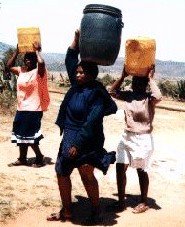
Imagine waking up long before sunrise, walking for more than two hours to the nearest river or borehole and then carrying a bucket full of water on your head all the way home.
Now imagine you are a woman or a young child and it is your responsibility to carry this heavy bucket of water every day of your life
This is a reality for millions of women and children around the world who do not have access to fresh water on tap. What quality of life could you expect from one bucket of water for your whole family? How could you wash, drink, clean, cook or even grow vegetables? How much time and energy does it take to provide your family with this most basic human requirement?
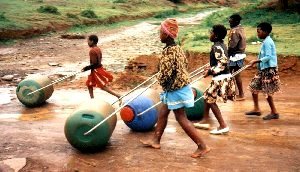
A very simple invention has been improving the quality of many such lives for the past twelve years.


You can read about it HERE.

[I found this mentioned in the admirable blog of a designer and writer in Brighton called Jonathan Baldwin. Apart from this and chat about graphic design, he reproduces there the whole script of Four Candles and a marvellous photo of Norman Stanley Fletcher.]

Thursday, 24 November 2005

Manners maketh man

(William of Wykeham: motto of Winchester College and New College, Oxford. Not really relevant but I couldn’t think of another title)

I was hurrying along a crowded London pavement when I collided with a man going in the opposite direction. It was 90% my fault because of my carelessness and 10% his because of his width and swagger.

It felt like walking into a concrete block. He was a head shorter and many pounds heavier than I: shaven head, earring, tattoos, biceps stretching the sleeves of his T-shirt.

He looked up at me with little piggy eyes in a totally expressionless face, and for a second or two I considered my options: humbly express my profound regret, or run like hell. Neither seemed hopeful: he did not look like a man who would be likely to accept an apology gracefully, and even on his short bandy legs he could probably run faster than me.

But before I could do anything at all, he said: "Sorry, mate".

Makes you feel warm all over, doesn’t it? And ashamed of stereotyping.