Saturday, 28 February 2004

Art for the inartistic


Anyone seeking fulfilment as an artist but handicapped by a total lack of talent should study the works of Goswell Frand.

Tuesday, 24 February 2004

Grinding small

I once rebuked a friend for misquoting the line about the mills of God, but was chastened to find on looking it up that I had quite the wrong idea about the source: Blake, I had vaguely thought, or 1st Corinthians, or something of that kind. Not at all: the line is from a translation of the Sinngedichte of Friedrich von Logau ("Gottesmuhlen mahlen langsam...."). How about that?

And how many people know the terrifying second line?
Though the mills of God grind slowly, yet they grind exceeding small;
With patience He stands waiting, with exactness grinds He all.


....and if you say it out loud, tum-ti tum-ti tum-ti tum-ti, you can tell that the translator was Longfellow, as in: And the gentle Mudjekeewis/Raven head submissive bowed/Takes her hankie very slowly/Blows her nose exceeding loud.


.

Saturday, 21 February 2004

Yes, it's from Tannhäuser

For most of my adult life I have had a tune on the brain. I don’t hum it incessantly, but it is always there, lurking behind my conscious thoughts, and often when I feel like a bit of a hum it is this tune that comes out.

It’s a nice tune, slowish and a little melancholy, and it goes: “Da dee da dum, da dada dee, dee da dee DUMM ….” That’s just the first bit, of course.

Now, there are three remarkable things about this tune. First, everybody knows it. Second, nobody knows what it is. Third, everybody thinks he knows what it is.

When I first asked someone the name of it, about 25 years ago, I thought I had found the answer straight away. “Ah, sure and I know it” he said (his name was O’Connell), “it’s a song about the Donegal Mountains. John McCormack used to sing it.”

“Oh, right,” I said. “Come to think of it, it does sound Irish.” But when I mentioned it to an Italian friend, he said, “Irish? Nonsense. It’s obviously Neapolitan.” He la-la’d a bit and, no doubt about it, it was Neapolitan. It positively reeked of garlic. And there you have the terrible thing about this tune. It is all things to all men; every language seems to fit it with equal felicity. It could be anything.

I tried it on a Russian friend ; he knew it, of course, and when he hummed it, balalaikas accompanied him, icy winds whistled across the steppes, and in the simple melody there was the sadness of a million dispossessed kulaks. Then again, my grandmother said it was one of Marie Lloyd’s biggest hits.

So it went on, for years and years. One day an erudite friend would say, “Well, it’s Hugo Wolf, of course. Try the Spanisches Liederbuch". The next, a less erudite friend would be convinced it was from a late-night revue he’d seen the previous week.

Then, at last, quite recently, I got it: a man told me that is definitely an old Basque cradle song. This sounded improbable enough to be true and, further, he knew some of the words (in Basque, if you please!).

So that’s that. But one problem remains: BBC radio hardly ever plays a Basque number, and nobody I know listens much to Radio Basque, so where did I and all my friends hear the wretched tune in the first place?

Personally, I still think it might be a 16th century English madrigal. Anyone happen to know the origin of a thing that goes “Da dee da dum, da dada dee ….”?

Thursday, 19 February 2004

Sayings of the week

"I don't know what statements these folks have attribulated to me but I sure as hell didn't make them." - George W Bush

"I am not altogether against sin." The Archbishop of Canterbury

"I did once make a mistake: I thought I was wrong, when I was right." -Tony Blair

Wednesday, 18 February 2004

Style Guide

Here is a selection from an advice list for journalists that circulates in the United States. Its origin is unknown, but the Pulitzer Prize-winning journalist William Safire certainly contributed to it.

1...Verbs has to agree with their subjects.
2...Prepositions are not good words to end sentences with.
3...And don’t start a sentence with a conjunction.
4...It is wrong to ever split an infinitive.
5...Avoid clichés like the plague.
6...Also, always avoid annoying alliteration.
7...Be more or less specific.
8...Parenthetical remarks (however relevant) are (usually) unnecessary.
9...
No sentence fragments.
10..Contractions aren’t necessary and shouldn’t be used.
11..One should never generalise.
13..Eschew ampersands & abbreviations, etc.
14..Eliminate commas, that are not necessary.
15..Never use a big word when a diminutive one would suffice.
16..Kill all exclamation marks!!!
17..Use words correctly, irregardless of how others use them.
18..Use the apostrophe in it’s proper place and omit it when its not needed.
19..Puns are for children, not groan readers.
20..Proofread carefully to see if you any words out.
21..Also, if you reread your work, you can find on rereading a great deal of repetition can be avoided by rereading and editing.
22..A writer must not shift your point of view.
23..The passive voice should rarely be used.
24..Place pronouns as close as possible, especially in long sentences, as of 10 or more words, to their antecedents.
25..Writing carefully, dangling participles must be avoided.
26..If any word is improper at the end of a sentence, a linking verb is.
27..Take the bull by the hand and avoid mixing metaphors.
28..Avoid trendy locutions that sound flaky.
29..Always pick on the correct idiom.

And here is another of my own:
30..Quotations should be both correctly attributed and apt, or, as Goethe put it, “Während des Aufenthaltes in den Stationen ist die Benützung des Abortes nicht gestattet.”

Tuesday, 17 February 2004

I was so young, and so terribly, terribly talented

Noel Coward’s memoirs don’t quote some of his best lines, perhaps because they are apocryphal:

Now tell me, Mr Coward, is it true that you actually have champagne for breakfast?
Doesn’t everyone?

Mr Coward, I’ve written a five-act play in blank verse. Would you care to read it?
Madam, I would rather be thrown, naked, into a vat of boiling pitch.

Uncle Noel, what are those doggies doing?
Well, you see, darling, the doggie in front has been suddenly struck blind and the doggie behind has very kindly offered to push her all the way to St Dunstan’s.

His better-known bits of repartee, about gherkins, and where to stick Bonnie Langford’s head, don’t come over well in print. I mean, it’s the way he told ‘em. The same goes for the version of Let's Do It which he sang in Las Vegas. I can only remember:
     Martians, I trust, do it,
     Ernest Hemingway can...just...do it....

Monday, 16 February 2004

An exercise in futility

Review by William Guipe in West End Weekly:

When Façade was first performed, Edith Sitwell declaimed her poems through a megaphone from behind a screen. In the new production of Istvan Groyer’s Melamine-Faced Chipboard which opened last night at the Alice B Toklas theatre, a clever variation of this arrangement keeps the cast behind a screen but reverses the megaphone: they cannot be heard, but can hear every word spoken in the audience. A further neat twist is that the man who works the lights (or rather, light) is prominently placed and fitted with a lapel microphone, so that as he fumbles incompetently with the console his muttered obscenities resound throughout the auditorium.

   The play is, of course, about incomprehensibility and the total futility of all forms of human intercourse. Nine Bulgarian dyslexics gather together in a disused boot-polish factory and ruminate about their ailments and their relationships. Enmities develop, alliances form and collapse, wild schemes are mooted, argued over and finally abandoned. All this comes across more powerfully than in any previous production of the play I have ever seen, the point – or lack of point – being magically reinforced by the complete invisibility and inaudibility of the actors.

   I was pleased to have the opportunity of seeing this fine piece performed by what may, for all I know, be an excellent cast, and to realise that its previous obscurity (it flopped in Florence and was booed in Budapest) was undeserved.

   I urge you to go and see this play before it closes on Saturday, though you will not find this easy because the Alice B Toklas is very difficult to find even for those who know Hoxton well. If you have to give up the search, you may comfort yourself with the thought that this is just what was intended, a wry comment on the theme of the play: we cannot locate, we do not know why, and trying to find out is, ultimately, futile.

   Groyer always said that he was trying to offer an experience which is totally inaccessible not just to the uncultured but to everyone including intellectuals, thus demonstrating that the idea of any kind of thought or emotion being transmitted from one person to another is a dangerous myth, and that the medium is the message only in the sense that neither has any significance whatsoever.

Saturday, 14 February 2004

Character reference

Dear Sirs
ARTHUR PRITCHARD
In reply to your query, I am happy to confirm that I have been acquainted with the above for more than twenty years and am therefore well-placed to know that in Arthur Pritchard an ugly, vicious exterior conceals an ugly, vicious nature.
The nicknames by which his disgusting band of intimates know him – Plugface Pritchard, Arthur the Almost Human, Old Slobberchops and so on – are quite inadequate to describe either the repulsiveness of his personal appearance or the unique bestiality of his character and habits.
I would unhesitatingly recommend Arthur Pritchard for any position for which degeneracy, extreme turpitude, blatant immorality and total disregard of ordinary decent standards are the prime requisites.

Yours faithfully

[I don’t know if he got the job. If it was a senior position at Conservative Central Office, he probably did.]

Tuesday, 10 February 2004

Urban pot-holing

Last summer I was invited by some friends to join them on one of their week-end explorations of the Huddersfield sewers. Not very enthusiastic at first, I came back convinced that here is the ideal way to fill those dull days after Cowes, for it is in late August – especially after a dry summer – that many municipal sewers are at their best and offer the most exciting possibilities.

I am told by experienced égoutistes that even the greatest of English drainage systems cannot compare in charm and variety with those to be found on the Continent, particularly in Bulgaria and Northern France. Be that as it may, much excellent sport is to be had within fifty miles of London at such places as Slough and Hitchin, though these popular centres are usually very crowded in the season and one may have to wait one’s turn at the manhole.


If you can go further afield it is worth trying one of the towns on the Adriatic coast, where many of the best hotels have private manholes and some even rent interesting routes for the exclusive use of their guests. Personally, I would prefer to stay in one of the modest pensions which cater for students with limited resources, where in the evenings there is much good talk of sluices and grease-traps.

Beginners should join one of the organisations affiliated to the Fédération Internationale des Amis d’Ecoulement Souterraine, the sport’s governing body. Membership of a recognised club will get you a discount on the tolls which many astute local authorities are now charging and which can make even a simple underground trip quite expensive.

Several travel agents offer inclusive tours at around £600 per person for ten days, visiting two or three of the outstanding Continental systems, with guides and equipment provided. One particularly enterprising trip being offered this year at £625 takes you along nearly 130 miles of sewers in Rouen, Le Havre and Dieppe, much of the way through pipes only eighteen inches in diameter.


Monday, 9 February 2004

Slow Man at the Keyboard


In 1982 I bought myself a Sinclair Spectrum and was hooked for ever. Years later I discovered that you could actually do quite useful things with a computer, but in those early days I was very happy to devote hours of my time to writing, laboriously in Sinclair Basic, programs which did nothing very much.

The one which I considered the pinnacle of my achievements was called BOUM!: you typed in your name and age and after a bit of chat it told you how many heartbeats you had had since you were born, then it beeped the old Charles Trenet song at you (Boum! Quand notre coeur fait Boum……..) and the words in French, with accents, appeared on the screen while a little red heart bounced along the lines fitting the words to the tune.

When, after a couple of months of slaving at this every night, I first ran the program and it worked, I felt, like Churchill in 1940, that my whole life had been but a preparation for that moment, and was disappointed when nobody fell about with admiration for my little red bouncing heart.

But I continued playing contentedly for many hours a week. I never liked computer games much, probably for the same reason that I never liked real games – because everyone I knew always beat me. But children who thrashed me at Ping had no desire to write silly pointless programs, so in that field I kept well ahead of them.

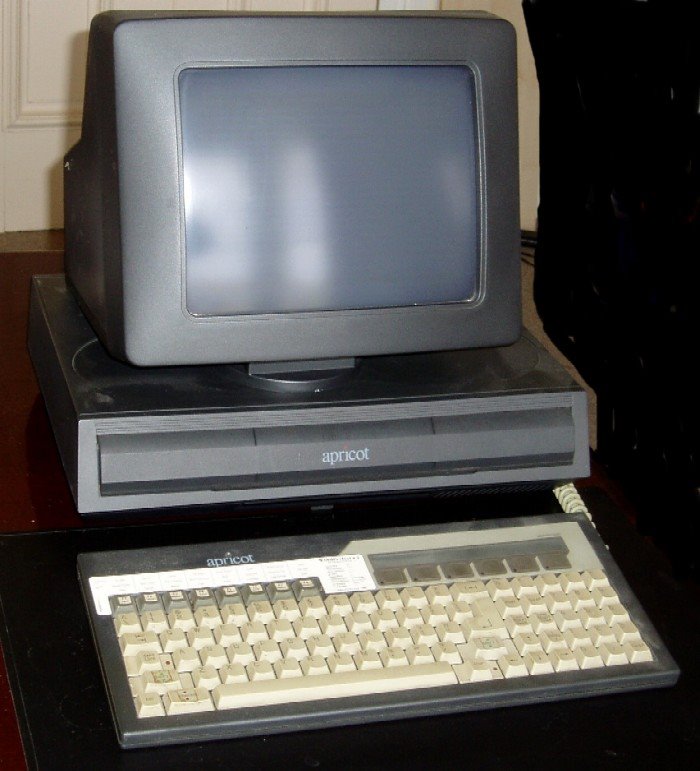
Then in 1984 I persuaded my employers to let me buy an ACT Apricot computer for my office: an elegant black thing it was, with a mammoth 256KB of RAM, 20MB Winchester Hard Disk, 12” monitor, Superwriter and Supercalc. (I still have it and no doubt it still works, but I know that if I tried to use it I would be constantly reaching for a non-existent mouse.) I built a padded hood to try to subdue the racket made by the daisy-wheel printer, but it was still deafening, so I had to get a dot matrix printer as well; this made a nasty buzzing sound and produced horrid blurred print.
All this lot cost £5,316.

This meant that I then had not only the evenings and weekends but also the working days to play computers, so I leapt into MSDOS with delight and had fun with batch files and all that sort of thing. Also, by the end of 1985 I had launched into what passed for DTP before DTP was invented. There was something called Managers’ Alphanumeric General Interface Code (MAGIC). You typed your text into your word processor interspersed with codes, rather like HTML tags, such as [m18][f24][s14][d18]; this one means 18 pica measure, Garamond 14 points with line space 18 points. Then you sent the file to photo-typesetters and if you were lucky back came the artwork ready to send to the printers.

Obviously, this was a fairly laborious procedure, but I produced such things as 120-page handbooks with it for a while until eventually DTP software and desktop laser printers arrived and life became much easier. By 1987 I had acquired a PC (in those days they were called "IBM-compatible") running the appalling Windows 2.0 (it was clear to me that this Windows thing would never catch on). I also bought the first non-Mac version of Aldus PageMaker (now owned by Adobe and no longer being developed) and an early version of Excel.

That was the last sea change in my relationship with computers. Since then it has just been more of the same, really; over the years I have bought perhaps 25 PCs, some for my office, some for me (and my wife) and some on behalf of a dozen charities with which I became involved. I got them from a variety of suppliers - international, national, local - and reached one conclusion about dealing with computer firms: that computer engineers are, on the whole, honest, friendly and good at what they do, while computer salesmen are, on the whole, arrogant, stupid and incompetent.


In the last few years, of course, the internet has arrived and this is now a major source of pleasure for me. I have made a few websites or webpages - for myself, for a charity, for an arts group, for a house to let, for a caterer, for a café, for a dramatic soprano. I am not much good at these - I can only do very simple ones, very slowly - but this modest skill is in demand because I don't charge anything.

And I typeset small publications with dear old Pagemaker 6.5 and make little databases with Excel 2002 and, of course, I've got bloody Windows XP.

But what's the use of all that hardware and software if it will not run BOUM! with its little red bouncing hearts?

Sunday, 8 February 2004

Forgotten poet

The quadricentenary of the birth of the poet and dramatist Edmund Crowsely (1604-1643) seems to be passing quite unremarked, even in his native Whitby. It is true that his plays have been, deservedly, almost forgotten, with the exception of the comedy Merry John Tickle, but perhaps it is time for a revival of his tragedy Follow The Turtle To My Father's Tomb, which contains some of the loveliest lines in all post-Shakespeare seventeenth-century verse, such as:
The single thought is licens'd in the mind,
And of this confidence is passion made.

Sunday, 1 February 2004

Passing Out


Passing Out Parade: Mons Officer Cadet School, 1952

Thursday, 29 January 2004

Try the new pachyderm size

At one time, I remember, it was all quite simple. You just picked up a packet of cereal or bar of soap, or whatever it was, and if you proposed breakfasting or washing in a really big way you chose a large packet of cereal or a large bar of soap.

Then some bright young man in advertising realised that this was no way to sell things, and the Monster Size was born. I had always had the impression that monster was a noun, but presumably the idea of a monstrous bar of soap has undesirable associations, suggesting a huge, evil, Quatermass sort of thing with warts, bursting out of its packet and overcoming everybody with its carbolic miasma. This is definitely not what the public wants when it buys a bar of soap, so Monster Size it has to be.
Since then the position has deteriorated further. Nowadays, practically anything consumable – disinfectant, cigarettes, indigestion powder and so on – comes to us in sizes named in such a way that comparison is impossible without looking for some 6-point type that says 120g or whatever.

When I was quite young I had worked out the exact significance of Large Sizes. They were, I realised, different from Small Sizes because there was more in them; in short, they were bigger. When I reached the age of economic awareness I also came to understand that they cost more, and yet, in a way, less.

This knowledge stood me in very good stead for many years but is now quite useless. I simply have no idea whether the Family size or the Economy Size is the one to go for. I know that the Jumbo Size must be pretty big, but how does it compare with the New Double Size? To make matters worse, the good old Small Size seems to be fighting a losing battle against the Trial, Handy and Pocket Sizes.

The development of the idea, it seems to me, has gone quite far enough. The trouble is, the possibilities are by no means exhausted. No manufacturer, as far as we know, has yet introduced a Goliath Size, a Grand Canyon Size, or a Czar of All The Russias Size. And, if my unpractised brain can toss these out, how many hundreds more will the bright young men in advertising produce? Trying to keep track of them is a Man-Sized problem.

Monday, 26 January 2004

Sheep and computers

My son co-produced The Graduate in the West End a few years ago and when I was checking the net for reviews of the Jerry Hall recast I came across one in Spanish. Google provided a computer translation:

THEY ONLY APPLAUDED HIS BELLWETHER IN SKIN
Critical did pebre to model Jerry Hall after their theater debut.
No matter how hard empiluchó, the ex- ones of Mick Jagger did not convince to the critical with its performance. The American supermodel Jerry Hall dazzled to the British theater critical with its beauty, but most of them it was than contented less with his performance in "the graduated one". "you do not let your work regulate, Jerry", it said the newspaper to him Daily Telegraph after assumeing the role of Mrs. Robinson carried out in the cinema by Anne Bancroft in 1967 and in the London theater by Kathleen east Turner soon year. Hall took off everything for a scene in which it must appear naked in the shining night of debut, made Tuesday. In order to support moral to him, in this occasion they attended its ex-husband, Mick Jagger, and its son James, of 14 years. In spite of the critics of the press, the producer Sacha Brooks was of very good spirit the morning of Wednesday.


So the computer gave "bellwether" for "leading lady". Brilliant!
There must be something about computers and sheep. We all know the one about the back translation from the Russian of "hydraulic ram" coming out as "water-sheep".

(This isn't Jerry Hall, it's Kathleen Turner, her predecessor as Mrs Robinson)

Friday, 16 January 2004

World class nosework

It has been reported in the papers once again that, as a publicity stunt, someone is attempting to push a peanut across London with his nose. This is commented upon as if nose-pushing small objects along were a newly-invented activity. Not a bit of it: many years ago Beachcomber regularly chronicled all the major contests organised by the Welsh Nasal Pea-Pushing Association.

But clearly the sport is nowadays in decline, when an amateur attempt at an simple urban run with an easily-nudgeable object makes news. Back in the thirties, such giants as Evans the Hearse and "Iron-Nostril" Balzarotti were fighting it out in rugged mountain terrain. Balzarotti's Snowdon record of two hundred and thirteen hours, four minutes and twelve seconds has never been challenged.

Thursday, 15 January 2004

Mrs C

Talking of names, I wonder how many people know that Dr Crippen's wife, before being Cora Turner and adopting the stage name Belle Elmore, had been born KUNIGUNDE MACKAMOTSKI

Wednesday, 14 January 2004

Screen name

While browsing through Halliwell's Who's Who in the Movies I came across the details of a "Dignified German character actor in Hollywood films" (actually he was Austrian) called GUSTAV VON SEYFFERTITZ. Now this is quietly amusing, but then, almost thrown away, there was the note that he acted under the name of G. BUTLER CLONBLOUGH.

When I had finished thrashing about, moaning and drumming my heels on the floor, there came into my mind a picture, crystal clear and colourful, of a meeting of Gustav, his family and his associates, probably taking place at Big Lou's Bagel House and Loxery on Wilshire and Canyon. He has called them together to ask for their ideas for a screen name which would trip off the tongue more easily than the one he came from the Fatherland with, but by midnight they have got nowhere, and the suggestions are becoming increasingly desperate: Scorpion de Rooftrouser? Syd Von Maxoff? J. Cornelius Whoops? Molonay Tubilderborst? Arthur "Mad Fred" Dettmold? ...and so on.

Suddenly from Agnes, his agent's secretary, a quiet, mousy girl, comes an excited whisper: "How about G. BUTLER CLONBLOUGH?".

Oh, the cries of delight! "Of course!" "Why didn't you think of that, Abe?" "Goldwyn'll love it!"

And then, later, Gustav - or rather G. Butler as we must now call him - to Agnes: "Gee, Miss Blatnick! Without your glasses your eyes are... kinda... well, cornflower!"

The rest is history: the Oscars, the Hollywood Wedding of the Year, how Agnes, in her excitement, throws up over her bridesmaids (the Glutetsky Sisters, a top close-harmony group) and how after a few years their lovely children Wilmington, Prodinda and Wotan make distinguished careers for themselves in, respectively, forestry, juggling and biogenetics.....

Tuesday, 13 January 2004

Actors and actresses

We use author and poet rather than authoress and poetess, but until fairly recently it was permissible to distinguish persons who act by gender. Now, it seems, not, and style guides tell journalists to stick with actor.

There is tradition of women who appear on the stage being known as actors. From Pepys’ Diary, 27 Dec 1666: “Doll Common doing Abigail most excellently, & Knipp the widow very well, & will be an excellent actor, I think".

But Fowler (1926) has three columns of typically elegant and thoughtful prose on Feminine Designations and includes actress in a list of established feminine titles. The 1968 Burchfield revision rambles a bit and ends "...The whole question of gender distinctions...is sensitive, verging on explosive. All possible 'solutions' introduce uglinesses or new inconsistencies or leave false expectations in their wake. Ours is an uneasy age linguistically". This is unhelpful.

Perhaps there are some ageing female actresses who like to be so called (though apparently not Judi Dench or Diana Rigg) but younger ones generally don’t. Let my thespian (thespienne?) daughter-in-law, who has been in everything from The Oresteia to The Bill but is still young, have the last word: She says actress has acquired a faintly pejorative tinge, and wants people to call her actor, except for her agent, who should call her often.

Saturday, 10 January 2004

In the very first row of the second-raters

That was where Somerset Maugham, in his autobiography, placed himself. Perhaps that was a little presumptuous, as was the tribute to him that appeared in Punch at the time of his 80th birthday, when he was sunning himself like an old lizard in the south of France:

As I bask in Antibes and in honour,
I consider the works of my pen
Which have made me in one long lifetime
All things to all literate men:
A Stevenson told of the facts of life,
A Kipling shorn of his creed,
The rich man’s Marie Corelli
The poor man’s André Gide.

Friday, 9 January 2004

Answer


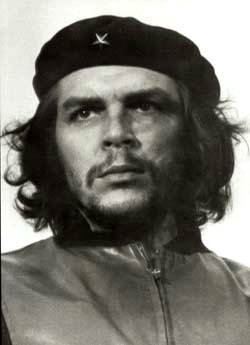
The photo is of Che Guevara in disguise. It was taken in 1965 when he was preparing to travel outside Cuba incognito to foment revolution in other countries. This famous one of him in a black beret had been taken five years earlier.


This is the answer to the question asked HERE